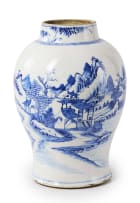
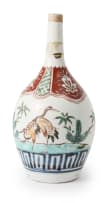
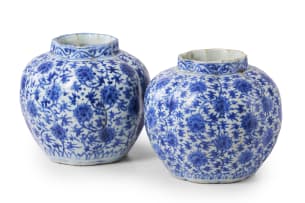
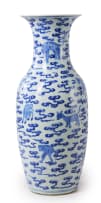
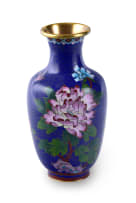
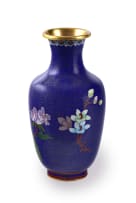
A Chinese cloisonné vase, 20th century
Day Sale
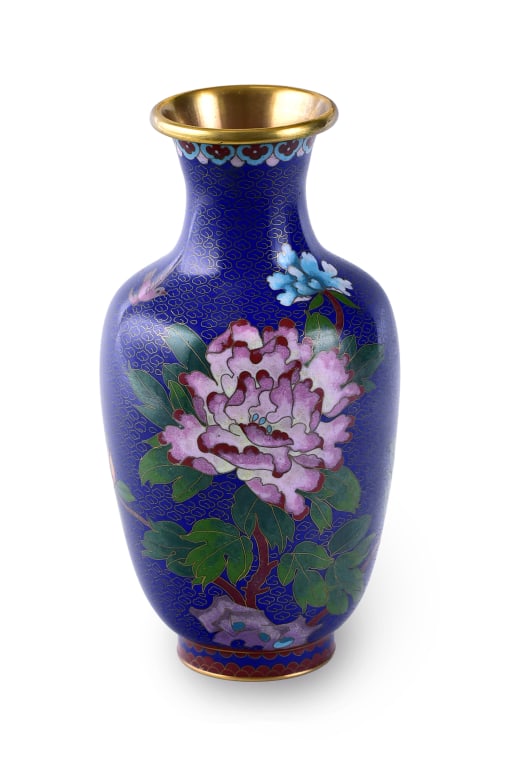
LOT 102
A Chinese cloisonné vase, 20th century
Incl. Buyer's Premium & VAT
About this Item
Notes
Cloisonné is essentially made by taking a base object, such as a copper vase and laying on it a design made up of small cells (called cloisons) constructed from thin wires. Some of these cells are then filled with powdered glass or paste of a particular colour and the object fired so that the glass melts to fill the cell. The process is repeated using different colours in other cells (as each colour fires at a different temperature) until the item is completely enamelled with a multicolour design. Finally the enamel, which at this stage will be dull and lumpy, is polished to give a superb porcelain finish.
Cloissonné art has a long history in China dating back to the Yuan dynasty (1271-1368) when it was introduced from the Middle East. Objects were intended for furnishing temples and palaces and so exhibit fine craftsmanship, even enamelwork and vibrant colours. In much Chinese cloisonné blue is usually the predominant colour, and the Chinese name for the technique, jingtailan refers to this blue (lan), and the Jingtai Emperor.
Provenance
Private Collection.
More from Generations of Collecting: An Important Collection of Cape Silver, Oriental Ceramics, Furniture and Art