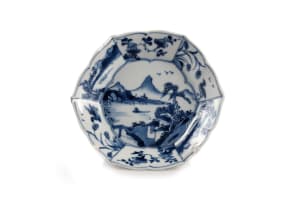
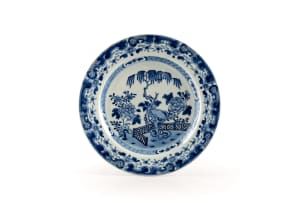
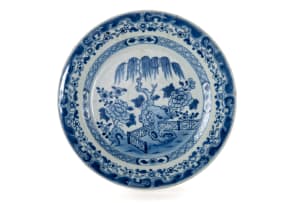
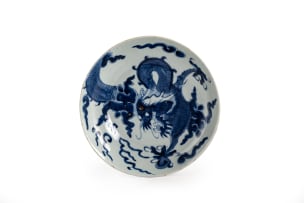
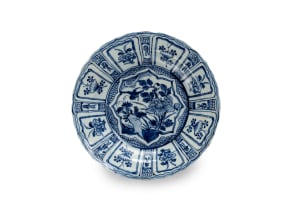
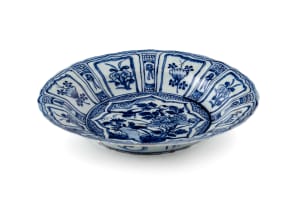
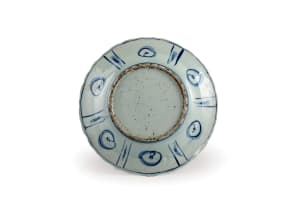
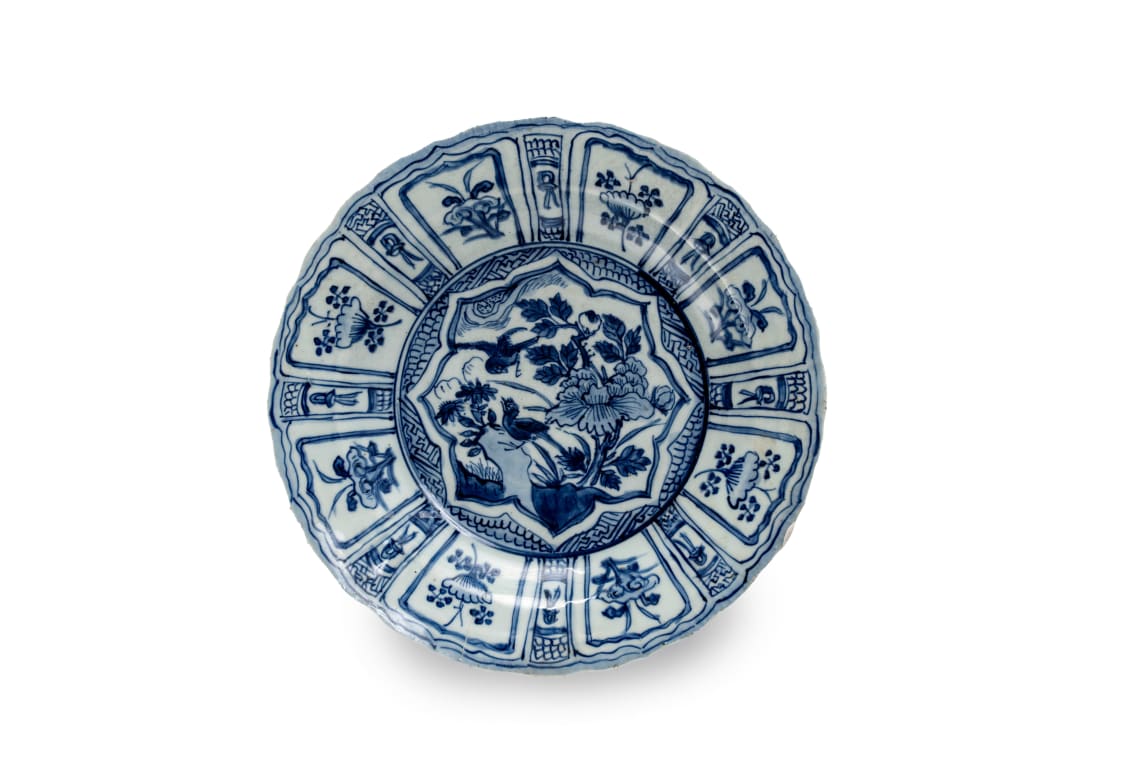
A Chinese blue and white 'Kraak' dish, Wanli period, 1573-1620
Ceramics and Glass
About the SessionIncluding a colourful selection of Clarice Cliff and Moorcroft, fine Chinese blue and white, and the distinctive 'Medusa' pieces from the Rosenthal-Versace design collaboration
LOT 186
A Chinese blue and white 'Kraak' dish, Wanli period, 1573-1620
Incl. Buyer's Premium & VAT
About this Item
Notes
Dutch merchants arrived in Asia towards the end of the 16th century. The Vereenigde Oost-Indische Compagnie, VOC (Dutch East India Company, 1602–1799), was founded in 1602 and competed fiercely with the Portuguese as traders. Porcelain from captured Portuguese vessels (caraccas) was called kraak porcelain, a Dutch corruption of the Portuguese word. The VOC shipped it in huge quantities, and soon it was a commonplace item in Dutch interiors.
Kraak porcelain was primarily bought for practical use, but pieces also had decorative functions. The paintings, done in underglaze blue only, show landscapes and animals, rarely human figures, making this porcelain suitable for Islamic markets, too. Buddhist and Daoist good luck symbols make up the panelled border decorations. Plates and dishes were moulded. They are thin, usually rather quickly finished and often have kiln grit adhering to the underside.
Literature
CS Woodward (1974) Oriental Ceramics at the Cape of Good Hope 1652–1795, Cape Town: AA Balkema, illustrated on page 4.
Provenance
Von Geusau Collection
More from June Interiors: Furniture, Silver, Ceramics & Glass