Irma Stern
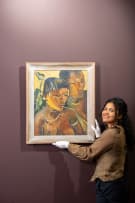
Two Women
About the SessionSpanning 4 centuries of global art history, The International Sale, presents 127 exceptional lots by artists from 27 countries across five continents. The auction highlights masterworks ranging from 17th century European paintings to post-2000 editions by contemporary artist's such as Mr Brainwash (lot 51), Jim Dine (lots 83-86), Isaac Julien (lot 108), Jeff Koons (45), and Lucas Samaras (lot 107 and 110). The sale is anchored by important pieces from Georg Baselitz, Erik Laubscher, Shirin Neshat, and a newly repatriated 1935 portrait by Irma Stern.
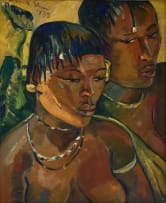
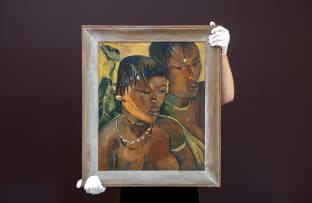
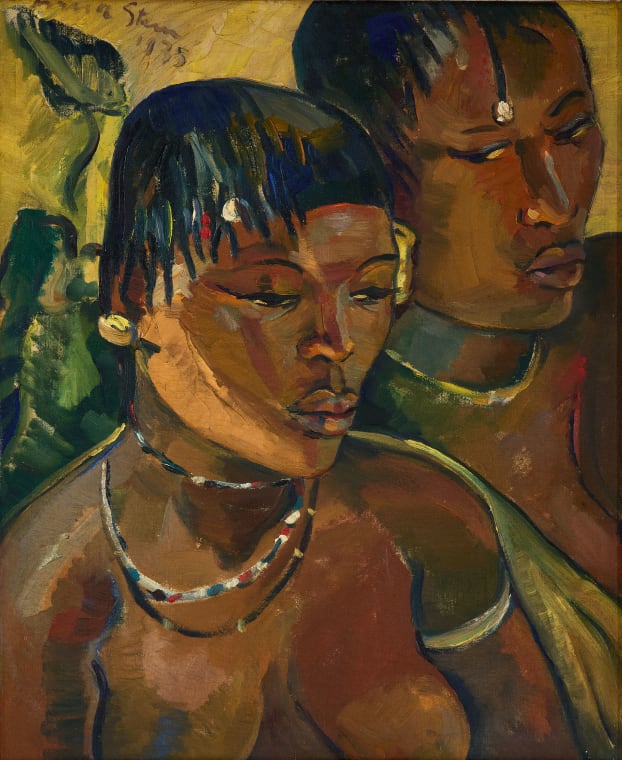
The auction's diversity is driven by rare museum-quality highlights, led by Irma Stern's Two Women (lot 31), which returns to South Africa after decades in a Berlin private collection. It is joined by Erik Laubscher's rare recto-verso painting Young Family / Construction (lot 48), an Iranian-American artist Shirin Neshat photographic portrait linked to her award-winning Turbulent installation (lot 66), and a uniquely hand-coloured linocut by German master Georg Baselitz titled Das Pferd, Im Wald und auf der Heide Series (The Horse, in the Forest and on the Heath Series) (lot 72).
LOT 31
Irma Stern
Two Women
About this Item
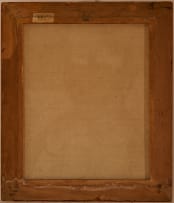
signed and dated 1935; inscribed with the number 2 on the reverse
Provenance
Private Collection, Berlin.
Exhibited
The Cooling Galleries, London, Oil Paintings, Watercolours and Drawings from South Africa by Irma Stern, 7 May to 24th May 1937, probably exhibited with the title Zulu Sisters, cat. no. 2.
Notes
Special thanks to Sandra Klopper for assistance with the research of this painting.
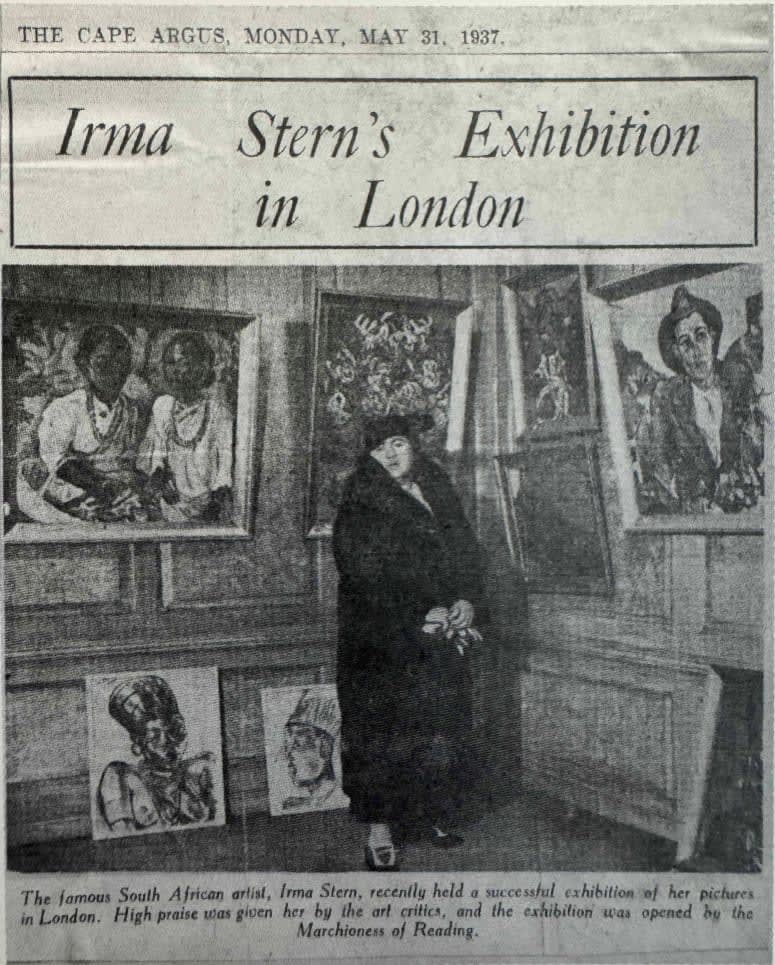
In 1935, following an extended journey across South Africa that included visits to Zululand (northern KwaZulu-Natal) and the Transkei (Eastern Cape) in pursuit of subjects, Irma Stern told the Cape Times that she intended to exhibit in London.1 In January 1937, she announced plans to show at The Cooling Galleries, a prominent London art dealership located at 92 New Bond Street. The printed catalogue listed 27 oils, 19 watercolours and 14 charcoal drawings.
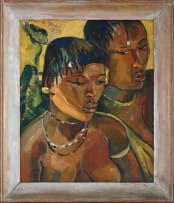
Among the oils were four works with Zulu subjects in their titles: Zulu Woman, Zulu Chief’s Daughter, Group of Zulu Women and a double portrait, Zulu Sisters (catalogue number 2) (fig 1 and 2). The present lot, inscribed ‘2’ on the reverse, was probably exhibited under the title Zulu Sisters. In 1932, Stern had produced a striking portrait of two Madeira sex workers that revealed her increasingly assured use of colour. She would continue to produce powerful double portraits inspired by her travels across South Africa, the Belgian Congo and Zanzibar.
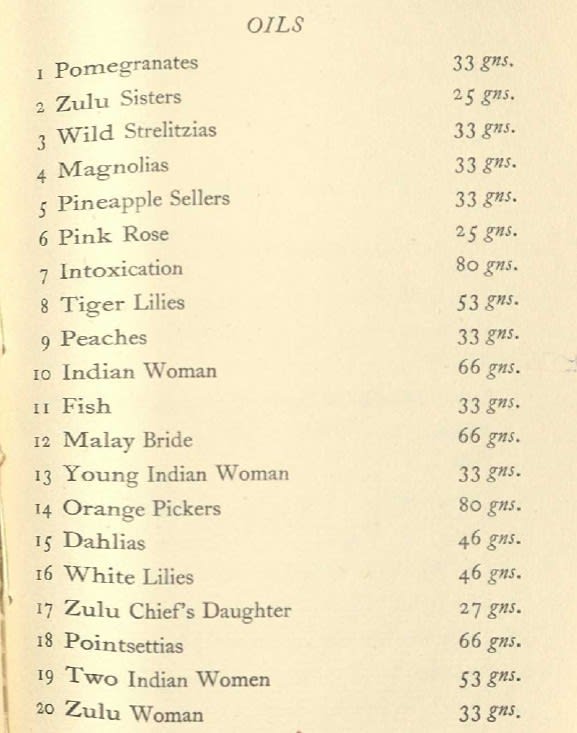
(fig 1) Zulu Sisters (Catalogue Number 2), featured in The Cooling Galleries exhibition catalogue.
Recently repatriated from Europe, where it had been held in a private collection for decades, Two Women is redolent of Stern’s earlier high-Expressionist style of the 1920s, particularly in its tonalities and use of black to graphically delineate the two sitters, as well as its evocation of youth and innocence. In a short introduction to the London catalogue, Marjorie Juta described this aspect of Stern’s output as follows: “Powerful, vivid, full of colour and movement, her modern treatment depicts admirably the vigour and beauty of the native races”.2
Juta, author of the first full-length biography of Paul Kruger, published in 1937, was emphatic in describing Stern as “one of South Africa’s greatest painters”. She emphasised Stern’s international pedigree for London audiences, noting her frequent exhibitions across Europe and her refusal, since 1929, to show in Nazi Germany in protest against the persecution of Jews. Her early struggles in South Africa were contrasted with her "instantaneous" reception in Europe.
The 1930s witnessed a sea change in attitudes to Stern and European modernism across South Africa. In 1935, Edward Roworth, an early antagonist, described Stern as “an outstanding personality of the South African art world” in a favourable review of her new Cape Town exhibition.3 He singled out her Madeira Harlots (1932) (fig 3) as a “remarkable picture”, while still reserving his old animosity for her “native studies”. The tide of opinion was increasingly turning against critics such as Roworth.
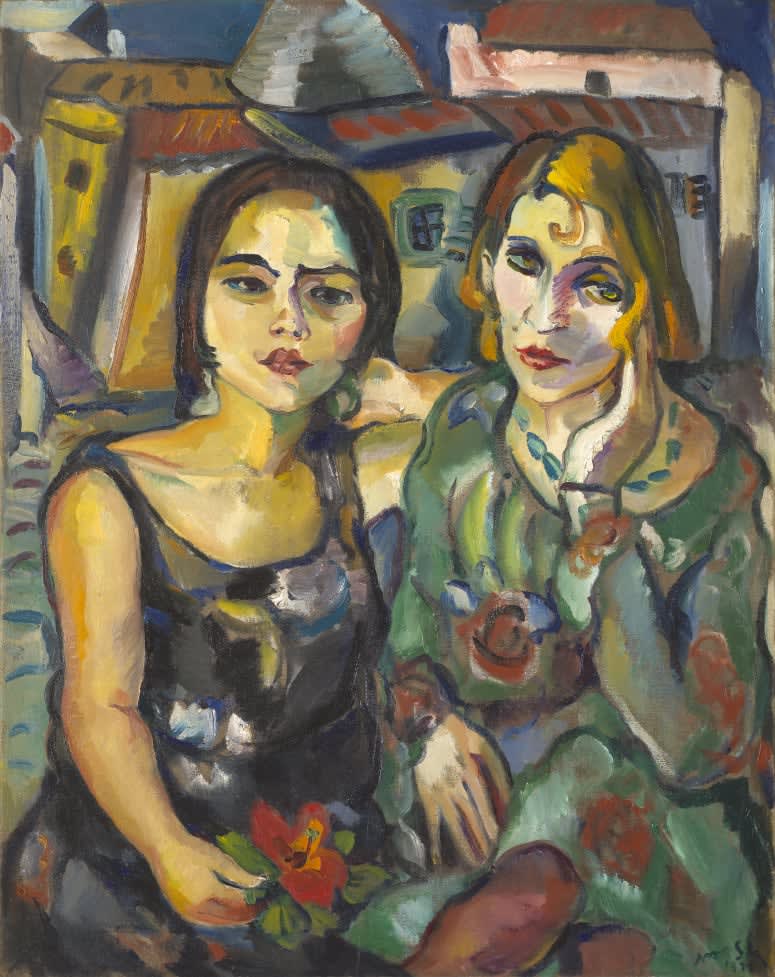
(fig 3) Straatvroue, Madeira (Street Women, Madeira) (1932), Courtesy of the Rupert Art Foundation Collection, Rupert Museum, Stellenbosch.
That year, Roza van Gelderen, a close friend and champion of Stern’s work, gifted the group portrait Swazi Girls (1931) (fig 4) to the National Gallery. Richard Feldman, a friend and patron, published a lengthy appreciation in which he described Stern’s paintings as “ecstatic poems” derived from her travels “to see the natives in their natural surroundings, living their own lives”.4
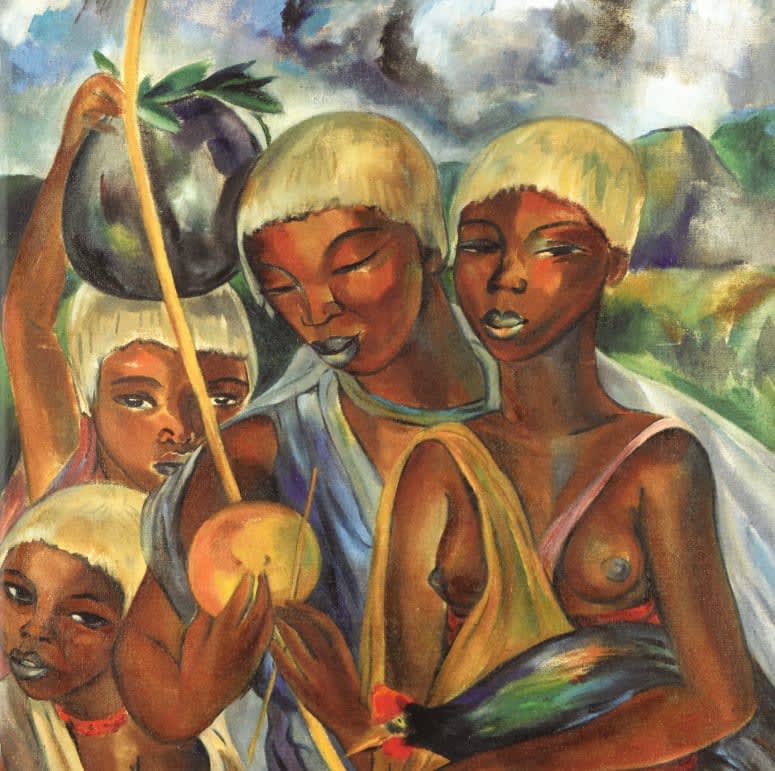
(fig 4) Swazi Girls (1931) (detail) presented by Roza van Gelderen to the South African National Gallery, Iziko South African National Gallery permanent collection, illustrated in Iziko Museums of South Africa (2015) Brushing up on Stern, Cape Town: Iziko Museums of South Africa, page 35.
The changing reception of Stern’s portraits of African subjects is particularly relevant to Two Women. In 1935, the Cape Times reported that Stern was impressed by “the Eastern influence on the personal decoration of the native women” she encountered in Zululand and the Transkei.5 Stern’s attentiveness to this is visible in the detailing of the women’s beadwork and decorative, almost Art Deco-like treatment of their evasive eyes. The anonymous author speculated on the melancholy attributes of Stern’s sitters in her portraits of African women. “F.P.R.”, reviewing Stern’s 1937 Cape Town exhibition shortly before her departure for London, also addressed this quality, contrasting her recent “more objective” portraits of African sitters with earlier works in which she had sentimentalised her subjects.6
Zulu Sisters (probably the present lot) was offered for sale in London in 1937 for 25 guineas (£26.25), equivalent to approximately £2 320 in 2026 British purchasing power, or roughly R50 800 at current exchange rates. The sum was substantial: for a middle-class household earning between £250 and £350 a year, a range documented in contemporary expenditure surveys, the purchase price represented approximately 7.5–10.5% of annual income.
The most expensive works in the catalogue were two oils, Intoxication and Orange Pickers, each offered at 80 guineas. Stern’s London exhibition was reported as “very successful” by the Cape Times, and was followed by exhibitions and travels across Europe, including The Hague, Amsterdam, Paris, Salzburg and Vienna, as well as a four-month working stay in Italy.7 She returned to South Africa by boat via Dakar in 1938.
1. – (1935) Cape Times Supplement, 26 October; and – (1935) Irma Stern’s Native Studies’, Cape Times, 6 November.
2. Marjorie Juta (1937) Paintings, Water-Colours and Drawings from South Africa by Irma Stern, London, The Cooling Galleries Ltd, pp. 4–5.
3. Edward Roworth (1935) ‘Triumph of Irma Stern’, Cape Times, 6 February.
4. Richard Feldman (1935) ‘Idylls of the Black: An Appreciation of the Work of Irma Stern’, South African Opinion, 17 May, p. 10.
5. – (1935) ‘Irma Stern’s Native Studies’, Cape Times, 6 November.
6. F.P.R. (1937) ‘The Art of Irma Stern’, Cape Argus, 10 February.
7. – (1938) ‘Irma Stern Returns’, Cape Times, 28 February.
More from The International Sale