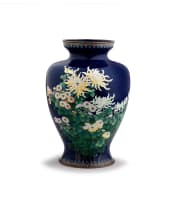
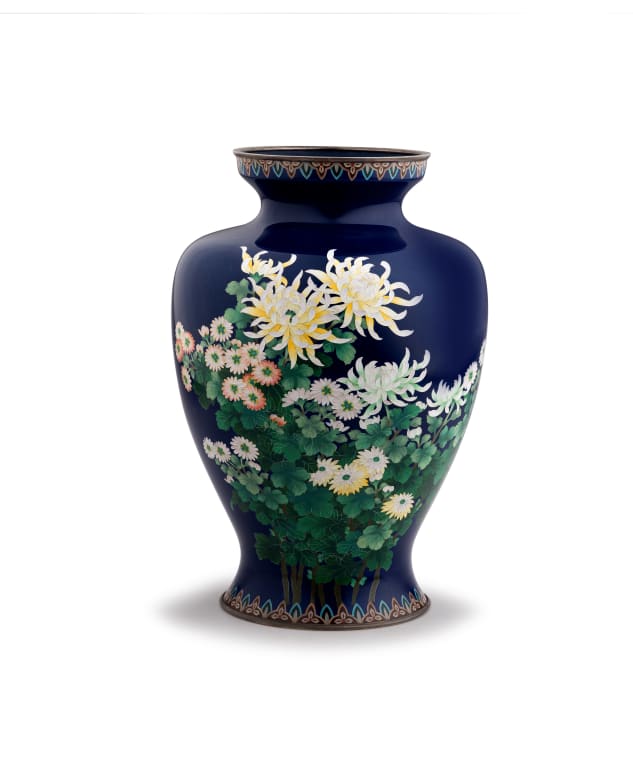
A Japanese Cloisonné vase, Ando Cloisonné Company, late 19th/early 20th century
Ceramics and Glass
About the SessionIncluding a colourful selection of Clarice Cliff and Moorcroft, fine Chinese blue and white, and the distinctive 'Medusa' pieces from the Rosenthal-Versace design collaboration
LOT 208
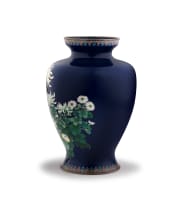
A Japanese Cloisonné vase, Ando Cloisonné Company, late 19th/early 20th century
Incl. Buyer's Premium & VAT
About this Item
Notes
Japanese Cloisonné of the Meiji period was unrivalled in quality and finesse of detail. Cloisonné is essentially made by taking a base object, such as a copper vase and laying on it a design made up of small cells (called cloisons) constructed from thin wires. Some of these cells are then filled with powdered glass of a particular colour, and the object is fired so that the glass melts to fill the cell. The process is repeated using different colours in other cells (as each colour fires at a different temperature) until the item is completely enamelled with a multicoloured design. Finally, the enamel, which at this stage will be dull and lumpy, is polished to give a superb porcelain finish.
More from June Interiors: Furniture, Silver, Ceramics & Glass