Maggie Laubser
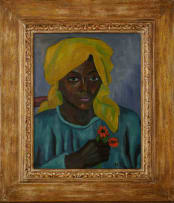
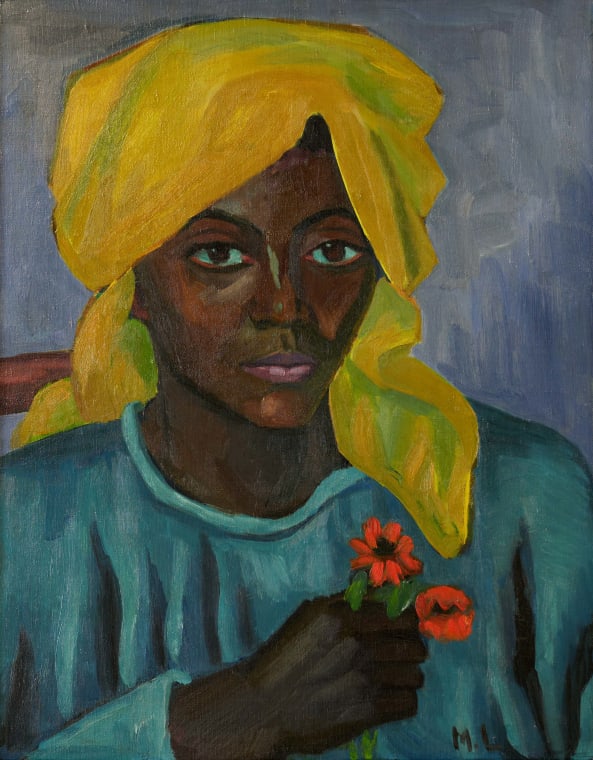
Portrait of a Woman with Headscarf Holding Flowers

LOT 143
Maggie Laubser
Portrait of a Woman with Headscarf Holding Flowers
Incl. Buyer's Premium & VAT
About this Item
signed with the artist's initials
Provenance
Dr T E W Schumann, Pretoria, acquired through Professor M L du Toit, c. 1933.
Mrs Elita de Klerk.
Literature
Dalene Marais (1994) Maggie Laubser: Her Paintings, Drawings and Graphics, Johannesburg and Cape Town: Perskor Publishers, illustrated in black and white on page 212, cat. no. 693.
The present lot holds a unique place in recent history, having hung prominently in the background of F W de Klerk’s final address. Released posthumously following his death in Cape Town at the age of 85, this pre-recorded video captured the former president against the backdrop of this work, underscoring his significant and debated history in South African society.
View the video featuring this lot in the background here.

Notes
Maggie Laubser was part of a small vanguard of European-trained painters who modernised South African art in the 1920s and 1930s. Like her contemporaries, Wolf Kibel and Irma Stern, her bold Expressionist style, which placed colour at the centre of her practice, was heavily criticised and sales were initially poor. Yet even at this formative stage of her career, Laubser enjoyed considerable critical and institutional support, a history recorded in the provenance of this exceptional portrait of a young woman wearing a yellow headscarf.
The work was originally acquired in a sale brokered by Martin L du Toit, founder and editor of the literary journal Die Nuwe Brandwag (The New Sentinel, 1929–33) and inaugural head of the Department of Cultural History and Art at the University of Pretoria. Du Toit was an active champion of Expressionism in the Transvaal, introducing audiences to Laubser and Stern, among others. Laubser met Du Toit in 1929, a transformative year in which the Union government acquired several of her works for its embassies in Belgium, France, Germany, Italy and the Netherlands.1 Du Toit organised Laubser’s first exhibition in the Transvaal in 1931, at Macfadyen Memorial Hall, University of Pretoria, followed by another at the same venue in 1933.
In Dalene Marais’s catalogue raisonné, this undated work appears in a grouping that predates 1932. Whatever its precise date, by the time Laubser was introduced to Transvaal audiences, her sensitive portraits of working women from the Cape’s farms had become an important part of her output. Esmé Berman describes her many portraits of the late 1920s and early 1930s as “strong, positive portrayals” marked by “her sympathetic awareness of the human being behind the features”.2
This portrait is emblematic. The almond-eyed sitter, dressed in traditional farm clothing, is shown seated indoors, indicated by the back of a chair at right. Her presence is most immediately registered by the blazing yellow of her headscarf, yet it is Laubser’s attention to her face – particularly the cheekbones, nose and jewel-coloured lips – that ultimately directs the eye. Berman notes that Laubser produced her portraits “without the model in view, drawing on her memory and insight in order to interpret more than mere physical appearance”.3
This aspect of her painting, its rootedness in the imagination as much as reality, formed the basis of an evocative passage in Johannes Meintjes’s 1944 monograph on Laubser:
“To her, everything is a wealth of colour and design. This unassuming, solitary woman does not merely paint pictures; she lives them. They are created after prolonged study and countless sketches – repeated over and over until she truly knows her subject – and only then does she paint, away from the subject itself and from other people. Drawing upon her knowledge, intuition, and rich imagination – sometimes even a playful wit, yet always with deep empathy – she creates something that comes from within” (original in Afrikaans).4
Both Berman and Du Toit, who had planned to write a monograph on the artist before his untimely death in 1938, identified a note of melancholy in Laubser’s work. Berman suggested that her paintings were “as much a portrait of the artist as of the individual sitter”.5 Du Toit ventured a bolder cultural interpretation. Writing under an alias in Ons Vaderland, he identified the essential character of Afrikaner art as sober, reflective and melancholic, arguing that the leitmotif of paintings by Afrikaner artists such as Laubser was “essentially tragic”, characterised by “inherent pessimism and melancholia”.6
That Laubser resonated with Afrikaans-speaking audiences is well documented, both in the provenance of this work and beyond. This painting appeared as a backdrop in former president F W de Klerk’s posthumous video apology of 11 November 2021, in which he apologised without qualification for the pain, hurt, indignity and damage caused by apartheid. The appeal of Laubser’s portraits of farm folk and fishermen – natuurmense, as Meintjes put it7 – is also evident in the recollections of the writer Hennie Aucamp.
Writing in 2002 in an appreciation of opera singer Mimi Coertse, whose art collection while based in Vienna8 included a Laubser, Aucamp recalled how, with money earned by his mother from the sale of eggs and cream, he acquired a Laubser painting of an old woman wearing a headscarf.9 He observed that the affectionate Afrikaans expressions “Onse Maggie” and “Onse Mimi” could, despite their apparent affection and intimacy, also carry a patronising undertone.9 The possibility of such cultural identification and debate owes much to Du Toit’s early enthusiasm for, and promotion of, Laubser.
1. Dalene Marais (1994) Maggie Laubser: Her Paintings, Drawings and Graphics, Cape Town: Perskor, page 7.
2. Esmé Berman (1970) Art and Artists of South Africa, Cape Town: A A Balkema, page 175.
3. Ibid., page 175.
4. Johannes Meintjes (1944) Maggie Laubser, Cape Town: H A U M Jacques Dusseau & Co, page 16.
5. Berman, op.cit. page 175.
6. Quoted in Jeanne van Eeden (2008) ‘Collecting South African Art in the 1930s: The Role of Martin du Toit’, Historia 53.1, May. Page 167
7. Meintjes, op.cit. page 16.
8. Mimi Coertse (2007) 'n Stem vir Suid-Afrika: My storie, soos vertel aan Ian Raper, Somerset West, Litera Publikasies, page 136.
9. Hennie Aucamp (2002) ‘Hoekom het jy teruggekom, Mimi?’, in Johan van Rooyen (ed) Mimi: 'n Feesbundel, Pretoria: Protea Boekhuis, pages 23 – 25.
More from Evening Sale