Erik Laubscher
Euphorbias


LOT 160
Erik Laubscher
Euphorbias
About this Item
signed and dated '56
Provenance
The Artist’s Collection, 2009.
The Erik Laubscher Heritage Trust.
Exhibited
This work was exhibited in Cape Town in 1956. The exact details are not confirmed but it was substituted for the work that Laubscher had shown at the Venice Biennale.
South African National Gallery, Cape Town, Paris and South African Artists 1850-1965, 14 April to 29 May 1988, cat. no. 150.
Johannesburg Art Gallery, Johannesburg, Paris and South African Artists 1850-1965, 22 June to17 July 1988, cat. no. 150.
Sasol Art Gallery, Stellenbosch, Erik Laubscher, 25 June to 31 July 1994, cat. no. 20.
Michael Stevenson and Deon Viljoen (2003) South African Art 1850 - 2003, Cape Town: Stevenson and Viljoen, cat. no. 12.
SMAC, Stellenbosch, Erik Laubscher: A Major Retrospective Exhibition, 5 December 2009 to 25 February 2010.
EBONY/CURATED, Bordeaux House, Franschhoek, Erik Laubscher: The Landscapes, A Selection Of Works From 1946 – 2012, 28 October 2017 to 7 January 2018.
EBONY/CURATED, Cape Town, Modern Masters VII, June to July 2025.
Literature
Lucy Alexander, Emma Bedford and Evelyn Cohen (1988) Paris and South African Artists 1850-1965, Cape Town: South African National Gallery, illustrated in colour on page 89.
Michael Stevenson and Deon Viljoen (2003) South African Art 1850 - 2003, Cape Town: Stevenson and Viljoen, illustrated in colour, unpaginated.
Hans Fransen (2009) Erik Laubscher: A Life in Art, Stellenbosch: SMAC, illustrated in colour on page 59.
Phillippa Duncan and Marc Stanes (curators) (2017) Erik Laubscher: The Landscapes, A Selection Of Works from 1946 – 2012, Cape Town: Ebony Curated, illustrated in colour on page 8.
Ruth Prowse School of Art (2024) A Celebration: Ruth Prowse School of Art, Cape Town: Ruth Prowse School of Art, illustrated in colour on page 21.
Notes
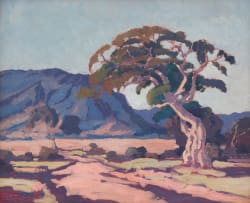
In a 2005 catalogue accompanying an exhibition at Johans Borman Fine Art, Amanda Botha wrote on Erik Laubscher in context with Jacobus Kloppers and Walter Meyer. Botha said of the older artist that Laubscher’s experience is ‘located in the expanses of the South African landscape where it is possible, as it were, to breathe freely – [both] in his sensory perception of it and on the canvas’.
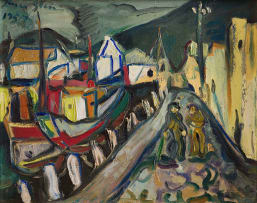
Upon his return to South Africa in 1951 from France, Laubscher became recognised for his bold use of luminous and resonant colour and his capacity to absorb the influence of contemporary masters without being influenced by their personal idiosyncrasies. His still life compositions (fig 1), which acknowledged the influence of Bernard Buffet, were exhibited alongside the works of the more established New Group in Cape Town.
During a holiday to Bushman’s River Mouth in 1953 Laubscher began drawing the local Euphorbia forests. Deciding that pencil was unsuitable for the subject he used a charcoal of his own manufacture, burning sticks in the evening fires (fig 2). These drawings formed the basis for the body of work which signalled a departure from the eloquent but Eurocentric post-Paris still life (fig 3). It was also here that Laubscher made his first strides towards abstraction by filling in spaces between the foliage with flat planes of pure colour.
By 1956 the young artist was married with two young children. His professional standing as an artist was cemented when he was invited to submit works for the 1956 Venice Biennale. His work Landscape with Red Sky received favour among judges at the event and he was awarded a special mention. This meant however that when the collective Biennale works were exhibited to a Cape Town audience Euphorbias (1956) was substituted as the former had travelled to Geneva as part of a cultural exchange. Indeed it was this that led Matthys Bokhurst to publish the news that South Africa had been invited to participate in the fourth Sao Paulo Biennale.
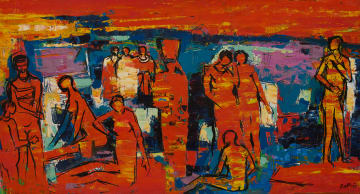
Euphorbias (1956) is a substantial composition characterised by strong flat planes of colour that defy the two-dimensionality of the painting surface. Laubscher’s use of black functions as both a descriptive line and a register through which the eye travels. The euphorbias from which the title is derived appear sinuous and humanoid. Given Laubscher’s deepening friendship with Jan Rabie, this writer argues that the work can be experienced as a metaphor for the existential path that the young artist had embarked upon. As an artist he was constantly challenging himself creatively while also assuming the roles of husband and father.
Hans Franzen (2009) Erik Laubscher: A Life in Art, Stellenbosch: SMAC.
Erik Laubscher. The artist’s own unpublished press clipping books (Vol I 1946-1979).
No Author (no date) Johans Borman Biography, online, accessed July 2017.
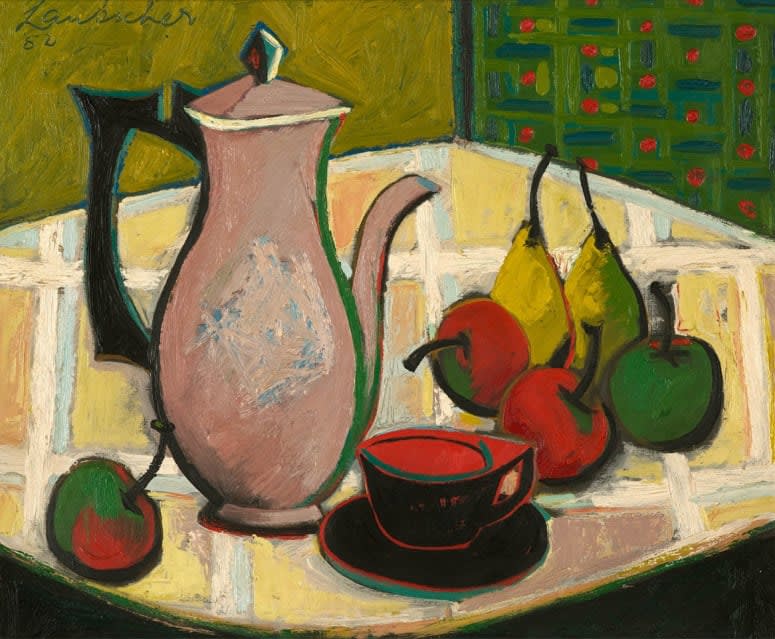
(fig 1) Still Life with Coffee Pot and Fruit (1952) Strauss & Co, Cape Town 3 March 2018, lot 605, sold R2 273 600 (USD 141,833.08).
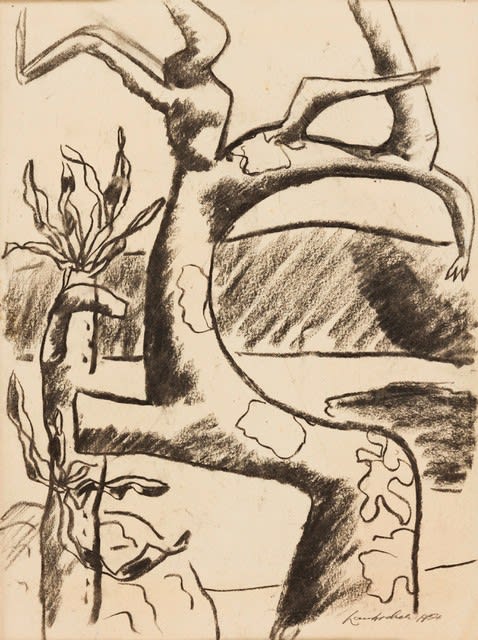
(fig 2) Study for Euphorbia (1954) charcoal on paper.
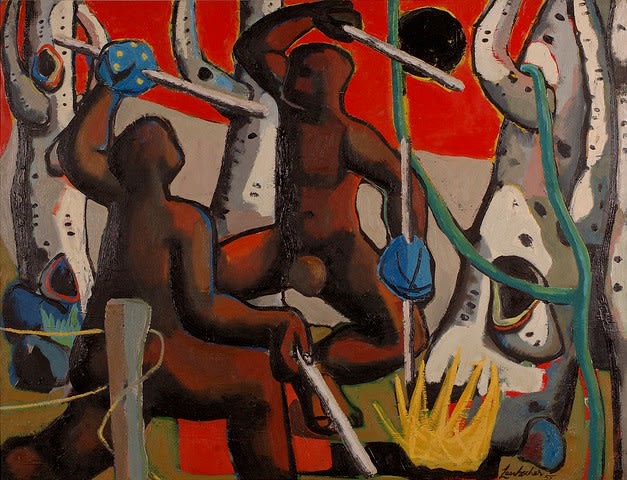
(fig 3)Two Stick Figures (1955) Sasol Art Museum Collection, illustrated in Hans Franzen (2009) Erik Laubscher: A Life in Art, Stellenbosch: SMAC, page 63. Image courtesy of the Erik Laubscher Heritage Trust.
More from Evening Sale