Moses Kottler
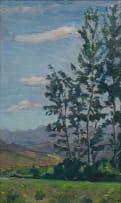
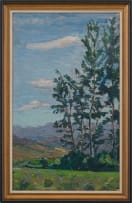
Welgevonden I
LOT 106
Moses Kottler
Welgevonden I
Incl. Buyer's Premium & VAT
About this Item
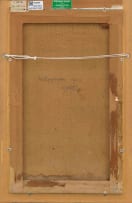
signed, dated and inscribed with the title on the reverse
Literature
J du P Scholtz (1976) Moses Kottler: His Cape Years, Cape Town: Tafelberg, illustrated in colour on page 86, cat. no. 3.
Notes
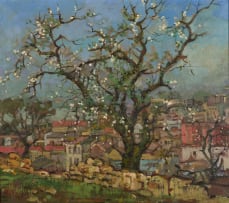
A rare painting from Moses Kottler's formative years, this 1912 landscape predates his celebrated career as one of South Africa's foremost portrait sculptors.
Kottler was born in Joniškis, Lithuania, then part of Czarist Russia. The seventh of ten children, he was known affectionately as Moshé: inarticulate but strong-willed, with a commanding personality and a pull toward making things.
Toward the end of the 19th century, the Kottlers began immigrating to South Africa, settling among Oudtshoorn's large Jewish community, where they worked first as traders, farmers and then merchants. Kottler, meanwhile, enrolled at the Bezalel School of Arts and Crafts in Jerusalem. Unable to train in sculpture there, he turned instead to sketching, drawing, and painting. In 1911 he enrolled at the Munich Academy, again unable to enrol in the sculpture programme. He remained there until mid-1913, his stay broken by a family reunion trip back to South Africa. It was during that visit home that the present lot was likely produced.
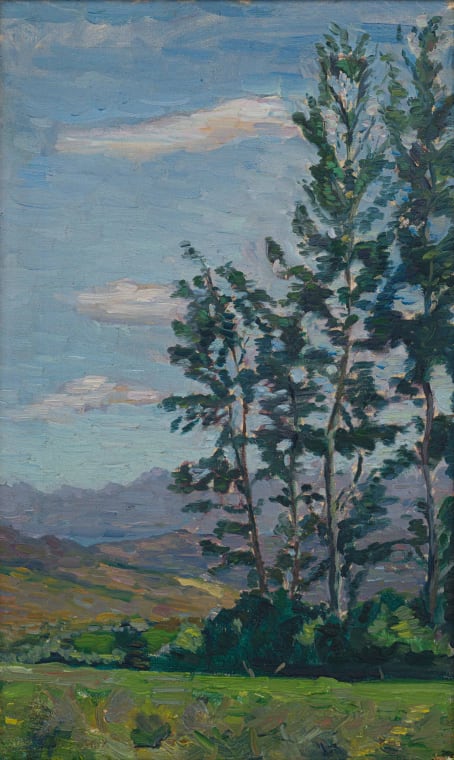
Richly textured and vividly coloured, the work takes its cue from the European modernist tradition of Impressionism which would have influenced Kottler in his time abroad. The composition is anchored by a stand of large trees, with the iconic peaks of the Cape winelands rising along the horizon beyond. Greens, yellows, and purples animate the foreground, giving way to ochres and umbers, and finally to a soft, muted purple grey as the mountains recede into the distance. The vigorous brushwork alive with colour, light, and a real sense of space, captures the rustic character of the Cape landscape itself.
Before settling permanently in South Africa, Kottler passed through Paris, where he befriended Josef Tchaikow, who introduced him to modern sculpture. Unable to sustain himself in Europe, he arrived in Oudtshoorn in early 1915, and the two years that followed proved significant in laying the foundations for him as an important portrait sculptor. In December 1916 he moved to Cape Town where he befriended cartoonist D C Boonzaier and painters Nita Spilhaus, Hugo Naudé, Enslin du Plessis, Florence Zerffi, and Ruth Prowse. These friendships anchored his creative and intellectual life and he began receiving commissions for portrait busts. Kottler and his peers established the New Group - an ensemble of artists who sought to push the boundaries of the conservative artistic traditions in pursuit of a distinctly South African idiom. After a European tour with his wife, Eva Goldberg, Kottler relocated to Johannesburg, where he finally established himself as a sculptor.
U Ben Yosef (1989) The Graven Image: The Life and Work of Moses Kottler, Cape Town: Perskor Publishers.
No Author (2019) South African History Online, Moses Kottler, online, accessed 1 August 2026.
Esmé Berman (1996) Art and Artists of South Africa, Johannesburg: South Book Publishers.
More from Evening Sale