Gerard Sekoto
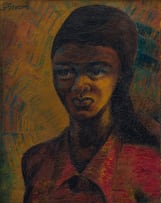
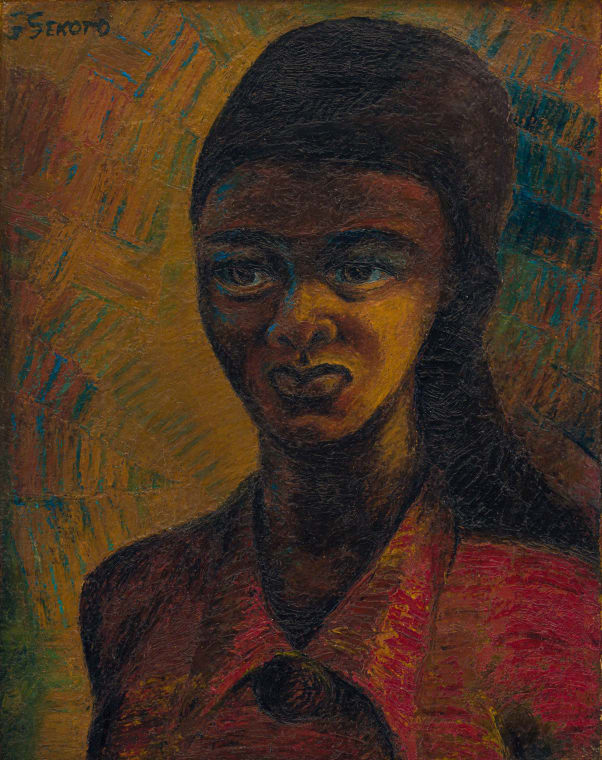
Pensive Young Woman
LOT 336
Gerard Sekoto
Pensive Young Woman
Incl. Buyer's Premium & VAT
About this Item
signed
Provenance
Estate Late Mrs Rhona Kobrin, c. 1940s.
Strauss & Co, Johannesburg, 1 June 2015, lot 251.
Notes
Early in his career, Gerard Sekoto received support and encouragement from Reverend Roger Castle, who offered informal art classes that Sekoto attended for a time. In 1939, he took part in his first exhibition at the Gainsborough Gallery in Johannesburg alongside Castle’s students. There he met Judith Gluckman, who introduced him to oil painting, as he had previously worked mainly with poster paints.1
This work was likely painted in 1939 while Sekoto was under her guidance. The influence of Gluckman can be seen in the textured, stippled surface treatment shared by both artists during this period. Documentation indicates that his formal instruction under Judith Gluckman lasted a mere six weeks. This brief period of study likely served as a catalyst for technical experimentation, of which this work may be a primary exemplar.2
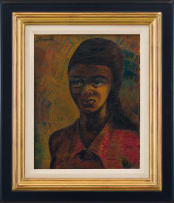
Pensive Young Woman displays many of the defining characteristics of Sekoto’s early style, including strong dark outlines and the vivid contrast between shadowed forms and a bright yellow background. It may be among his earliest oil paintings and already hints at the stylistic direction his later work would take. The approach taken in this portrait is similar to that of Woman with a Green Scarf and Boy with a Yellow Cap. In each work there is a similar handling of the medium: with similar dark outlines delineating the form of the figure. His approach to his colour palette is also similar, the bright yellow-orange background highlights the shadowed figure creating a secondary focal point.
The distinctive, zigzagging brushstrokes diverge significantly from the established pre-exile corpus. While this specific technique reappears sporadically in the 1960s and 1970s, its absence in other known works from the pre-exile period underscores its transitional nature.
Pensive Young Woman captures the honesty and atmosphere of Sekoto’s early work. Its dark tonal quality likely reflects the realities of township life at the time, where limited electricity and lighting shaped everyday experience. Rather than presenting an idealised image of township life, the painting offers a more direct and authentic portrayal of the environment in which Black South African artists lived and worked.
1. Barbara Lindop (1988) Gerard Sekoto. Johannesburg: Dictum Publishing, page 21.
2. Interview with Barbara Lindop, 2026.
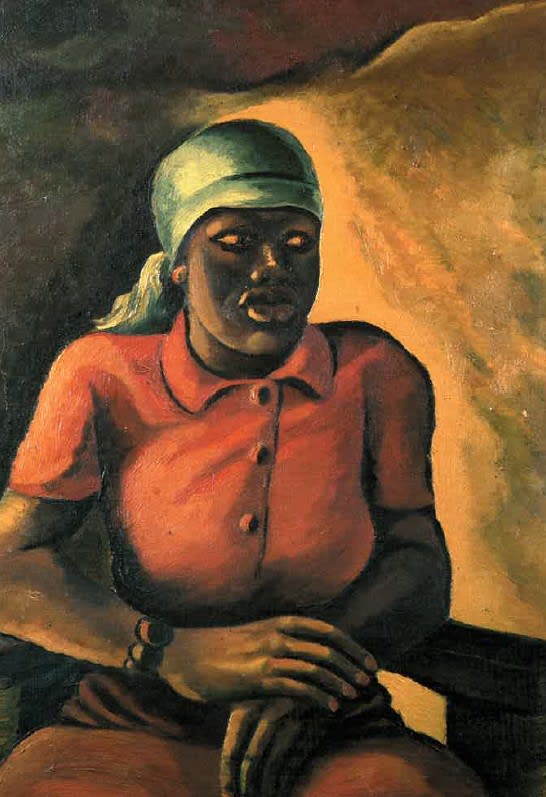
Woman with a Green Scarf, illustrated in Barbara Lindop (1988)
Gerard Sekoto, Randburg: Dictum Publishing, page 59.
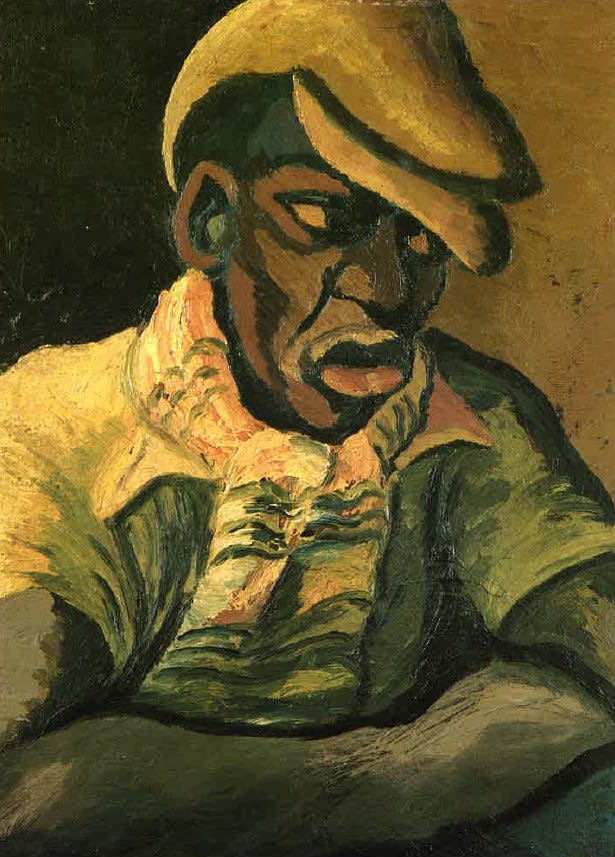
Boy with a Yellow Cap, illustrated in Barbara Lindop (1988)
Gerard Sekoto, Randburg: Dictum Publishing, page 61.
More from Modern and Contemporary Art