Irma Stern
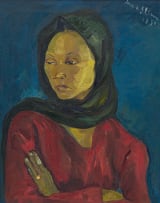
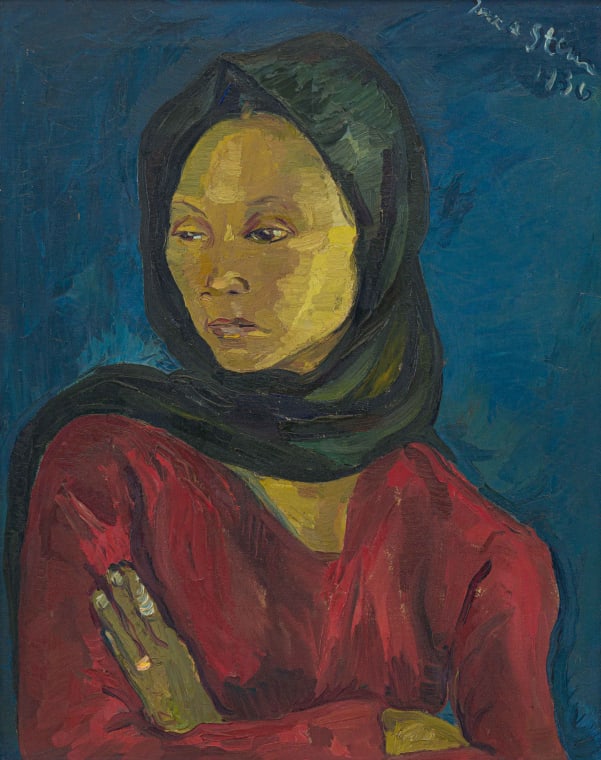
Malay Woman
LOT 335
Irma Stern
Malay Woman
Incl. Buyer's Premium & VAT
About this Item
signed and dated
Provenance
Die Kunskamer, Cape Town, c. 1970s.
Private Collection.
Notes
Irma Stern’s controversial first solo exhibition in Cape Town, in 1922, included a composition titled Malay Girls in Twilight. Over the ensuing decades she built up an extensive portrait archive of Cape Town’s diverse Muslim population, including adolescents, working women, brides, flower sellers, minstrels and religious leaders. Stern was particularly drawn to the outward expressions of social ritual and religious faith, often portraying her sitters in traditional or ceremonial dress.
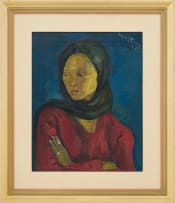
In this portrait of an unknown Malay woman, possibly a paid model, with folded arms and a hijab, Stern instead depicts an ordinary working woman whose appearance is shaped by the customs and prescriptions of her Islamic faith. The sitter’s posture and the restrained treatment of the blue background recall works from Picasso’s celebrated Blue Period, particularly Woman with Folded Arms (1901–02). While Picasso’s influence became more pronounced in Stern’s later work, in 1936, the year this painting was executed, she invoked his name while criticising the casual use of the term “modern art” by both admirers and detractors alike.
“There’s really no such thing as modern art,” said Stern following the opening of an exhibition of her paintings and sculpture at the Carlton Hotel in Johannesburg in October 1936. “There is good art and bad art; or there is art and no art. I don’t give a damn whether my pictures are modern or not ... If the work of El Greco were shown today as that of a living artist it would puzzle the public just as much as the work of Picasso does and would be called modern.”1
The remark derives from a transformative moment in Stern’s career, when the confusion and hostility that had greeted her early exhibitions were giving way to widespread admiration and commercial success. In June 1935, she had exhibited at Glen’s Gallery in Pretoria, where she lodged with Mayor Ivan Solomon and his wife, Lilian. In October 1935, the Cape Times reported that Stern had sold three works to the City Council of Pretoria.2 Stern listed two portraits, The Malay Priest (1931) and The Malay Tambourine Players (1930, now known as Two Malay Musicians), the latter famously left behind during a botched theft at the Pretoria Art Museum in 2012.
In March 1936, Stern exhibited sculpture alongside her paintings at Selwyn Chambers in Cape Town. Opening the exhibition, Sir William H. Clark, High Commissioner for Great Britain in South Africa (1935–40), praised her as “a modern who delights in audacities of colour and design”.3 Later that year, after participating in the Empire Exhibition at the Johannesburg Art Gallery, a landmark event in the reception of expressionism in South Africa, Stern exhibited at the Carlton Hotel. The exhibition was opened by the writer Sarah Gertrude Millin, who hailed her as “the most original, intellectual and psychological painter”.4
The sitter’s folded arms and averted gaze invite psychological interpretation, particularly when viewed through the lens of modernism’s interest in interior states and Apartheid history. Yet Stern’s remarks on Picasso and El Greco caution against easy assumptions. Rather than offering a portrait of psychological withdrawal, this work may better be understood as a fine example of Stern’s sustained attention to individual presence within a group construct, conveyed here through pose, colour and pictorial economy rather than narrative explanation.
1. (1936) “Vigorous Irma Stern”, Cape Times, 31 October.
2. (1935) Cape Times, 26 October.
3. (1936) “Pictures that Satisfy”, Cape Times, 3 March.
4. (1936) “Vigorous Irma Stern”, Cape Times, 31 October.
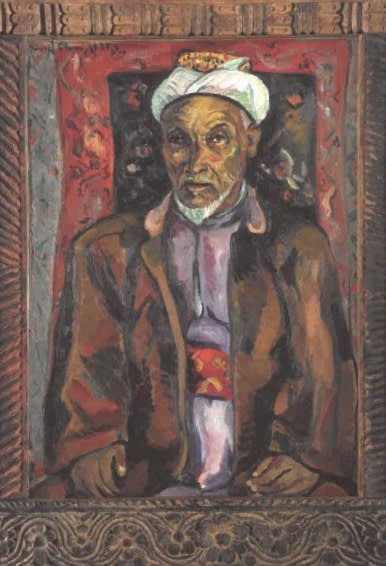
Malay Priest (1931) illustrated in colour in Lisa Horstmann and Lisa Marei Schmidt (eds) (2025) Irma Stern, exhibition catalogue, Munich: Hirmer Verlag, page 36.
More from Modern and Contemporary Art