Vladimir Tretchikoff
Daily Needs
LOT 328
Vladimir Tretchikoff
Daily Needs
Incl. Buyer's Premium & VAT
About this Item
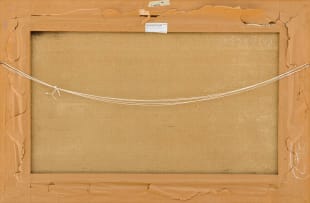
signed; inscribed with the artist's name and title on an South African National Gallery label adhered to the reverse
Notes
Tretchikoff was much attracted to themes that can be described as allegorical in his work. Though not frequently seen to this degree, these allegorical paintings, after his still lifes of 'exotic' female figures, are perhaps what the artist is best known for. Such works are at once enigmatic and also suggestive, creating compositions that demand looking, relooking and deep contemplation.
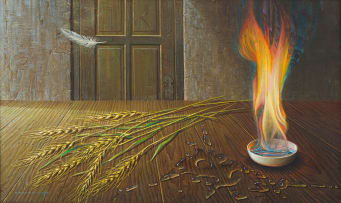
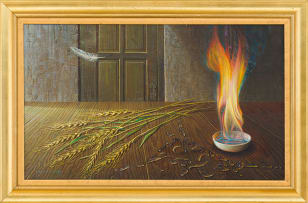
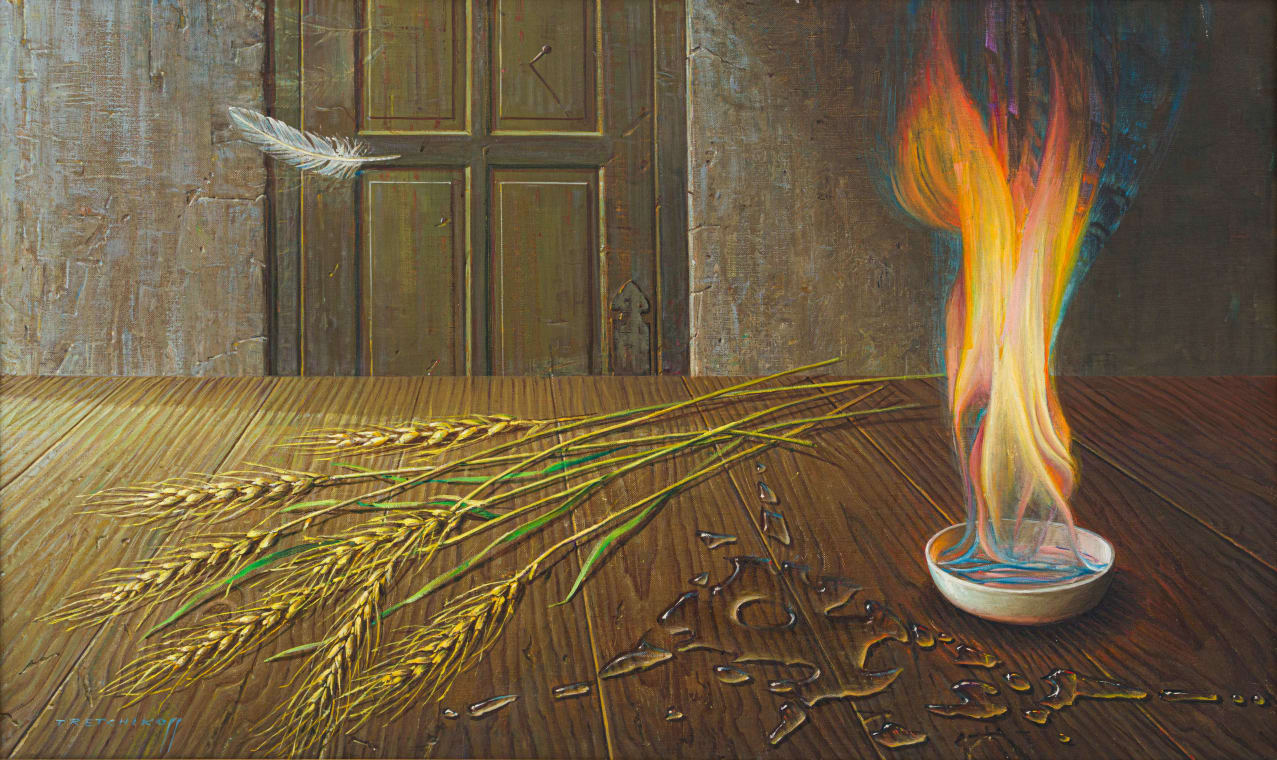
It is not often realised that Tretchikoff was deeply influenced by mystical ideas. Here, we see the artist drawing on the elemental forces of nature: air, represented by the floating feather, fire by the powerful flames magically emanating from the bowl on the table, water by the puddle and earth by the harvested wheat. There are the forces of life, and indeed the universe, within the spiritual dimension. They are in balance, and it is as if the artist is capturing a moment in time. The absence of any human figuration allows us, as the viewer, to be seen as the sole witness to this act of 'magic'.
The setting is one of rustic domesticity, and the composition is all the more charming and unusual for it. Here are none of the lush stage props we are familiar with in his more gorgeous works, a starkness that shows off the artist's power for the symbolic and profound.
Tretchikoff often wittily stated that he knew nothing of contemporary art, but in this work, we see his deep knowledge of and debt to classical painting. The scene could be one taken from Van Gogh, and the single nail in the wall, casting its shadow, is taken straight out from the work of Vermeer, an artist Tretchikoff greatly admired.
The ethereal quality of the composition foreshadows later works, such as his magisterial Ten Commandments (1978), and shows Tretchikoff in a philosophical and introspective mode. The use of a limited palette allows Tretchikoff to display his undoubted abilities as a painter to full effect, and taken as a whole, this is an important example of the artist as someone who could do more than represent 'the exotic' or a purveyor of beauty for its own sake.
Andrew Lamprecht, Curator of Historical Paintings and Sculpture at Iziko Museums of South Africa.
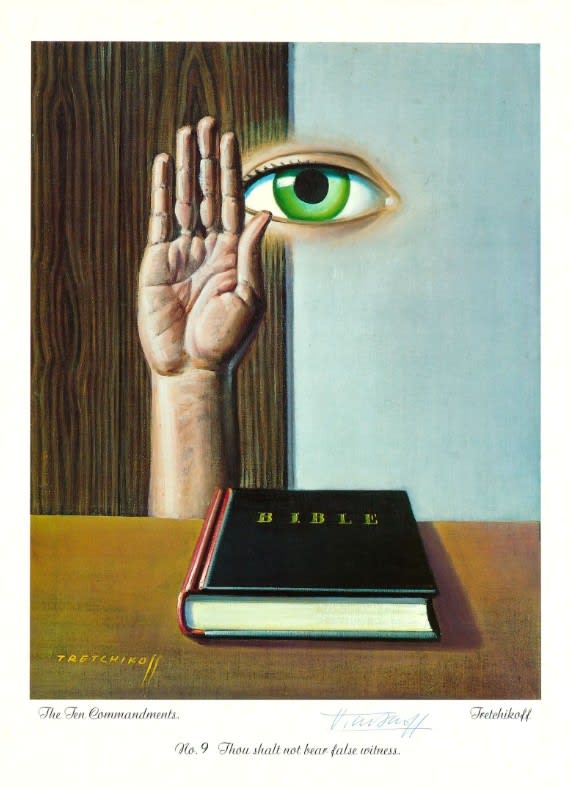
No. 9 Thou Shalt Not Bear False Witness from The Ten Commandments, portfolio (1978) Strauss & Co, Online, 18 April 2026, lot 260, sold R140 520 ($8,649.93).
Exhibited
South African National Gallery, Cape Town, Tretchikoff: The People’s Painter, 26 May to 25 September 2011.
Literature
Andrew Lamprecht (ed) (2011) Tretchikoff: The People's Painter, exhibition catalogue, Cape Town: Jonathan Ball, illustrated in colour on page 201.
More from Modern and Contemporary Art