Penny Siopis
Al Fresco
LOT 29
Penny Siopis
Al Fresco
Incl. Buyer's Premium & VAT
About this Item
signed and dated 90; inscribed with the artist's name, the title and medium on a label adhered to reverse
Exhibited
ΕΜΣΤ National Museum of Contemporary Art, Athens, Penny Siopis, For Dear Life, 18 May 2024 to 10 November 2024.
The Centre de Cultura Contemporania de Barcelona, Barcelona, Apartheid: The South African Mirror, 26 September 2007 to 13 January 2008.
Centro Cultural Bancaja, Valencia, Apartheid: The South African Mirror, April to June 2008.
Literature
Gerrit Olivier (ed) (2014) Penny Siopis: Time and Again, exhibition catalogue, Johannesburg: Wits University Press, illustrated in colour on pages 94 and 95.
Kathryn Smith (ed) (2005) Penny Siopis, Johannesburg: Goodman Gallery, illustrated in colour on pages 36 and 37.
Katerina Gregos (ed) (2024) Penny Siopis: For Dear Life A Retrospective, Art Athens: ΕΜΣΤ, illustrated in colour on pages 120 and 121.
Pep Subirós (ed) (2007) Apartheid: The South African Mirror, exhibition catalogue, Barcelona: Editorial Actar, illustrated in colour.
Notes
Across a career spanning five decades, and an output encompassing painting, installation and film, Penny Siopis has emerged as one of South Africa’s most important and influential living artists. Trained at Rhodes University in the 1970s, she rejected the conservative values of her provincial education in favour of a practice informed by Freudian psychoanalysis, feminist theory and, in later decades, new materialist philosophy.
Throughout her painting career in particular, she has remained a tireless innovator, consistently interrogating the physical, textural and iconographic possibilities of painting. One of the most important contemporary paintings ever to come to market at Strauss & Co, Al Fresco presents Siopis at the height of her powers, equally attentive to the material surface of painting and the burdens of history carried within images.
First presented in a solo exhibition at Goodman Gallery in 1990, this important painting was included in her first major European museum retrospective in 2024, in a section devoted to her History paintings (1985–95). Extending her earlier, lavishly painted allegories of excess and plenitude, encapsulated in the award-winning Melancholia (1986), Siopis began in the late 1980s to incorporate appropriated images from history textbooks, newspapers and journals into her paintings.
A key early work in this subset is Patience on a Monument: ‘A History Painting’ (1988), which depicts a black woman seated atop a mountain of cultural debris, peeling a lemon. The work explicitly invokes German theorist Walter Benjamin’s idea of history as accumulated wreckage and introduced the pile as a “primal image” in her artistic practice.¹ It also concretised Siopis’ interest in the mediation of colonial history through images.
“I did an enormous amount of research and looked at every history book that I could find that had depictions of types – colonisers and colonised,” Siopis later explained. “I was looking at the conventions of the representations of colonial history in the making.”²
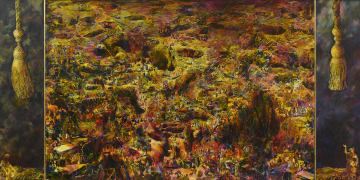
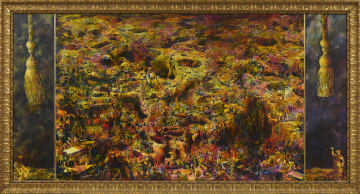
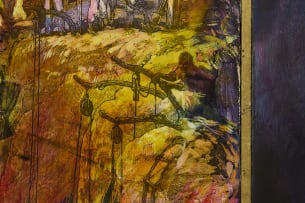
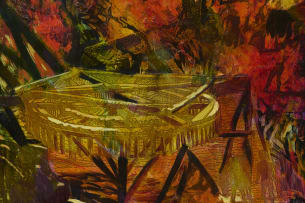
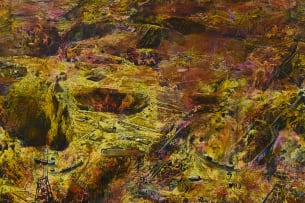
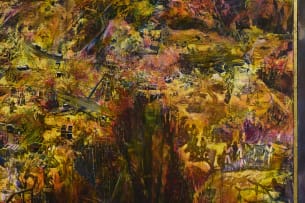
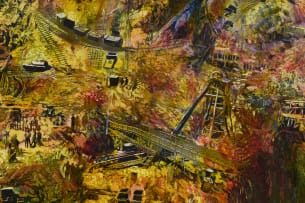
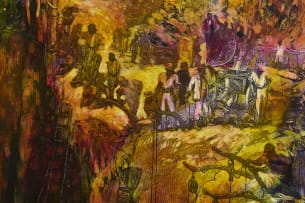
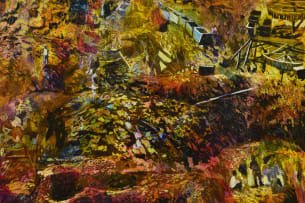
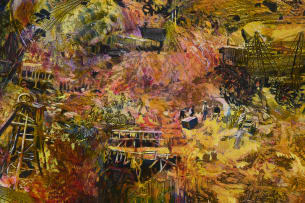
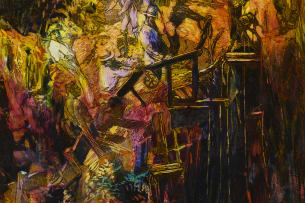
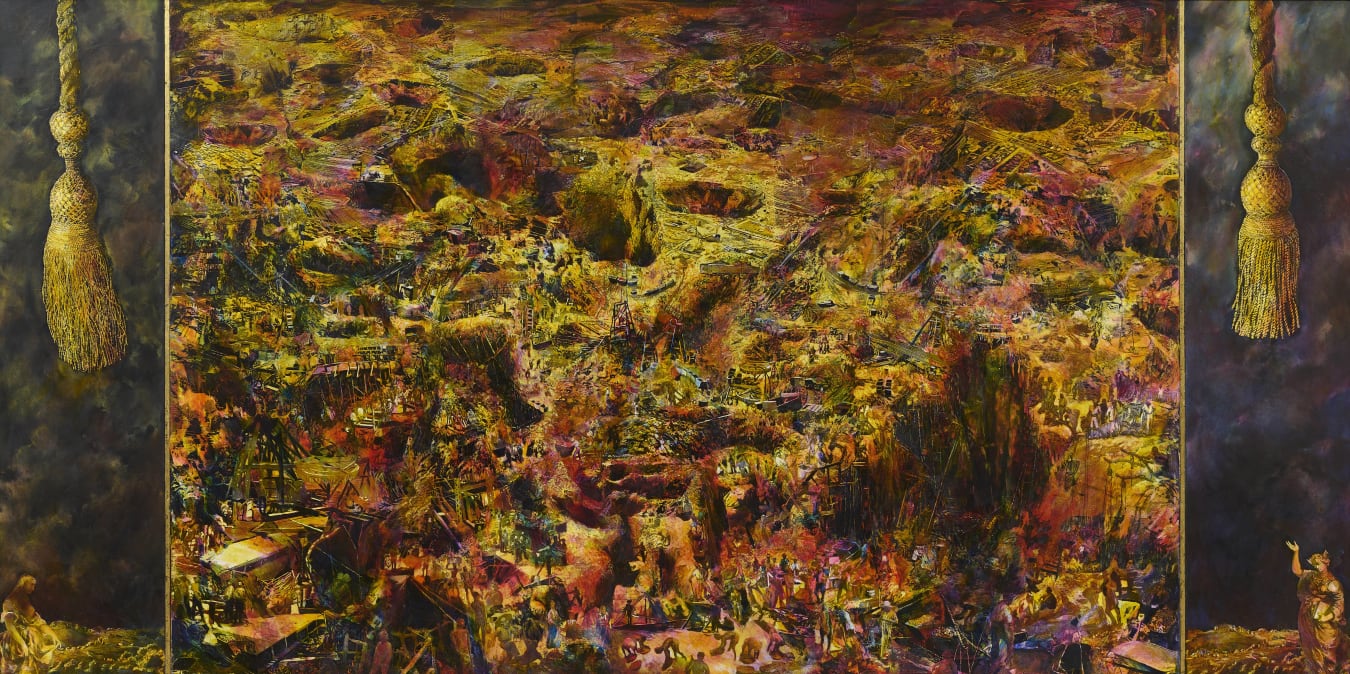
Al Fresco harnesses this collagist method to focus on South Africa’s history of resource extraction. Bookended by two magnificently detailed curtain tassels suspended above lone female figures in baroque poses, the tripartite composition centres on a vast landscape painting. It incorporates illustrations of early gold mining on the Witswatersrand, as well as opencast diamond mining at Kimberley where, from 1871 to 1914, some 50,000 miners excavated a huge hole in the earth using shovels, ladders, wheelbarrows, tramcars, tubs, hoisting ropes and hauling gear. The garments worn by the various figures register their status within the hierarchy of this historical pile.
Exceeding mere collage, the painting features extensive washes of red and golden yellow. A key episode in South Africa’s early industrial revolution is summoned and allegorised in the same mythic register and reduced palette as Peter Paul Rubens’ monumental painting The Fall of the Damned (1620). Scale is integral to the experience of this ambitious work. Writing about Siopis’ history paintings, art historian Griselda Pollock observed: “To read her paintings, your eye must travel the surface which is not only layered with paint, but built up of photocopied images … Dense and intensely worked surfaces give way as one pushes oneself, as with a Cezanne painting, through the weave of colour and brushwork, collage and surface additions, to a scene teeming with bodies and their conflicts, as they encounter each other in this crowded, brilliant space.”³
The work’s ironic title gestures towards the European tradition of open-air painting that transformed nineteenth-century art. Yet this is emphatically a studio painting: layered, staged and historically mediated. The magnificently detailed curtain tassels, recalling the elaborate French craft of passementerie, function as haptic icons of plenitude and excess. Unmissable within the composition, they also signal the privileges, theatricality and pretences underwriting white South African history.
1.Jennifer Law (2014) “Historical Delicacies”, in Time and Again, editor Gerrit Olivier. Johannesburg: Wits University Press. Page 75.
2. Penny Siopis (2014), “Conversation ii: Cake Paintings. History Paintings”, in Time and Again, editor Gerrit Olivier. Johannesburg: Wits University Press. Page 63.
3. Griselda Pollock (2005) “Painting, Diffrence and Desire in History: The Work of Penny Siopis 1985-1994”, in Penny Siopis, editor Kathryn Smith. Johannesburg: Goodman Gallewry Editions. Page 55.
More from Evening Sale