Ayanda Mabulu
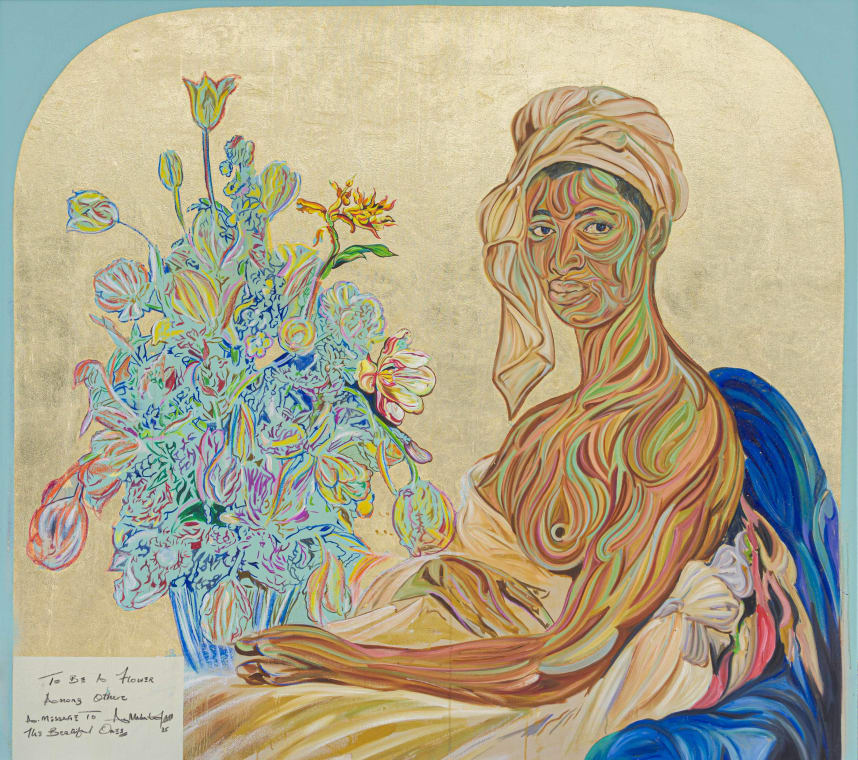
Beautiful Ones
LOT 102
Ayanda Mabulu
Beautiful Ones
Incl. Buyer's Premium & VAT
About this Item
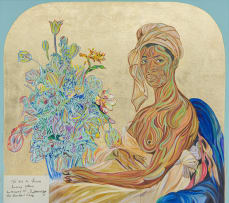
signed, dated 25 and inscribed with the title and 'To be a Flower Among Others'
Notes
Ayanda Mabulu is a self-taught visual artist from the Eastern Cape who is known for the provocative social commentary in his paintings. These pieces usually portray politicians in compromising scenarios as a means of critiquing systems of power and corruption.
Mabulu’s oeuvre also includes figurative works that explore the role that black women play as caregivers, protectors and custodians of African traditions.1 The women in these paintings stand out for the assertive poses they assume and the colourful, graphic linework that characterises their vibrant complexions. The present lot, Beautiful Ones, is expressive of Mabulu’s signature portraiture style.
The work references Marie Guillemine Benoist’s Portrait of Madeleine (1800). Guillemine’s sitter is said to have been modelled after a black enslaved woman who was brought to France from the French Island of Guadeloupe in 1800.2 Interestingly, the work was made between the abolition of slavery during the French Revolution in 1974 and its reinstatement in 1802 by Napoléon Bonaparte. James Smalls outlines how this timeframe places the painting in a context in which ‘the heroicised black image enjoyed considerable popularity in France.’3 In Mabulu’s rendition, the gold-leaf background regally frames the figure, and the lush arrangement of flowers beside her carries the symbolism of beauty, affection, and vitality. The inclusion of these elements can be seen as subversive, given the historically disempowered position of black and African women who were brought to Europe as forced labourers. While the figure’s exposed breast points to her vulnerability, the confronting gaze she holds conveys her agency. And, at 170 by 191 cm, the expanse of the painting emphasises the subject’s visibility, powerfully challenging the marginalisation of black women in the art-historical canon that Mabulu cites.
1. Kerri von Geusau (2020) Nataal Media, Ayanda Mabulu: We meet the artist at Victoria Yards to discuss the power and spirituality behind his paintings, online, accessed 16 March 2026.
2. James Smalls (2004) ‘Slavery is a Woman: ‘Race, Gender, and Visuality in Marie Benoist’s Portrait d’une négresse (1800),’ Nineteenth-Century Art Worldwide 3, no. 1 (Spring 2004), page 4.
3. ibid.
More from Evening Sale