Tracey Rose
Span II
About the SessionHair Matters: A Selection of Works from the Georgina Jaffee Collection is a tightly focused, thematic auction that initiates a critical dialogue on the profound significance of hair in contemporary artistic practice. Featuring a cohort of accomplished contemporary artists, primarily those working from the African continent or within the global African diaspora, this selection of works is guided by a singular conceptual mandate: every work turns to hair as a powerful nexus, serving as medium, metaphor, or focal point of exploration.
Hair Matters illuminates the diverse interpretations and artistic vocabularies through which hair shapes identity, memory, and meaning across cultures, nations, and histories. Featuring artists such as Léonce Raphaël Agbodjélou (Benin), Ifeoma U. Anyaeji (Nigeria), Sethembile Msezane (South Africa), and Hank Willis Thomas (United States), the auction examines the aesthetics, politics, and sociology of hair, with particular emphasis on African perspectives and the connective threads that link the continent and its global diasporas.
Curatorial Voices: Natasha Becker, Jared Leite, Vida Madighi-Oghu and Sihle Motsa.
LOT 34
Tracey Rose
Span II
Incl. Buyer's Premium & VAT
About this Item
signed, dated '97, numbered 2/7 and inscribed with the title in pencil in the margin
Notes
Selected by Curatorial Voices: Natasha Becker, Sihle Motsa and Jared Leite.
Another example from the edition is in the UNISA art collection.
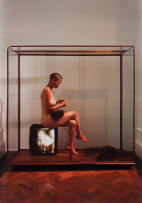
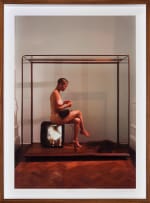
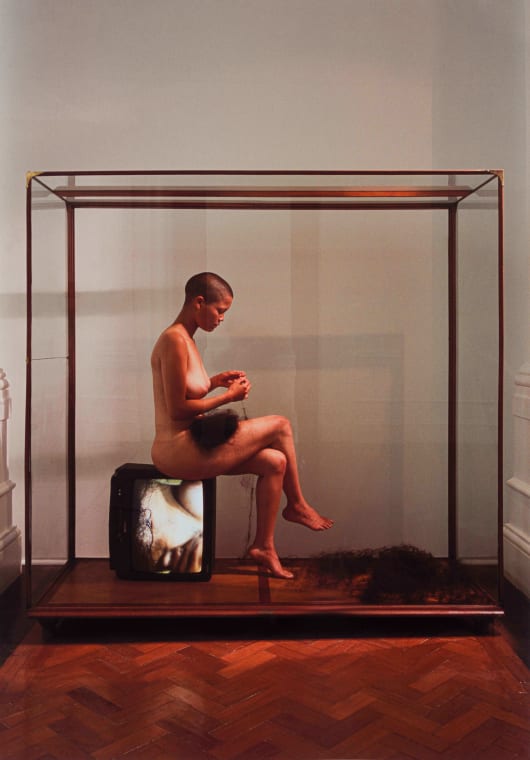
Tracey Rose's multidisciplinary practice engages with issues of oppression, gender, race politics and sexuality, often using her own body through performative and erotic gestures. The present lot is a photographic still from the performance with the same title, which was presented at Iziko South African National Gallery in Cape Town as a satellite event of the second Johannesburg Biennale, in the exhibition Graft, curated by Colin Richards in 1997 – an important career defining moment that launched Rose's career.
Span II examines the interconnections between race and hair, centring on Tracey Rose’s lived experience as a woman of mixed descent. Under the colonial gaze, 'Coloured' emerged as a category used to define those who did not fit neatly into the imposed binary of Black and White. Rose, who is of German and Khoisan descent1, embodies the complexities of an identity that has been routinely ignored, erased, and reduced to this singular designation. Within this context, hair takes on deep social and political significance. Beyond its physical presence and outward expression, hair becomes a critical marker within Apartheid’s body politics, used to classify, regulate and enforce racial hierarchy, particularly though the 'pencil test'.2 As Lee-At Meyerov observes, "Hair, within the context of Apartheid body politics, played a crucial role in the subjugation and marginalisation of the Coloured body, inflicting upon it the most humiliating and degrading form of symbolic violence. Hair did not merely inscribe the body with a racial otherness, but instead marked it as a ‘tainted’ site of ‘racial impurity’, acting as both a corporeal reminder of ‘miscegenation’, and a symbol of shame, degeneration and lowliness. It is from within this ambiguous racial landscape that Rose situates her own artistic practices, critically engaging with issues surrounding the gendered and racialised body".3
The performance presents the artist nude, seated sideways, upright and cross-legged atop a vertically oriented television screen that plays a recording of her hands weaving and knotting hair shaved from her own body. The immediate presence of her exposed body – enclosed within a vitrine, in a setting where the viewer cannot simply look away – actively resists the consumption and exhibition of Black and 'Coloured' women.
Another component of the performance, titled Span I, shows paroled prisoner, Michael Hanekom seated in a chair wearing overalls. He is incising text into a wall describing Roses experiences of being racialised, including struggles with having hair that was too curly and not straight enough. Span I and II can be read as confessionals – a cathartic release from imposed standards, through acts of self-defiance and self-proclamation.
1. Sue Williamson (2001) Tracey Rose, ArtThrob, online, accessed 16 November 2025.
2. Kunst Museum Bern (no date) Tracey Rose Span I and Span II (1997), online, accessed 23 January 2026.
3. Lee-At Meyerov (2006) The Use of Hair as a Manifestation of Cultural and Gender Identity in the Works of Tracey Rose, Master of Arts in Fine Art dissertation, University of Witwatersrand, Johannesburg.
Exhibited
South African National Gallery, Cape Town, Fresh: Tracey Rose, 19 February to 17 March 2001, another example from the edition exhibited.
Wits Art Museum, Johannesburg, Off the Wall: An 80th Birthday Celebration with Linda Givon, 10 August to 13 November 2016, another example from the edition exhibited.
Zeitz MOCAA, Cape Town, Shooting Down Babylon, Retrospective, 19 February to 2022 to 28 August 2022, another example from the edition exhibited.
Queens Museum, New York, Shooting Down Babylon, Retrospective, 23 April to 22 October 2023, another example from the edition exhibited.
Kunst Museum Bern, Switzerland, Shooting Down Babylon, Retrospective, 23 February 2024 to 11 August 2024, another example from the edition exhibited.
Unisa Art Gallery, Pretoria, We, The Purple, 2 March 2024 to 31 May 2024, another example from the edition exhibited.
Literature
Sue Williamson (1997) Johannesburg Biennale, Artthrob, online archive, online, accessed 14 January 2026.
Pitso Chinzima (1999) 'Interview with Tracey Rose', in Brenda Atkinson and Candice Breitz (eds), Grey Areas, Representation, Identity and Politics in Contemporary South African Art, Johannesburg: Chalkham Hill Press, mentioned from pages 88 to 89.
Emma Bedford (ed) (2001) Fresh: Tracey Rose, exhibition catalogue, Cape Town: Iziko South African National Gallery, illustrated in colour on page 31.
Kellie Jones (2004) 'Tracey Rose: Postapartheid Playground', Nka Journal of Contemporary African Art, No. 19, page 28, illustrated.
Okwui Enwezor (2005) 'The Enigma of the Rainbow Nation', in Sophie Perryer (ed), Personal Affects: Power and Poetics in Contemporary South African Art, Cape Town and New York: Spier and Museum of African Art, page 35, illustrated.
N'Gone Fall (2007) 'Providing a Space of Freedom', in Maura Reilly and Linda Nochlin (eds), Global Feminisms: New Directions in Contemporary Art, New York and London: Brooklyn Museum and Merrell, page 72, illustrated.
Percy Zvomuya (2011) Mail & Guardian, A Rose thorn in the Flesh, online, accessed 23 January 2026.
Josh Ginsburg and Jason Webb (2016) Off the Wall: An 80th Birthday Celebration with Linda Givon, Johannesburg: Wits Art Museum, illustrated in colour on page 59.
Kunst Museum Bern (no date) Tracy Rose Span I and Span II (1997), online, accessed 23 January 2026.
Provenance
The Georgina Jaffee Hair Matters Collection.
More from Hair Matters: A Selection of Works from the Georgina Jaffee Collection