Hank Willis Thomas
Come out of the Bone Age, Darling...1955/2015
About the SessionHair Matters: A Selection of Works from the Georgina Jaffee Collection is a tightly focused, thematic auction that initiates a critical dialogue on the profound significance of hair in contemporary artistic practice. Featuring a cohort of accomplished contemporary artists, primarily those working from the African continent or within the global African diaspora, this selection of works is guided by a singular conceptual mandate: every work turns to hair as a powerful nexus, serving as medium, metaphor, or focal point of exploration.
Hair Matters illuminates the diverse interpretations and artistic vocabularies through which hair shapes identity, memory, and meaning across cultures, nations, and histories. Featuring artists such as Léonce Raphaël Agbodjélou (Benin), Ifeoma U. Anyaeji (Nigeria), Sethembile Msezane (South Africa), and Hank Willis Thomas (United States), the auction examines the aesthetics, politics, and sociology of hair, with particular emphasis on African perspectives and the connective threads that link the continent and its global diasporas.
Curatorial Voices: Natasha Becker, Jared Leite, Vida Madighi-Oghu and Sihle Motsa.
LOT 15
Hank Willis Thomas
Come out of the Bone Age, Darling...1955/2015
About this Item
numbered 3/3
Notes
Selected by Curatorial Voice: Jared Leite.
Another example from the edition is in the Collection of the Jordan Schnitzer Family Foundation.
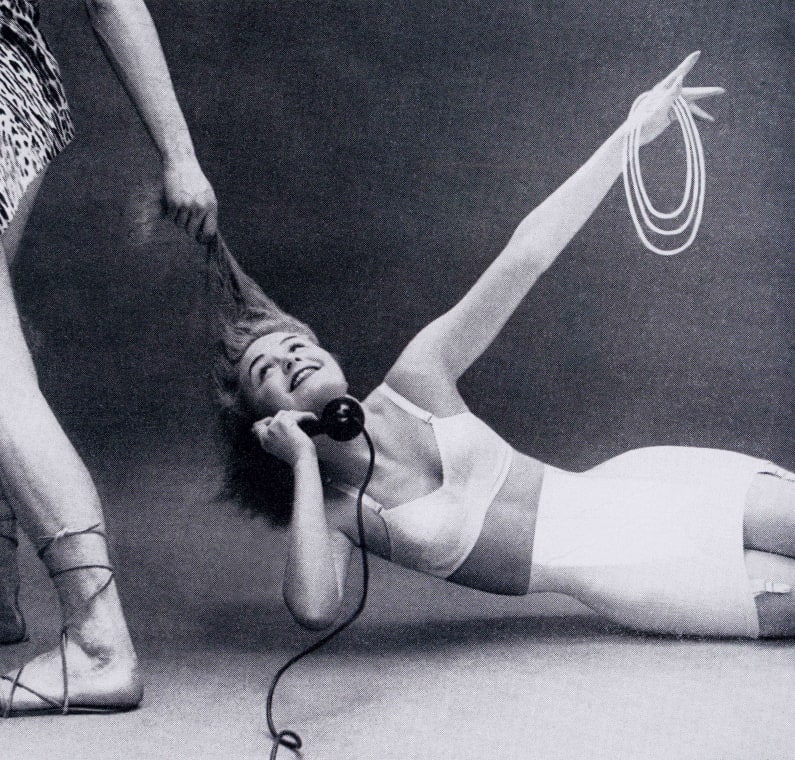
Throughout his conceptual practice, Hank Willis Thomas has been particularly attentive to the role(s) of the image in visual culture. The present lot, Come out of the Bone Age, Darling…1955/2015, is by no means an exception. Thomas Willis’ Unbranded series, which had previously looked at Black consumer culture in corporate America1 shifts in focus towards whiteness with Unbranded: A Century of White Women, 1915/2015. The enveloping body of work dealt with the construction and symbolic presence of white women in the public imagination and involved lifting images from advertising while removing their branding. The simple yet poignant gesture draws attention to the representational field, what Thomas Willis refers to as “the empire of signs”2 that shape our experience of the world.
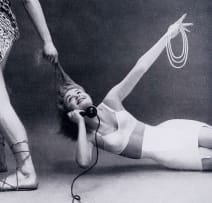
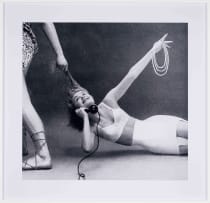
Willis Thomas’ extracted scene presents a slender white woman covered only by a brassiere and girdle, smiling whilst being dragged by her hair across the floor by an unknown figure. Holding a telephone to her left ear, she gazes gleefully at the anonymous character. Here, her surmisable pain is supplanted with pleasure, an inversion of the violence inherent in being pulled by one’s hair. The crude humour of the ad and its accompanying title indexes a moment of innovation in the design of women’s shapewear, the transition from ‘boned’ corsets to flexible materials. But for Willis Thomas, the captured memory of the image is not the development of a more comfortable corset, but the consistent treatment of the white woman’s body as an object of desire – something to be pulled and contorted into an idealised form.
But why hone in on the image of white women, specifically? Why not Black women, or women from other marginalised groups? Why in 2015?3 When asked this by Deborah Willis, Willis Thomas claims to be concerned more broadly with the fabrication of race and its dissemination, something not unlike a marketing campaign.4 Moreover, spotlighting white consumer aesthetics draws attention to the use of the white body as a counter-symbol for Blackness, the standard against which Black bodies are measured. Take for instance the historical context of 1955, the year of publication of the appropriated ad is the same year that Emmett Till was lynched for speaking to a white woman.5 Though Willis Thomas does not draw direct association between the image and this incident, he affirms its relevance to the moment in question in popular culture. In a similar vein, his work demonstrates that the use of the image in advertising is a telling marker of the attitudes of a society: its desires and repulsions, progressive and regressive tendencies.
Willis Thomas’ conceptual gesture serves as one of the few contributions from the African diaspora in the Hair Matters collection but still connects in meaningful ways to many of the other included works. A line could be drawn between Drum Magazine: Dolly Rathebe, April 1957 by Bob Gosani, and Drum Magazine: Linda Mhlongo & Ruth Nkonyeni, April 1961 by Peter Magubane. Despite the temporal rift between legacy advertising across the United States and South Africa, their dissonant motives and legacies of representation, there remains a thread counter-symbolism, resistance to hegemonic beauty standards, idealised notions of race and self-fabrication.
Jared Leite, Curator, Co-founder, and Director of Lemkus Gallery.
1. Unknown author (2023) LSU Museum of Art, Hank Willis Thomas, Unbranded: Reflections in Black by Corporate America, online, accessed 20 January 2026.
2. Roland Barthes (1982) Empire of Signs (1970), translated by Richard Howard, 1983, London: Jonathan Cape.
3. 2015 marked the emergence of Black Lives Matter as a global political movement, a response to systemic racism and ongoing police brutality in the United States.
4. Deborah Willis and Hank Willis Thomas (2015) Africanah.org, Hank Willis Thomas, an interview, online, accessed 20 January 2026.
5. Emmett Louis Till was murdered on August 28, 1995, in Mississippi. The alleged motive was for speaking to a white store clerk, Carolyn Bryant. Following his death, gruesome images of Till’s deceased body were published by Jet magazine, effectively broadcasting the brutality of the Jim Crow Era in the Southern United States.
Exhibited
Jack Shainman Gallery, New York, Unbranded: A Century of White Women, Solo Exhibition, 10 April to 23 May 2015, another example from the edition exhibited.
Goodman Gallery, Cape Town, Hank Willis Thomas/Ads Intimate Life/ 2017, 10 June to 1 July 2017, another example from the edition exhibited.
University of Arizona Museum of Art, Arizona, Hank Willis Thomas: Loverules, From the Collection of Jordan D Schnitzer and His Family Foundation, 18 January to 21 June 2025, another example from the edition exhibited.
Literature
Jillian Steinhauer (2015) Hyperallergic, The (Un)Changing Portrayal of White Women in 100 Years of Advertisements, online, accessed 18 January 2026, another example from the edition illustrated.
Allie Biswas (2015) The Brooklyn Rail, Hank Willis Thomas with Allie Biswas, online, accessed 18 January 2016, another example from the edition illustrated.
Anita Malhotra (2018) Artsmania, Interview with Hank Willis Thomas, online, accessed 18 January 2026, another example from the edition illustrated.
Chadd Scott (2024) Forbes, Artist Hank Willis Thomas' Friendship with Collector Jordan Schnitzer on View in Exhibition, online, accessed 18 January 2026, another example from the edition illustrated.
Provenance
Goodman Gallery, Cape Town, 2021.
The Georgina Jaffee Hair Matters Collection.
More from Hair Matters: A Selection of Works from the Georgina Jaffee Collection