Frank Marshall
Death
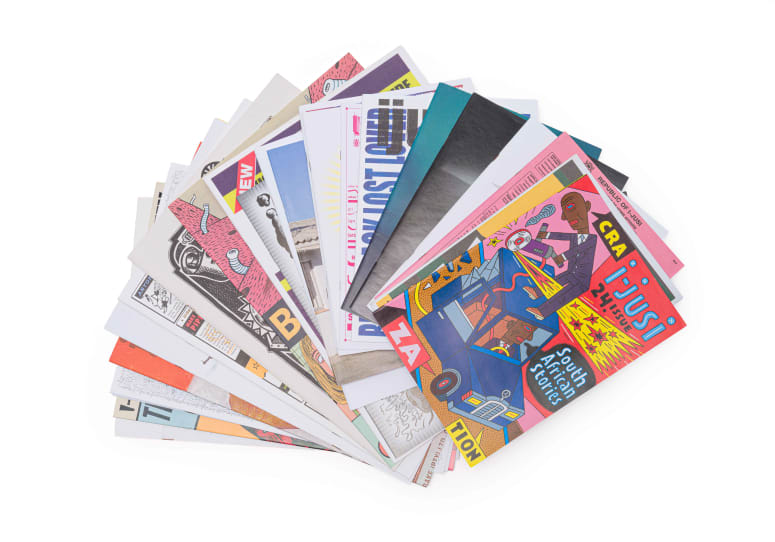
About the SessionFraming a Nation: The Garth Walker Photography Collection and Other Properties presents a selection of photographs from the personal archive of acclaimed graphic designer and photographer Garth Walker. Born in Pretoria, he trained at Technikon Natal in the 1970s, where he met artist Stephen Inggs, a life-long friend. Walker emerged as a pivotal figure in South African graphic design and visual culture in the 1990s through his design firm Orange Juice Design. In 1995 he launched the influential print magazine i-jusi as a platform to showcase new graphic design, typography and illustration. Later issues were sometimes exclusively devoted to photography.
Prominent artists featured in i-jusi included Roger Ballen, Conrad Botes, David Goldblatt and Anton Kannemeyer. It has been exhibited in over 25 countries and is held in the collections of the Museum of Modern Art, New York, Victoria and Albert Museum, London, and Bibliotèque Nationale d'France, Paris. Beyond the magazine, Walker is best known for the unique, custom typeface he produced for the Constitutional Court of South Africa in 2004. Inspired by street typography and prison graffiti, his typography is featured on the court’s building façade.
A longstanding collector, notably of Zulu headrests and nineteenth-century KwaZulu-Natal photography, Walker began acquiring contemporary South African photography in the early 2000s. His choices were instinctual and guided by his interest in vernacular design and the country’s rich documentary photography tradition. He acquired early works by Pieter Hugo, Zanele Muholi and Guy Tillim, before their international rise to prominence. His collection includes personal documentary work by the award-winning photojournalists Jodi Bieber and Greg Marinovich, as well as an important photo from 1965 by David Goldblatt taken at Hartebeespoort Dam north of Johannesburg. The influence of American documentary registers in his holdings of Stephen Shore and Rosalind Fox Solomon.
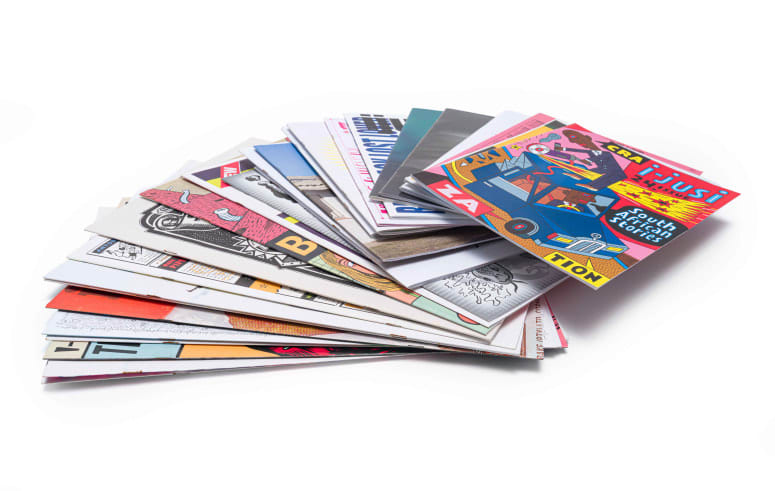
A highlight of this auction is the inclusion of i-jusi Portfolios #1, #2 and #3, produced to sustain the magazine’s independent publication and featuring seminal works by South African artists. Portfolio #3, with a photographic focus curated by Pieter Hugo, underscores the collaborative impulse shaping this material. The collection offers a rare opportunity to acquire works from a defining moment in the evolution of post-apartheid visual culture.

LOT 5
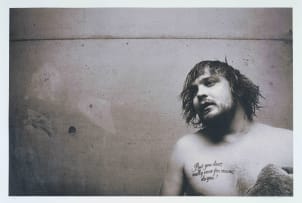
Frank Marshall
Death
About this Item
signed, dated, numbered 2/8 and inscribed with the title in pencil in the margin
Notes
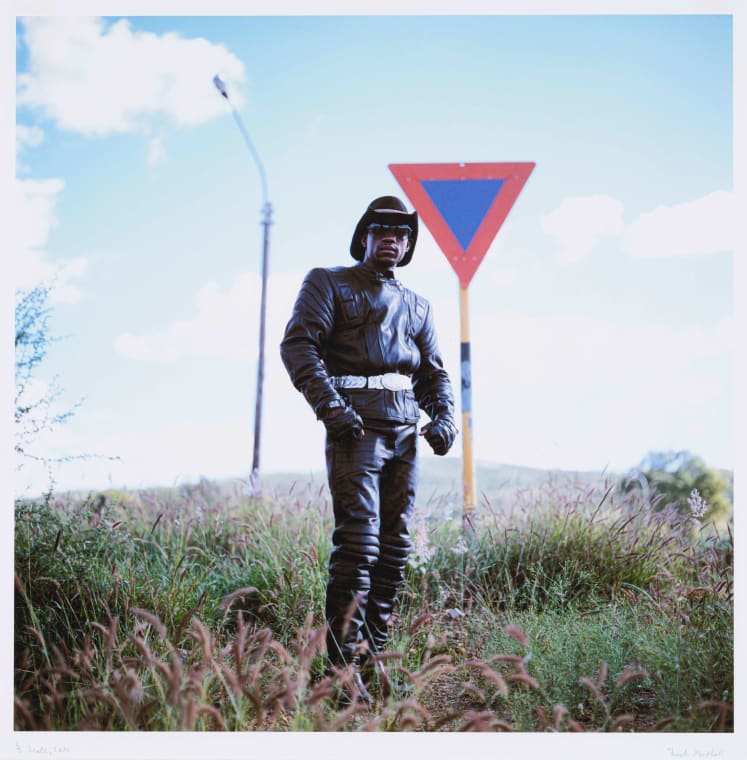
The present lot forms part of the Renegades series, a body of work produced in fulfilment of his undergraduate photography thesis at Tshwane University of Technology.
Marshall first travelled to Botswana in 2008 to accompany the South African heavy metal band Roots on tour. When he arrived in Gaborone, he was surprised to find such a vibrant local heavy metal scene. He was so influenced by what he discovered that he returned a year later to focus his thesis on the "Botswana Metalheads," creating a series of portraits he titled Visions of Renegades.
The series depicts members of the MaRok, locally derived from the Setswana word for "rocker,"1 a close-knit community of metalheads recognised by their distinctive aesthetic: black leather jackets, cowboy boots, spikes, skull rings, and heavily studded accessories that fuse global metal iconography with the cattle culture and western imagery of southern Africa.
Heavy metal arrived in Botswana in the late 1980s and early 1990s, trickling in via South Africa, international radio, bootleg cassette tapes, and knock-off CDs. In a country known for its relative orderliness and social conservatism, metal offered a form of catharsis and fierce individualism. For many Batswana youth, it resonated as a powerful outlet, an artistic rebellion against conformity and a means of navigating the social and political pressures of post-independence Botswana.2 The subculture faced resistance from religious and conservative quarters, with church groups at times petitioning to have metal shows cancelled, yet it endured and grew into a tight-knit community with a strong sense of brotherhood.3
Renegades earned Marshall significant national and international recognition. He was named a finalist in the Sony World Photography Awards Student Focus Competition, the first South African ever to reach the finals, and works from the series entered the permanent collections of Stanford University and the J. Paul Getty Museum in Los Angeles.
The photographic series consists of 60 posed environmental portraits, produced using two analogue cameras, a Hasselblad 500 CM and a Hasselblad 500 EL/M, on Fujichrome Provia 100F film.
1. No author (2015) Blabbermouth, Meet The Women Of Botswana's Heavy Metal Subculture, online, accessed 20 April 2026.
2. SA Explorer (2025) SA Expeditions, Head-banging in the Kalahari: Botswana’s thriving heavy metal scene, online, accessed 20 April 2026.
3. Jamie Fullerton (2022) Adventure.com, The new home of one of Africa’s most thrilling music subcultures, the village of Rakops in Botswana has just hosted its first Vulture Thrust Metal Fest. Jamie Fullerton joins 200 Botswana metalheads and experiences it for himself, online, accessed 20 April 2026.
Literature
No author (2012) GQ, Renegades, online, accessed 1 April 2026.
Mark Tutton and Errol Barnett (2017) CNN World, ‘Africa is the last frontier for metal’: Botswana’s metal heads still rocking', online, accessed 1 April 2026.
Exhibited
Rooke Gallery, Johannesburg, Renegades, 5 July to August 2011, another example from the edition exhibited.
Provenance
The Garth Walker Photography Collection.
The present lot forms part of a selection of photographs from the personal archive of acclaimed designer Garth Walker. Born in Pretoria and trained at Technikon Natal in the 1970s, Walker is best known for designing the unique typeface adorning the Constitutional Court of South Africa. He was also the publisher of i-jusi, a magazine for experimental graphic design and photography exhibited in 25 countries and held in important international collections. A discerning collector, Walker began acquiring contemporary South African photography in the early 2000s, guided by an instinct for vernacular image-making and documentary practice. The collection includes work by internationally acclaimed documentarians Jodi Bieber, David Goldblatt, Pieter Hugo, Greg Marinovich, Zanele Muholi and Guy Tillim. A key highlight is the inclusion of i-jusi Portfolios #1–3, with Portfolio #3 curated by Pieter Hugo. The collection offers a rare opportunity to acquire works from a defining moment in the evolution of post-apartheid visual culture.
More from Framing a New Nation