Hasan Essop and Husain Essop
Immos Halaal Butchery
About the SessionFraming a Nation: The Garth Walker Photography Collection and Other Properties presents a selection of photographs from the personal archive of acclaimed graphic designer and photographer Garth Walker. Born in Pretoria, he trained at Technikon Natal in the 1970s, where he met artist Stephen Inggs, a life-long friend. Walker emerged as a pivotal figure in South African graphic design and visual culture in the 1990s through his design firm Orange Juice Design. In 1995 he launched the influential print magazine i-jusi as a platform to showcase new graphic design, typography and illustration. Later issues were sometimes exclusively devoted to photography.
Prominent artists featured in i-jusi included Roger Ballen, Conrad Botes, David Goldblatt and Anton Kannemeyer. It has been exhibited in over 25 countries and is held in the collections of the Museum of Modern Art, New York, Victoria and Albert Museum, London, and Bibliotèque Nationale d'France, Paris. Beyond the magazine, Walker is best known for the unique, custom typeface he produced for the Constitutional Court of South Africa in 2004. Inspired by street typography and prison graffiti, his typography is featured on the court’s building façade.
A longstanding collector, notably of Zulu headrests and nineteenth-century KwaZulu-Natal photography, Walker began acquiring contemporary South African photography in the early 2000s. His choices were instinctual and guided by his interest in vernacular design and the country’s rich documentary photography tradition. He acquired early works by Pieter Hugo, Zanele Muholi and Guy Tillim, before their international rise to prominence. His collection includes personal documentary work by the award-winning photojournalists Jodi Bieber and Greg Marinovich, as well as an important photo from 1965 by David Goldblatt taken at Hartebeespoort Dam north of Johannesburg. The influence of American documentary registers in his holdings of Stephen Shore and Rosalind Fox Solomon.
A highlight of this auction is the inclusion of i-jusi Portfolios #1, #2 and #3, produced to sustain the magazine’s independent publication and featuring seminal works by South African artists. Portfolio #3, with a photographic focus curated by Pieter Hugo, underscores the collaborative impulse shaping this material. The collection offers a rare opportunity to acquire works from a defining moment in the evolution of post-apartheid visual culture.
LOT 40
Hasan Essop and Husain Essop
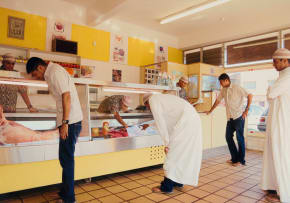
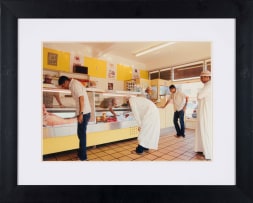
Immos Halaal Butchery
About this Item
from an edition of 3
Notes
Another example from the edition is currently held in the University of Cape Town Works of Art Collection.
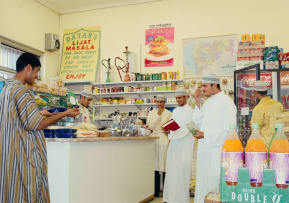
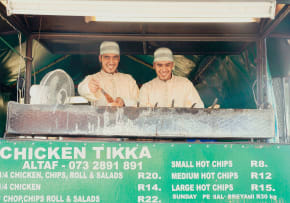
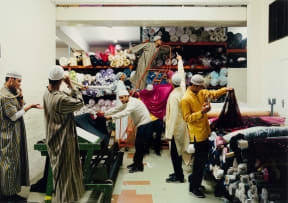
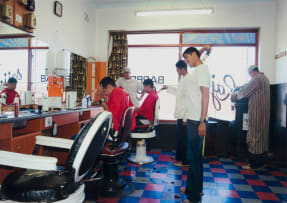
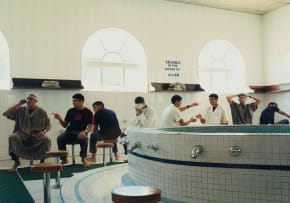
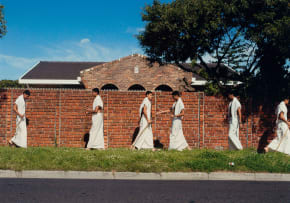
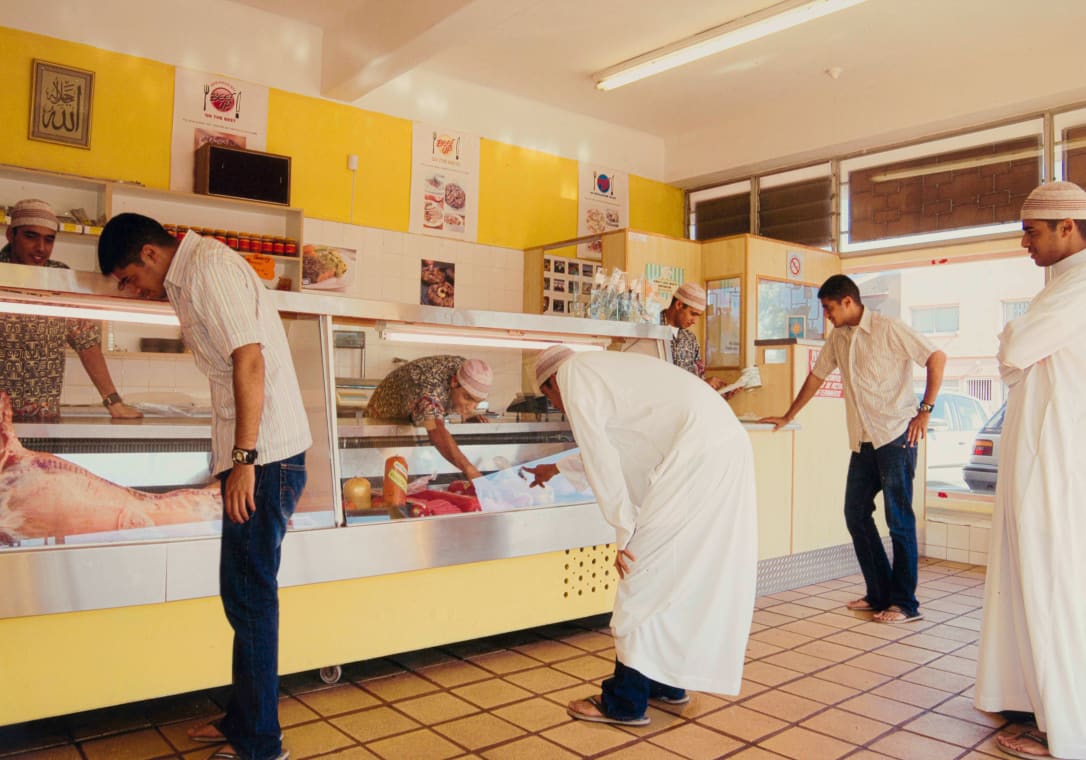
This work originates from Husain Essop's 2006 graduate exhibition at the Michaelis School of Fine Art, where he completed his Bachelor of Fine Arts majoring in Photography along with his bother, Hassan. The series is rooted in the Cape Town neighbourhood where the artists grew up, an area designated exclusively for Indian and Coloured residents under Apartheid-era segregation. Drawing on both lived and imagined experience, each image places the brothers as the central protagonists within locations intimately familiar to them: a Halaal butchery, a spice shop stocked with ingredients for traditional Indian cooking, the local mosque, and their family's fabric wholesale business.1
Rather than functioning as documentary work, the photographs seek to reconstruct dialogue by reclaiming familiar spaces and reinserting the artists into them. This is achieved through a painstaking process of digital compositing, taking upwards of 400 individual images that are then stitched together into a single large-format photograph, with each figure carefully integrated into the scene by hand.2 The decision to use only themselves as subjects is also one of principle: in Islam, the depiction of the human figure is considered forbidden, and by bearing that responsibility through their own bodies, Hasan and Husain transform a religious constraint into a deeply personal artistic statement.3
The themes explored in this early series, including identity, community, religion, and the negotiation of Muslim life within a secular, post-Apartheid society, would go on to define the brothers' broader practice. Their subsequent exhibitions, including Halaal Art at Goodman Gallery, Johannesburg (2010), Remembrance at Goodman Gallery, Cape Town (2012), and Unrest, which toured nationally following their receipt of the 2014 Standard Bank Young Artist Award for Visual Art, each built upon the foundation laid in this graduate work. Their photographs are held in numerous public and private collections, including the Deutsche Bank Collection, the Spier Art Collection, the Durban Art Gallery, and the Iziko South African National Gallery.
1. No author (2025) Ibali: Digital Collections UCT, Focus Fabrics, online, accessed 20 April 2026.
2. Alison Kane (2014) David Krut Projects, Hasan & Husain Essop Talk, online, accessed 20 April 2026.
3. No author (no date) CAACART: The Jean Pigozzi African Art Collection, Hasan and Husain Essop, online, accessed 20 April 2026.
Provenance
Michaelis School of Fine Art, Cape Town, 2006.
Private Collection.
Exhibited
Michaelis School of Fine Art, Cape Town, 4th Year Graduate Exhibition, 2006.
View all Hasan Essop and Husain Essop lots for sale in this auction
More from Framing a New Nation