Willem Boshoff
New York. In Memoriam, four
About the SessionOH YES! The Willem Boshoff Art Collection offers works from the personal collection of South Africa’s first word and leading conceptual artists. Willem Boshoff was born in 1951 in the industrial town of Vanderbijlpark and obtained his undergraduate and post-graduate degrees at the Johannesburg College of Art and Technikon Witwatersrand (both later absorbed into the University of Johannesburg). Boshoff’s father was a carpenter, which nurtured a deep appreciation for woodwork in the artist that he would later incorporate into his art practice.
Boshoff sensitises audiences to the knowledge systems, power dynamics and cultural memory that words carry through provocative sculptures, installations, prints and performances. Scale is key for Boshoff and is expressed through the sheer size of the artworks he constructs and the depth of the research that anchors his explorations of linguistics, natural science, politics and philosophy.
Boshoff’s fascination with words has seen the artist amass a collection of over 500 dictionaries and create many of his own. The title of this sale is a positive spin on his latest OH NO! Dictionary published in 2022 by The Ampersand Foundation. The glossary is a collection of strange and surprising words from dictionaries he compiled himself, such as the Dictionaries of Manias and Phobias, Red Names and Places Mother Might Not Approve Of.
Of Boshoff’s own works in this sale, his Highveld etching (lot 10) is captivating for how its indexing of the diverse plant species found in South Africa’s interior plateau mirrors the very grasslands that blanket the region. Dubul’ ibhunu (Kill the Boer) lot 14 also stands out for its confronting title, which brings up the complex histories and the debates about the political contexts of language in South Africa.
Many artworks in Boshoff’s collection, like Philippa Hobbs (lots 20 and 21) and Claude van Lingen (lot 1), were exchanged with his colleagues at the Technikon Witswatersrand (now the University of Johannesburg), where he taught for many years. They serve as gentle reminders of the influential role Boshoff has long played in South Africa’s art ecosystem as a mentor, educator and academic. In addition, Jackson Hlungwani’s woodcarvings (lots 6, 28 and 30) and Christo Coetzee’s symbolic compositions (lots 13 and 18) reflect Boshoff’s admiration of artists with similar material or conceptual approaches to him.
Following his initial reluctance to exhibit publicly, Boshoff had his first exhibition at the Johannesburg Art Gallery (JAG) in 1981. A set of 12 prints from his concrete poetry anthology, KykAfrikaans, that featured in this exhibition, is also under the hammer in our spotlight Evening Sale of Modern and Contemporary South African Art (lot 222). Since the exhibition at JAG, his artworks have been exhibited widely and are included in the permanent collections of important museums around the world. This sale presents the opportunity to bid on items that exemplify Boshoff’s pioneering use of language as a primary medium and conceptual framework, as well as the mainstays of his personal art collection.
LOT 22
Willem Boshoff
New York. In Memoriam, four
About this Item
Notes
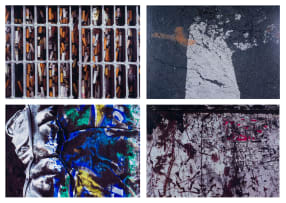
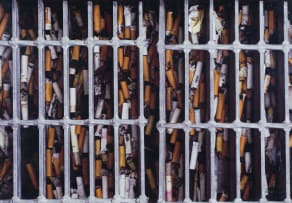
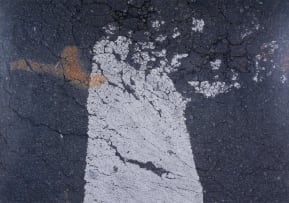
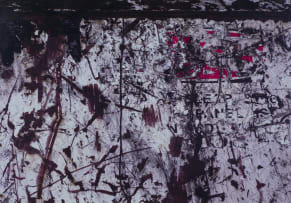
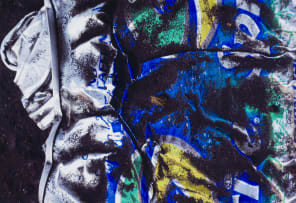
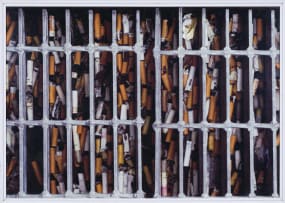
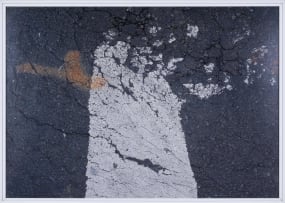
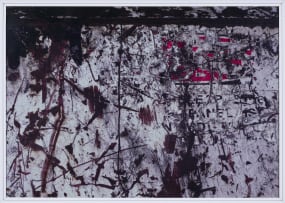
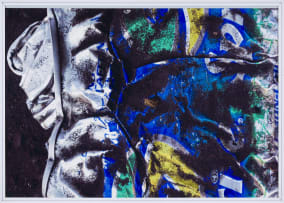
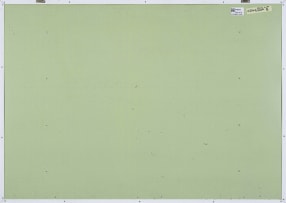
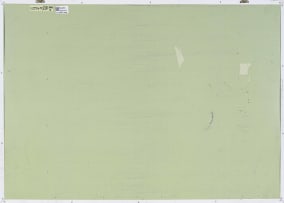
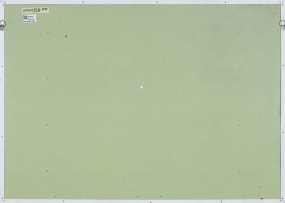
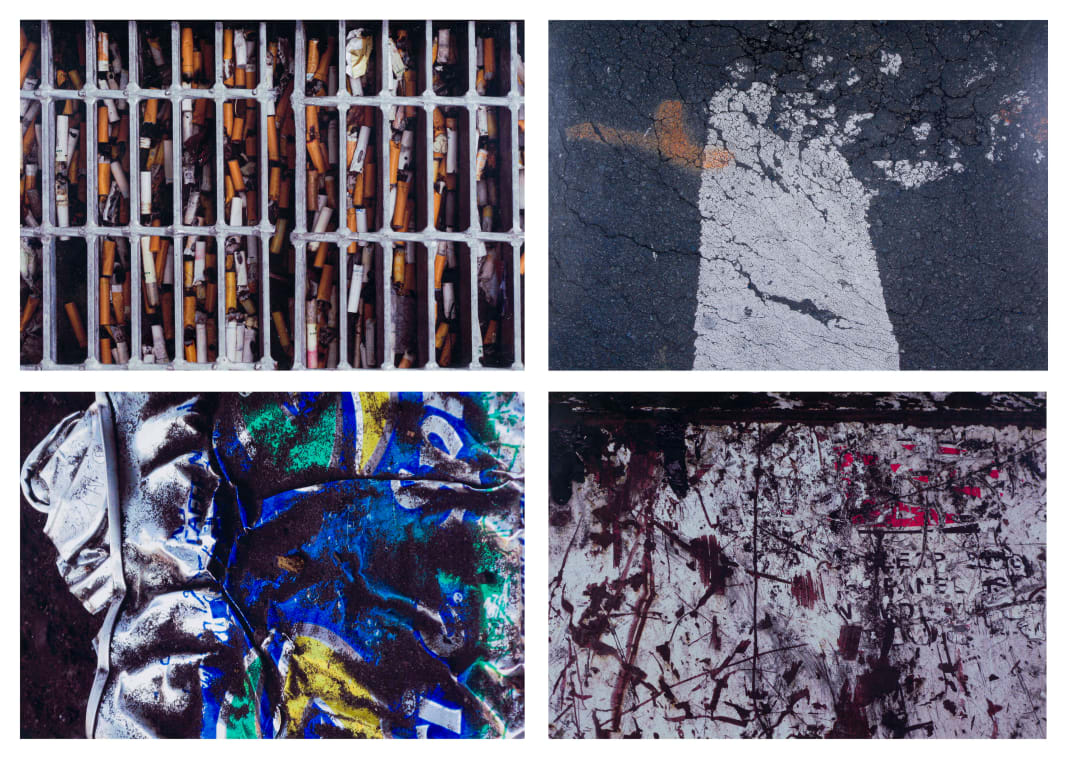
Each photograph housed in a light box.
Provenance
Willem Boshoff Collection.
I was in New York for a month in 2008. I have the dubious distinction of having walked right past some of the city’s finest buildings without paying them much attention, not a commendable trait in a student of art and architecture. Yes, I have a few romantic shots of the magnificent Woolworths building in the mist, but that was really a diversion. To the great perplexity of thousands of camera-slinging pedestrians I paid ‘inordinate’ attention to dirty skid marks on the roads or old paint cracking and peeling off buildings in the area.
Although I am amazed at the beauty and grandness of man-made structures, as a druid I am hell bent on scrying for clues regarding the soul of a city as defined by the ‘tea-leaves’ of debris washed up by the storm water. I consequently walk miles looking down at the road for obsolete things that stir my diviner’s juices. I keep my dedicated walks free of interruptions such as visits to tourist venues and shopping. My druidic walks are fully committed to searching out moments of rare vision. The primary function of the druid is to see. Bothersome problems like inadequate breathing or inappropriate dress can mess up a true walk. To be impatient during a walk can sink the effort as much as neglecting to have protection against the harsh sun.
Through the lens of a camera one might become ‘extravagant’, that is to stray beyond experiences offered by the beaten track – the extravagant individual roams about restlessly until a rewarding moment is reached. In Latin extra- is ‘beyond’ and vagari ‘to wander’. Buzz Lightyear in the film Toy Story shouts extravagantly: “To infinity and beyond.”
The extraordinary nature of my walks fills me with a sense of purpose and adventure. I become the vagabond – the free spirited monk who wanders from place to place – vagabond is from the same Latin root, vagari ‘to wander’. My walks help me see the world through different eyes. For example, I become fluctivagant, that is walking on waves, when my spirit is transported to drift and flow on ripples in icons I encounter when gazing intently at the crushed metal of abandoned old vehicles in a scrap yard.
Walks down ordinary city streets might render me montivagant, roaming about mountains and hills; nemorivagant, wandering about woods or nubivagant, passing through or among clouds. When Plato becomes overawed by foreboding monstrous shadows flickering on the walls of his cave, when things are not what they seem, the mimesis has kicked in.
Yet, this way of looking is only the beginning. Certain images appear to be defiant of comparison or historical precedent. Divergent classes of icon tend to force themselves on one’s wandering soul without any explicable theory. It would be easy if one could simply say that this, most noble kind of visual search serves to dignify the inner regions of consciousness as an anagogue. The anagogical sense provides an uplifting, mystical insight – in Greek anago is ‘lead up’. Anagogical songs, artworks and poems make the spirit soar and paint a dreamy-eyed expression on the spirit-filled face that will confound even El Greco, but the druid’s quest is hardly ever so defined.
The value of tough hermetic images is often found in their dissonance, in the fact that they wage war with precepts and expectations. Demands of such perplexity can be exerted so that the psyche is not only rendered speechless in their wake but sweating and well spent – this is when the druid truly goes to work.
I prefer to be solivagant – I walk alone so that I may give my full attention to the walk. The true vagabond wanders from place to place by himself or herself, ignoring pressures of home or job, intent only on being there and seeing beyond.
In 2007 I performed some dedicated solitary walks to the west of Johannesburg, around the fabulous lakes, woods and hills surrounding the NIROX residency situated in an enigmatic valley of the world heritage site called Cradle of Humankind. I spent almost four months there in the cold of winter making new artworks and recovering from effective but life sapping chelation treatment I had received for severe lead poisoning.
During my early morning walks at NIROX I took photographs of the naked trunks of Celtis africana trees, commonly known as ‘White Stinkwood’. These were composed as a memorial slide show called ACHEIROPOIETOI (images not made by hand). My mornings were filled trying to get a glimpse of dryads, the nymphs of woods and trees. I was particularly interested in Ptelea, a tragic tree nymph of the hamadryad kind. She is exclusively married to Celtis and Ulmus (Elm) species of trees – the Ulmaceae. She protects her tree partner for life and if her beloved tree should die, she dies with it. The Elms of Europe had of course nearly all died out in the terrible blight known as Dutch Elm disease in the latter part of the twentieth century. I became infatuated with Ptelea and was saddened by the abuse and disfigurement she had suffered, especially by traces of bodily harm and genital mutilation, but I was also encouraged by her survival and evidence of healing and mending. In springtime the trees get back their lush crown of leaves that block out the sun and then intimate aspects of the tragic nymph in the lower trunks of trees are not easily visible.
During my nights and free time at NIROX I worked on my new dictionary entitled WHAT EVERY DRUID SHOULD KNOW. With severe insomnia lending a hand, I have written no less than fifteen dictionaries since 1977.
One of these compared the divination of sangomas and inyangas of Africa to that of the ancient shamans and druids of the northern continents. I discovered that druids and dryads get their names from the old Greek word drus, meaning ‘tree’. The druid is an unconventional priest of the trees.
I have included aleatoric (incidence interacting with coincidence) practises in my lifestyle and art-making since 1972. When I walk, I observe telltale signs in leaves and stones on the ground, in the trajectories and proximities of branches and the lay of the land, pretty much like a druid in need of guidance will do. Since ACHEIROPOIETOI I have made a number of druidic walks in Wales the original domain and homeland of European druids and in the Kalahari Desert where Khoisan shamans have been active for centuries.
My stay in New York was in the apartment of the Ampersand Foundation, at 275 Greenwich Street, less than 100 yards away from Ground Zero. Before the trip I had time to reflect on how, as a druid, I might undertake a series of random walks around the Ground Zero area. I would be looking for tragic traces of the Poliad, a nymph of the city. As always, my druidic walk had to be governed by the inductive method of reacting to visual effects displayed in a random manner. It was spring in South Africa, and the visit to New York happened in their fall, a season I know as autumn. I prefer the word ‘fall’. I entered an area situated in vague shadows between tragedy and recovery. Ground Zero was then a large, hidden gash in the Manhattan landscape and the great effort to construct the new building project had not yet broken even with street level.
The attack on the World Trade Centre happened on September 11, 2001 and my birthday is the day after, on September 12. My visit to the area in September 2008 made it possible for me to attend the downtown Manhattan commemorations of September 11. I completed my earlier walks before and around my birthday, in good weather with the sun shining. During the last part of my visit I often arrived home, soaking wet from the drizzle. I treat atmospheric conditions and the sequence of visual revelations with great respect because they destine the mood of my walks. If the sky was crying then I was walking on tears.
Once on the streets I would take a deep breath and proceed to walk slowly in a direction such as decided by telltale flashes of the catastrophic event. I would look for signs of disaster, of things falling apart and of dramatic impact – ‘disaster’ is from the Italian dis- ‘bad’ and astro ‘star’. I felt lost in in-between time, a time between the tragedy and the resurrection of a new building. The people of downtown Manhattan were desperately and slowly patching up disintegrated parts. Pedestrians stoically suffered discomfort of movement in the streets and showed great resolve to embrace a new era weighing heavily on their minds.
I set out to catch the following on camera:
- tread marks and impact scars such as from the large wheels and metal teeth of heavy-duty vehicles, graders and forklifts
- the lines of the figure 11 suggesting twin towers, sometimes lying down horizontally
- duct tape and repair putty holding things together for the moment or bits and pieces fraying apart, flaking off, washed-up or tearing loose
- signs of the season of fall, fallen leaves and plant matter in decay and with that also items like bits of rusting scrap, cement waste set firmly on the ground, debris and sawdust that look to be falling or have fallen
- archival traces of aerial flight, of impact and blow-out
- temporary barricades and thick sheets of steel that cover holes and underground installations so that pedestrians and vehicles can get around.
- fractured architecture in reflections on the glass facades of buildings
- names of individuals etched into concrete or graphic markings that look like partially erased writing. Scratch marks in the floor blend away in bright sunlight, but when it rains, water gathers in the grooves making them easier to ‘read’.
The work NEW YORK 09-11-2001: IN MEMORIAM is one of several memorial works I have undertaken. Lately I have laid out memorial gardens, prematurely commemorating the 30,000 plants thought to become extinct in the near future.
In 1979 I wrote a poem “Die Begrafnis” (The Funeral) to say how impossible it is to make intelligent conversation and think when under the weight of the loss of a loved one. I offered the names of different soils and dusts typed in strata on the page as hopeless consolation. No effort at coming to terms with our deepest loss tends to suffice. As the ones we love are submitted to the earth, grief becomes overwhelming and only aspects of soil and ash left in their wake stare us numbly in the face.
As the sun fades away names scratched into the concrete, it helps us to forget, to let go and reach closure. At the same time we try to remember, we try to retrieve any traces of lost ones, to bring them back in some small, sad way. The ‘tearful’ texts in this walk are on the border of being legible and illegible. We tend to search for clarity in the incidental ‘transcripts’ of the wet downtown streets of Manhattan, only to find the sun bleaching that recognition away. We seem to be pointlessly subjected to the unending paradox of forgetting and remembering, of loss and retrieval.
- Willem Boshoff
New York. In Memoriam accessed 30/06/2026.
More from OH YES!