Willem Boshoff
Dubul' Ibhunu (Kill the Boer)
About the SessionOH YES! The Willem Boshoff Art Collection offers works from the personal collection of South Africa’s first word and leading conceptual artists. Willem Boshoff was born in 1951 in the industrial town of Vanderbijlpark and obtained his undergraduate and post-graduate degrees at the Johannesburg College of Art and Technikon Witwatersrand (both later absorbed into the University of Johannesburg). Boshoff’s father was a carpenter, which nurtured a deep appreciation for woodwork in the artist that he would later incorporate into his art practice.
Boshoff sensitises audiences to the knowledge systems, power dynamics and cultural memory that words carry through provocative sculptures, installations, prints and performances. Scale is key for Boshoff and is expressed through the sheer size of the artworks he constructs and the depth of the research that anchors his explorations of linguistics, natural science, politics and philosophy.
Boshoff’s fascination with words has seen the artist amass a collection of over 500 dictionaries and create many of his own. The title of this sale is a positive spin on his latest OH NO! Dictionary published in 2022 by The Ampersand Foundation. The glossary is a collection of strange and surprising words from dictionaries he compiled himself, such as the Dictionaries of Manias and Phobias, Red Names and Places Mother Might Not Approve Of.
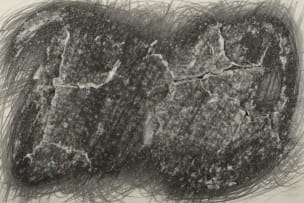
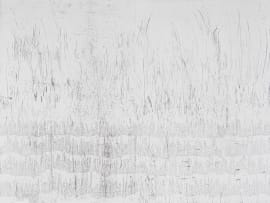
Of Boshoff’s own works in this sale, his Highveld etching (lot 10) is captivating for how its indexing of the diverse plant species found in South Africa’s interior plateau mirrors the very grasslands that blanket the region. Dubul’ ibhunu (Kill the Boer) lot 14 also stands out for its confronting title, which brings up the complex histories and the debates about the political contexts of language in South Africa.
Many artworks in Boshoff’s collection, like Philippa Hobbs (lots 20 and 21) and Claude van Lingen (lot 1), were exchanged with his colleagues at the Technikon Witswatersrand (now the University of Johannesburg), where he taught for many years. They serve as gentle reminders of the influential role Boshoff has long played in South Africa’s art ecosystem as a mentor, educator and academic. In addition, Jackson Hlungwani’s woodcarvings (lots 6, 28 and 30) and Christo Coetzee’s symbolic compositions (lots 13 and 18) reflect Boshoff’s admiration of artists with similar material or conceptual approaches to him.
Following his initial reluctance to exhibit publicly, Boshoff had his first exhibition at the Johannesburg Art Gallery (JAG) in 1981. A set of 12 prints from his concrete poetry anthology, KykAfrikaans, that featured in this exhibition, is also under the hammer in our spotlight Evening Sale of Modern and Contemporary South African Art (lot 222). Since the exhibition at JAG, his artworks have been exhibited widely and are included in the permanent collections of important museums around the world. This sale presents the opportunity to bid on items that exemplify Boshoff’s pioneering use of language as a primary medium and conceptual framework, as well as the mainstays of his personal art collection.
LOT 14
Willem Boshoff
Dubul' Ibhunu (Kill the Boer)
About this Item
signed, dated and inscribed with the title on the reverse
Provenance
Willem Boshoff Collection.
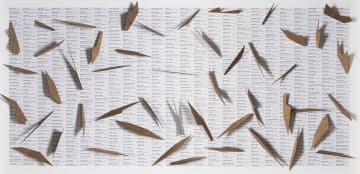
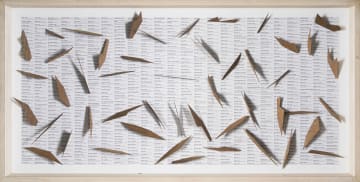
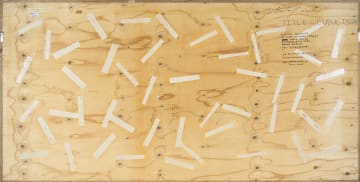
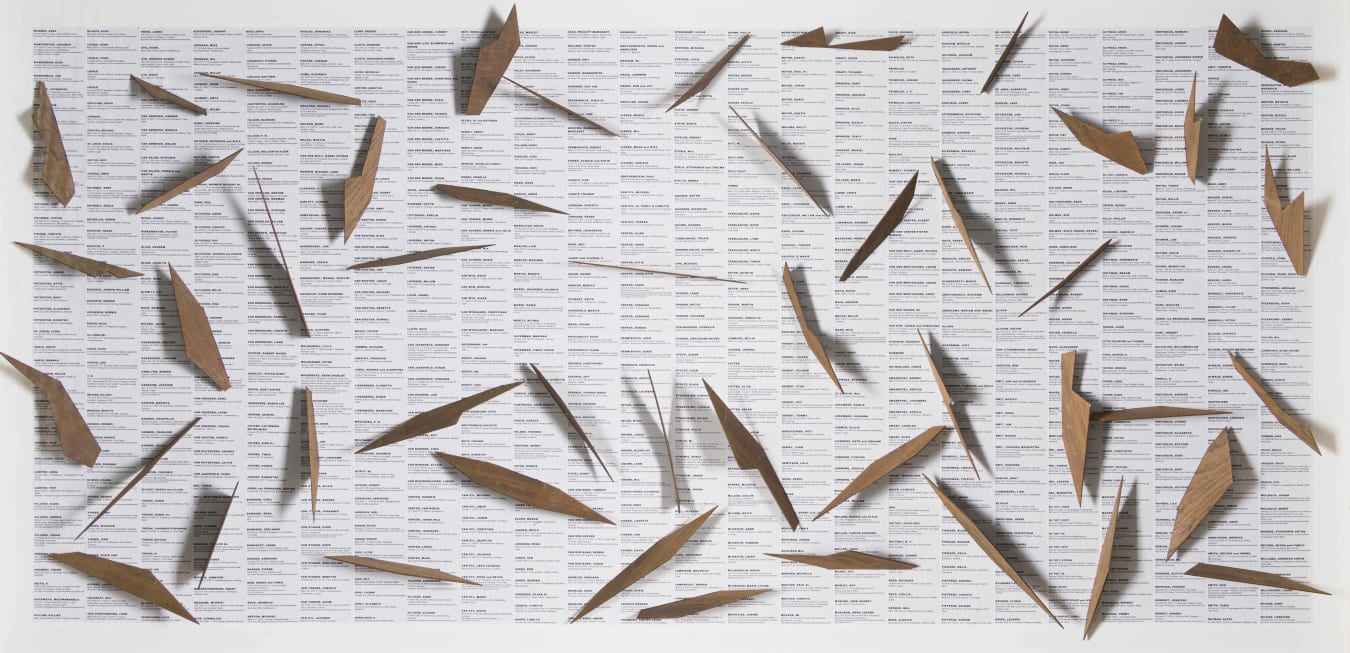
DUBUL’ IBHUNU was exhibited at the 2011 Basel Art Fair as well as at the exhibition SWAT at the Goodman Gallery, Johannesburg. The work looks to recent farm murders in rural South Africa and the subsequent storm of protest and litigation around the public singing of a pre-apartheid struggle song ‘Ayasab' amagwala (The cowards are scared). The song is better known by the phrase Dubul’ iBhunu (‘kill the boer’). This line, when sung publicly by ANC Youth League leadership, has evoked much protest in the light of more than 4 000 murders of white farmers all over the country in recent years. The song was historically sung in protest against the expropriation of land by the white minority regime of apartheid, before South Africa’s first inclusive democratic elections of 1994.
Since the demise of statutory apartheid, many variants of this song have continued to be sung. Some have raised questions about the appropriateness of singing struggle songs post-apartheid. Others claim that these songs are part of ‘Struggle heritage’. The debate recently gained momentum when a South African court interdicted the controversial ANC Youth leader, Julius Malema, from singing Dubul’ iBhunu in public. Both the ANC Youth League and the ANC government defended Malema. The legal battle continues, referring to issues of freedom of speech within South Africa’s post-apartheid liberal democracy as enshrined by the South African constitution endorsed in 1996 by former president Nelson Mandela. Fuel was added to the fire when rock star Bono performed the song during U2’s 2011 South African tour.
Ibhunu is a vernacularisation of the Afrikaans word boer (farmer), but in black South Africa the word is a pejorative slur against white people. The singing of Dubul’ iBhunu is often accompanied by toyi-toying (the toyi-toyi is a taunting kind of protest dance).
DUBUL’ IBHUNU consists of a paper collage with text reflecting the names of approximately 1 000 murdered farmers (out of a total of more than 4,000 committed in South Africa between 2000 to 2011). The names of people murdered have been recorded verbatim from websites located on the internet. Sharp pieces of Imbuia wood cut into the writing, slicing into the names.
For Willem Boshoff, it is an outrage that these deaths are not a priority for the government, which he believes fears that it may lose votes if it is seen to be supporting white victims. DUBUL’ IBHUNU openly defies the taboo against publicly speaking out about crime in South Africa.
- Willem Boshoff
DUBUL’ IBHUNU accessed 30/06/2026.
More from OH YES!