Jack Heath
Cosmic Events
About the SessionSpanning 4 centuries of global art history, The International Sale, presents 127 exceptional lots by artists from 27 countries across five continents. The auction highlights masterworks ranging from 17th century European paintings to post-2000 editions by contemporary artist's such as Mr Brainwash (lot 51), Jim Dine (lots 83-86), Isaac Julien (lot 108), Jeff Koons (45), and Lucas Samaras (lot 107 and 110). The sale is anchored by important pieces from Georg Baselitz, Erik Laubscher, Shirin Neshat, and a newly repatriated 1935 portrait by Irma Stern.
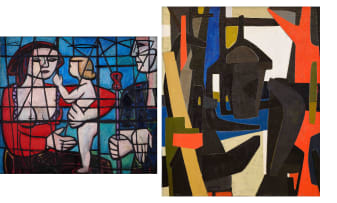
The auction's diversity is driven by rare museum-quality highlights, led by Irma Stern's Two Women (lot 31), which returns to South Africa after decades in a Berlin private collection. It is joined by Erik Laubscher's rare recto-verso painting Young Family / Construction (lot 48), an Iranian-American artist Shirin Neshat photographic portrait linked to her award-winning Turbulent installation (lot 66), and a uniquely hand-coloured linocut by German master Georg Baselitz titled Das Pferd, Im Wald und auf der Heide Series (The Horse, in the Forest and on the Heath Series) (lot 72).
LOT 97
Jack Heath
Cosmic Events
About this Item
signed and dated
Notes
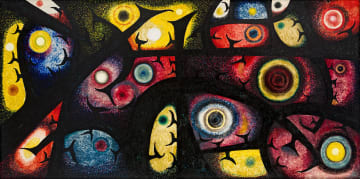
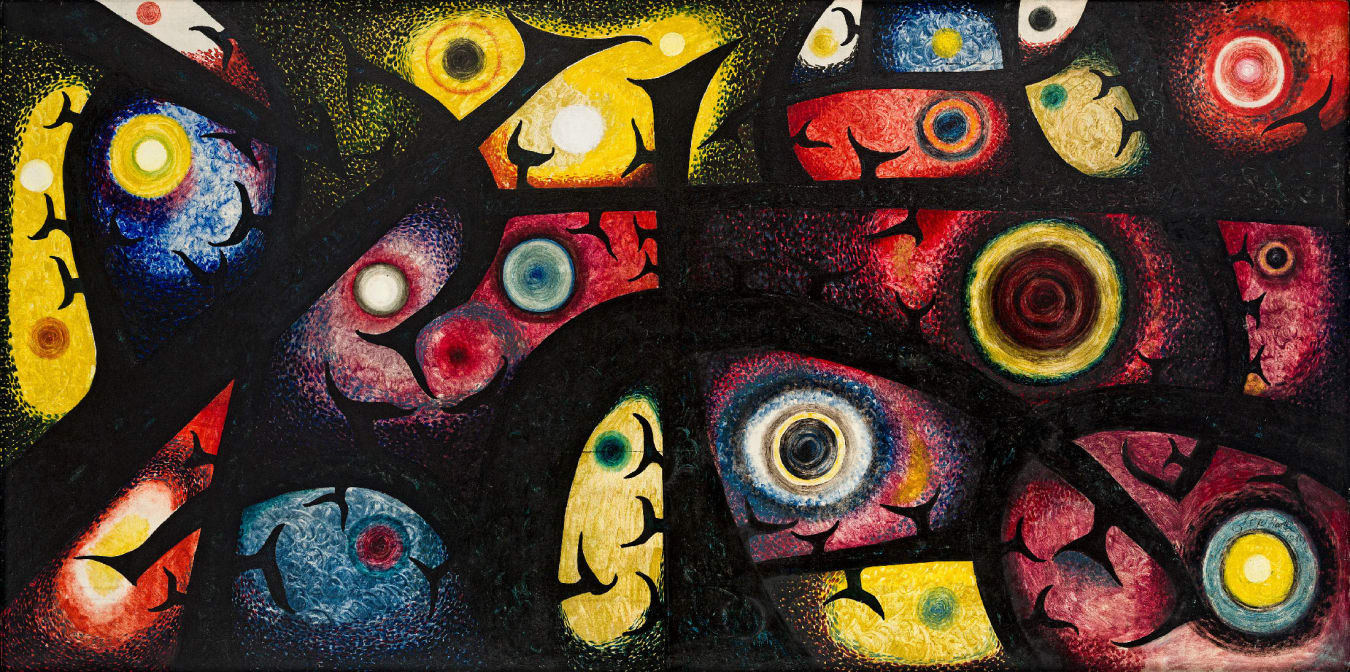
In Heath's work, the influences of "(Graham) Sutherland, (Paul) Nash and other English contemporary artists" meet a "new cultural and geographic terrain" in South Africa.1 Cosmic Events is an exemplary large work from the last decade of the artist's career, during which he turned almost entirely to abstraction, although in the tradition of British modernism, the roots of representation remain. Leeb-du Toit describes these works as "powerful and ominous, their strength located in their sublimity in scale, saturated colour and hermetic content."2
Heath's daughter Jinny, commenting on the present lot, noted that her father's "fascination with thorn forms started shortly after his arrival in South Africa in 1947."3 Images of thorns recur in Heath's work 'until the year of his early death in 1969, when he produced the powerful painting Thornveld Fire.4 In reference to another sketch, Jinny makes reference to the 'multiple possible meanings' of the thorn forms, which might include the Karroo landscape and perhaps even Christ's thorny crown.5
Cosmic Events is an example of an identifiably 'modernist-inspired contemporary South Africa idiom' that deals directly with the same crises of faith and representation that occupied many of the artist's British contemporaries. The painting combines Heath's characteristic visual intensity in its "expressive interpretation of form, diaphanous layering of saturated colour and tone [and] conceptual form and content."7
John Charles Wood Heath, professionally known as Jack Heath, was born in Staffordshire and schooled at the Acock’s Green and Aston Elementary Schools in Birmingham. He won a scholarship to Handsworth Grammar School, where he remained from 1926 until 1932. He matriculated in 1931 with a distinction in History, and in 1932 he was awarded the Higher School Certificate in Literature, History and Art. He won a scholarship to the Birmingham School of Arts and Crafts where he studied art between 1932 and 1936, followed by the Royal College of Art in London from 1936 to 1939. In 1938, he won the British Institute Empire Scholarship in Engraving and in 1939 the Drawing Prize. Heath is known for his paintings, drawings, engravings and murals, and he is generally considered to have been a British Modernist and Abstractionist but was also heavily influenced by Neo-Romanticism.
Heath married Jane Tully Parminter in 1940, and they had two children, Bronwen (Jinny) and Jonathan. He volunteered for service in the army at the outbreak of World War II, saw action in Italy in 1943, was injured on Queen’s Beach in the Normandy Landing in 1944, and was then demobilised in 1946. In mid-1946 the Heaths moved to South Africa, as he was appointed Lecturer in Painting and Drawing at Rhodes University College. In 1947, he was appointed as Head of the School of Art at the Technical College in Port Elizabeth, where he remained until 1952. He was appointed Professor of Fine Art at Natal University College, Pietermaritzburg, in January 1953. Heath died suddenly in June 1969.
Heath exhibited extensively in South Africa, including at the First Quadrennial Exhibition of South African Art in 1956, at Gallery 101 in 1962, and on the Eastern Province Society of Fine Arts Jubilee Exhibition in 1968, amongst others. In 1977, a posthumous exhibition of Heaths’ work was shown at the University of Natal and the Heath Family Retrospective was exhibited at the Tatham Art Gallery in Pietermaritzburg between 2009 and 2010.
Heath’s works are represented in prestigious collections in England, including the Imperial War Museum, the National Maritime Museum, and the National Portrait Gallery, as well as in public and private collections in South Africa, such as the Tatham Art Gallery and Iziko South African National Gallery.
1.Juliette Leeb-du Toit (2009) Jack Heath: Mediating Modernism in KwaZulu-Natal, Pietermaritzburg: Tatham Art Gallery.
2. Ibid.
3. Jinny Heath. (2015) Jinny Heath: An Artist Family, [Online], Available: http://jinnyheath.tumblr.com/
4. Ibid.
5. Ibid.
6. Juliette Leeb-du Toit (2009) Jack Heath: Mediating Modernism in KwaZulu-Natal, Pietermaritzburg: Tatham Art Gallery.
7. Ibid.
More from The International Sale