Kitano Tsunetomi
The Heron Maiden (Sagi Musume)
About the SessionSpanning 4 centuries of global art history, The International Sale, presents 127 exceptional lots by artists from 27 countries across five continents. The auction highlights masterworks ranging from 17th century European paintings to post-2000 editions by contemporary artist's such as Mr Brainwash (lot 51), Jim Dine (lots 83-86), Isaac Julien (lot 108), Jeff Koons (45), and Lucas Samaras (lot 107 and 110). The sale is anchored by important pieces from Georg Baselitz, Erik Laubscher, Shirin Neshat, and a newly repatriated 1935 portrait by Irma Stern.
The auction's diversity is driven by rare museum-quality highlights, led by Irma Stern's Two Women (lot 31), which returns to South Africa after decades in a Berlin private collection. It is joined by Erik Laubscher's rare recto-verso painting Young Family / Construction (lot 48), an Iranian-American artist Shirin Neshat photographic portrait linked to her award-winning Turbulent installation (lot 66), and a uniquely hand-coloured linocut by German master Georg Baselitz titled Das Pferd, Im Wald und auf der Heide Series (The Horse, in the Forest and on the Heath Series) (lot 72).
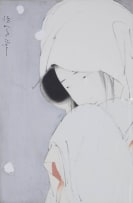
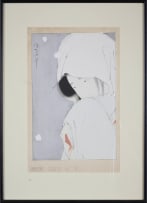
LOT 65
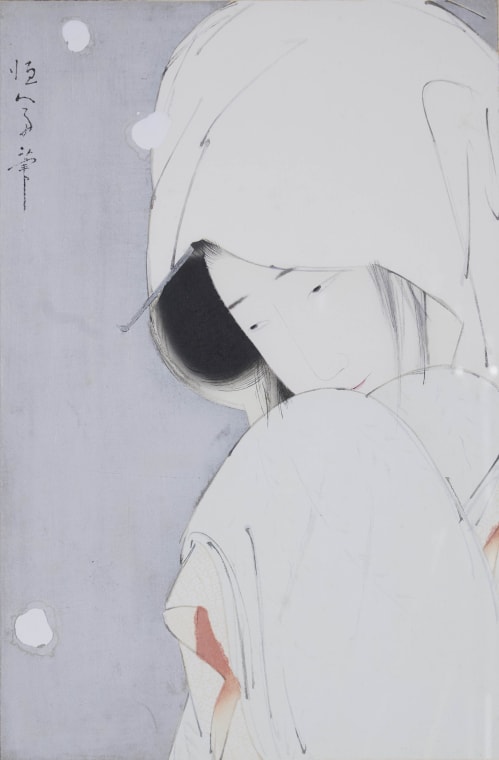
Kitano Tsunetomi
The Heron Maiden (Sagi Musume)
About this Item
signed in the image; stamped with the carver and printer's seal Chokoku Yamana Yoshimitsu, suri Matsuno Kassui (carved by Yamana Yoshimitsu and printed by Matsuno Kassui), numbered Go Dai (unnumbered) and inscribed with the publisher's mark Nezu Seitaro Zohan (copyright of Nezu Seitaro) in the margin
Provenance
The Japanese Print Shop, Liberty London.
Private Collection, and thence by descent.
Notes
Published by Nezu Seitaro.
Kitano Tsunetomi was born 1880 in Kanazawa. He moved to Osaka as a young man where he would establish himself as a leading master of bijin-ga (meaning pictures of beautiful women), a genre of Japanese art that focuses on idealised representations of female beauty which became particularly prominent during the Edo period (1603–1868), and in his own lifetime, earn recognition as the first Nihonga artist from Osaka.
Tsunetomi began his career in 1892 as an apprentice in woodblock printing workshops in Kanazawa. In 1897, he worked for the carver Nakayama Komataro before moving to Osaka in 1898 to study under the painter and print designer Inano Toshitsune. The following year, he began contributing illustrations to the monthly publication Shin-Nihon.
Initially working as a newspaper illustrator, Tsunetomi developed a distinctive style influenced by ukiyo-e and the emerging Nihonga tradition. His elegant and often psychologically charged depictions of women, particularly those associated with Osaka’s entertainment districts, became his hallmark.
He exhibited at the government-sponsored Bunten exhibitions from 1910 and received national recognition in 1911. In 1917, he became a member of the Japan Art Institute. Through his paintings and teaching, Tsunetomi helped establish Osaka as an important centre for modern Japanese painting and remains celebrated as one of the foremost bijin-ga artists of the Taishō and early Shōwa periods.
More from The International Sale