Attributed to Antonio Mancini
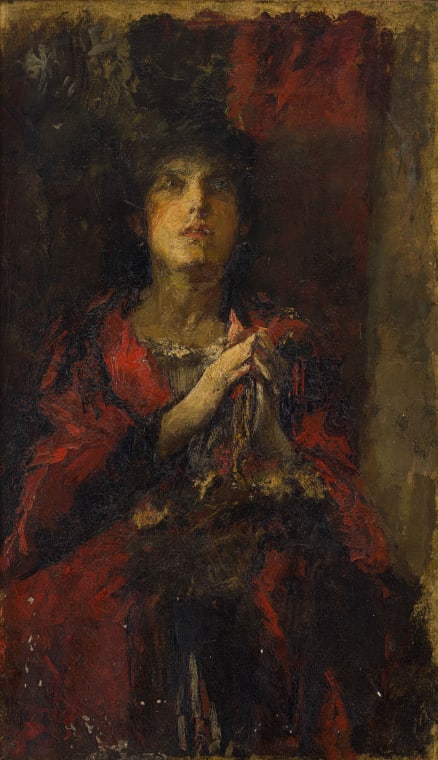
The Prayer
About the SessionSpanning 4 centuries of global art history, The International Sale, presents 127 exceptional lots by artists from 27 countries across five continents. The auction highlights masterworks ranging from 17th century European paintings to post-2000 editions by contemporary artist's such as Mr Brainwash (lot 51), Jim Dine (lots 83-86), Isaac Julien (lot 108), Jeff Koons (45), and Lucas Samaras (lot 107 and 110). The sale is anchored by important pieces from Georg Baselitz, Erik Laubscher, Shirin Neshat, and a newly repatriated 1935 portrait by Irma Stern.
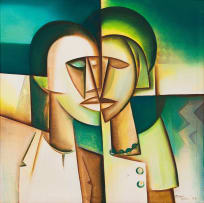
The auction's diversity is driven by rare museum-quality highlights, led by Irma Stern's Two Women (lot 31), which returns to South Africa after decades in a Berlin private collection. It is joined by Erik Laubscher's rare recto-verso painting Young Family / Construction (lot 48), an Iranian-American artist Shirin Neshat photographic portrait linked to her award-winning Turbulent installation (lot 66), and a uniquely hand-coloured linocut by German master Georg Baselitz titled Das Pferd, Im Wald und auf der Heide Series (The Horse, in the Forest and on the Heath Series) (lot 72).
LOT 121
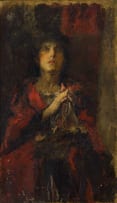
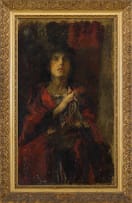
Attributed to Antonio Mancini
The Prayer
Incl. Buyer's Premium & VAT
About this Item
Notes
Born in Rome in 1852 to a tailor and a seamstress, Antonio Mancini showed very early talent in the arts. Mancini was admitted to the Academy of Fine Arts in Naples at only 12 years old, studying under Domenico Morelli, a painter of historical scenes favouring dramatic chiaroscuro and vigorous brushwork, and Filippo Palizzi. He was also close friends with sculptor Vincenzo Gemito, with whom he shared a poor and difficult youth.
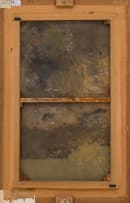
Mancini worked as a foremost figure of Verismo, an indigenous Italian response to 19th century Realist aesthetics. His work commonly depicted children of the poor, juvenile circus performers, and musicians whom he observed in the streets of Naples. Mancini's most distinctive technical trait was the graticola, a system consisting of two identical wooden frames, each strung with strings or wires stretched both vertically and horizontally across their middles to create a grillwork of squares. One of these frames was placed before the artist's canvas, while the second was placed between the artist and the model, providing a screen through which to view the subject. He often allowed these grid marks to appear in the painting. His later works also incorporated impasto elements, working bits of glass, metal foil, and other glittering materials into thick paint to achieve light effects not otherwise obtainable in oil.
Throughout his life, Mancini exhibited in notable institutions such as the Musée d'Orsay, with other works at the Galleria Nazionale d'Arte Moderna e Contemporanea in Rome, the Museo Civico-Galleria d'Arte Moderna in Turin, and the De Mesdag Collection in The Hague.
View all Attributed to Antonio Mancini lots for sale in this auction
More from The International Sale