Athi-Patra Ruga
The Lands of Azania (2014 - 2094)
LOT 180
Athi-Patra Ruga
The Lands of Azania (2014 - 2094)
About this Item
Provenance
WHATIFTHEWORLD, Cape Town.
Private Collection.
Exhibited
WHATIFTHEWORLD, Cape Town, The Future White Woman of Azania Saga (2014-2094), 27 November to 1 January 2014.
Somerset House, London, Of Gods, Rainbows and Omissions, 2018.
Literature
Chad Rossouw (2016) ArtThrob, The Map is Not The Territory, online, accessed 4 August 2026.
Anna Stielau (2015) 'Towards a queer futurity: The utopian impulse in the work of Athi-Patra Ruga and Milumbe Haimbe', Agenda, 29:1, pages 127 to 139, illustrated in colour on page 129.
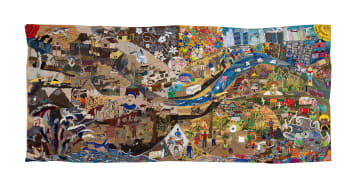
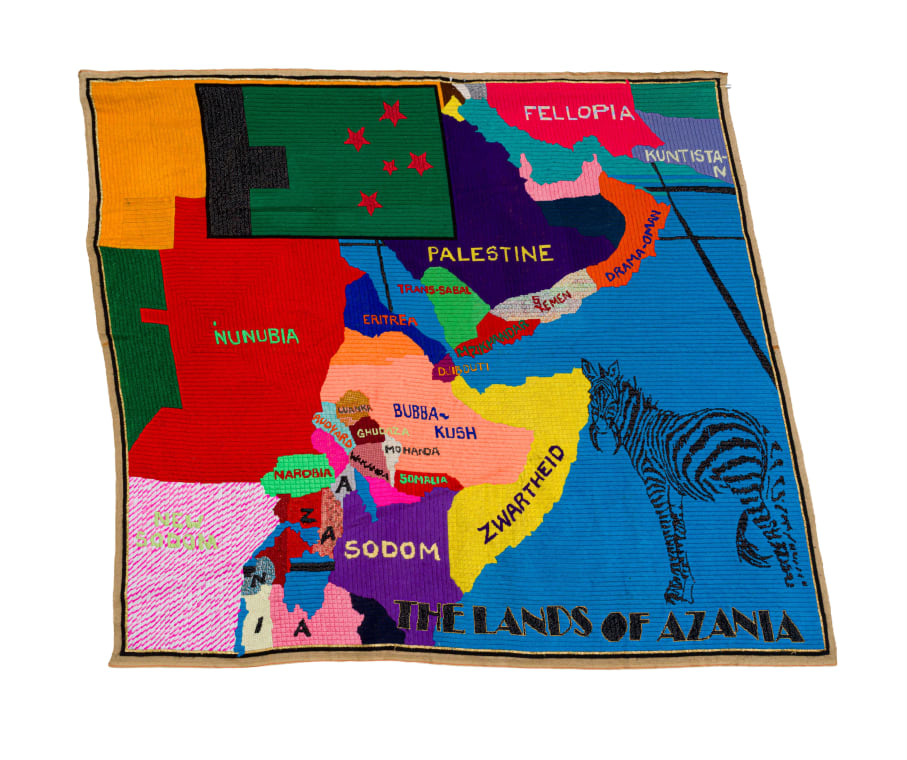
Map making is the first step of nationalism. I decided to create a map of this fantastical world of Azania and added countries around it in response to things that were really happening in the world. I stitched Sodom and New Sodom on there when Uganda was going crazy with homophobic stuff. - Athi-Patra Ruga
Notes
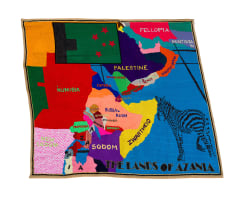
The present lot, The Lands of Azania (2014–2094), forms part of contemporary artist Athi-Patra Ruga's ever expanding mythology of Azania, in which invented characters and territories serve as a vehicle for engaging with the legacies of apartheid.1
Azania is a name of ancient Greco-Roman origin, used historically to designate territories along the eastern coast of Southern Africa. During the apartheid era, the term was adopted by Black Consciousness and Pan-Africanist movements, including the Pan Africanist Congress (PAC) and, later, AZAPO (Azanian People's Organisation), as an alternative to "South Africa," a name these movements associated with colonial and apartheid rule. 2
In this work, the artist's map reworks this idea into an invented cartography populated by territories such as Palestine, Sodom, Kuntistan, Zwartheid and Nunubia, names that draw on pre-colonial, colonial and biblical associations to evoke sin, excess and contemporary political tension. The work recalls the embroidered political maps of Italian artist Alighiero e Boetti, though where Boetti mapped existing geopolitical divisions, Ruga's fictional territories suggest that the politicised meanings attached to place names precede, and perhaps outlast, the nation-state structures those names come to represent.3
1. WHATIFTHEWORLD (2014) WHATIFTHEWORLD, The Future White Women of Azania Saga, online, accessed 12 August 2026.
2. Unknown Author (2018) The Journalist, East African Trade and The Origin of the Name Azania, online, accessed 12 August 2026.
3. WHATIFTHEWORLD (2014) WHATIFTHEWORLD, The Future White Women of Azania Saga, online, accessed 12 August 2026.
More from Evening Sale