Irma Stern
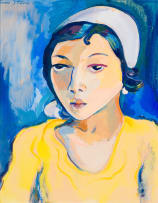
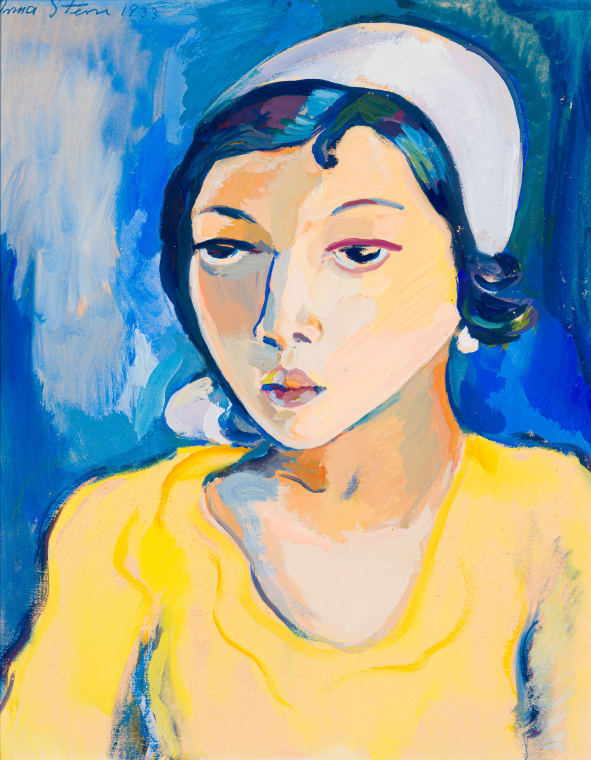
Cape Malay Woman with a Head Scarf
LOT 144
Irma Stern
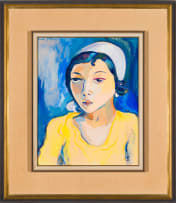
Cape Malay Woman with a Head Scarf
About this Item
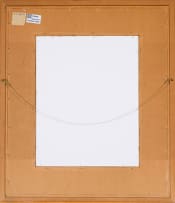
signed and dated 1933; numbered 43, 105 and inscribed 'Dr. M L du Toit' on the reverse of the sheet
Provenance
Acquired from the artist by Dr Martin L du Toit, 1933.
Acquired from Dr Martin L du Toit by the previous owner, circa 1952, thence by descent.
The Property of an Important Collector.
Notes
Offered at market for the very first time, Cape Malay Woman with a Head Scarf is a vibrant gouache that arrives directly from a private family collection where it has remained treasured for seventy-four years.
Irma Stern worked with gouache throughout her career, both in the studio and on her extensive travels. Its immediacy and portability made it ideally suited to recording people and places with remarkable economy, while its opaque, matte surface allowed for a richness of colour distinct from oil paint. This intimate portrait of a young woman set against a variegated blue ground demonstrates Stern’s assured command of the medium, balancing fluid draughtsmanship with passages of saturated colour.
Starting in the late 1920s, Stern became increasingly interested in colour theory, devoting herself to what she described as “studying and building up a new palette”.1 This enquiry occupied her for several years. In June 1935, she delivered a lecture in Pretoria titled “The relativity of colour and form in art”. Yellow, which had appeared only sparingly in her work of the 1920s, assumed growing importance as her palette became richer and more expansive.
The expressive possibilities of yellow had been transformed by an earlier generation of painters, notably Vincent van Gogh (1853-1890) and Paul Gauguin (1848-1903), standard-bearers of autonomous colour with whom Stern felt a profound affinity. In a 1937 letter to her friend Freda Feldman, she wrote: “At present I feel I can do the same as the best here and that is to say the best living and strangely enough Gauguin and mostly van Gogh seem to me very much like a level I have also reached.”2 An early indication of this chromatic confidence appears in Madeira Portrait (1931) (fig 1), also handled by Strauss & Co, where yellow assumes a far more commanding role.
In the present work by contrast, its use is more restrained, anticipating the way Stern would later deploy the colour to energise compositions such as Malay (Black Headdress) (fig 2), 1946. Here, yellow animates the sitter’s blouse and lends warmth to the modelling of her heart-shaped face. It functions neither symbolically nor decoratively, but as a means of investing an anonymous sitter with vitality, warmth and quiet dignity.
The ordinariness of the subject – a working woman depicted in unremarkable dress and a simple white headscarf – is equally significant, signaling a move away from the high romanticism of her depictions of Black and Coloured women in the 1920s towards the dignity of everyday life. The shift did not escape contemporary critics. Edward Roworth, one of Stern’s earliest antagonists in the Cape press, observed in 1934 that she had strayed from “the straight and narrow ‘Expressionist’ path into the more flowery fields of realism”.3 It was, however, a qualified realism, one in which expressive colour – above all yellow – remained an irreducible fact.
A note on the original owner: Dr Martin L du Toit was a prominent academic and an early champion of expressionism in the Transvaal. He founded and edited the literary journal Die Nuwe Brandwag (The New Sentinel, 1929–33, with cover designs by J H Pierneef), and became the inaugural head of the Department of Cultural History and Art at the University of Pretoria. In 1933, Du Toit – previously a colleague of Stern’s former husband, Dr Johannes Prinz, at the University of Cape Town – invited Stern to exhibit at Macfadyen Hall in Pretoria.4 It was her first exhibition in the administrative capital.
One newspaper characterised Stern as South Africa’s “wildest” painter5, but the critical reception was, on the whole, favourable, and the Pretoria Town Council acquired two paintings for its municipal collection. Stern returned to Pretoria in 1935 to exhibit at Glen’s Gallery. These activities preceded her participation in the art exhibition accompanying the Empire Exhibition of 1936, the large-scale festival held to mark Johannesburg’s golden jubilee. Du Toit served as chair and honorary curator of the art exhibition at the Johannesburg Art Gallery. An illustrated catalogue featured Stern’s Orange Pickers on its cover. The exhibition is now widely regarded as the “first significant demonstration of critical recognition” of expressionism and other emergent modernist styles in South African painting.6
1. Irma Stern (1933) The Irma Stern Trust Collection, Irma Stern's™ early biography as written by her: SA Life and the Woman's Forum December 7th 1933, online, accessed 7 August 2026.
2. Mona Berman (2003) Remembering Irma, Cape Town: Double Storey, page 53.
3. Edward Roworth (1934) ‘Notable Works of Art’, Cape Times, 22 December.
4. Jeanne van Eeden (1998) ‘Irma Stern’s First Exhibition in Pretoria, 1933’, South African Journal of Art History, No. 13, page 90.
5. Ibid, page 100.
6. Esmé Berman (1970) Art & Artists of South Africa, Cape Town: A A Balkema, page 67.
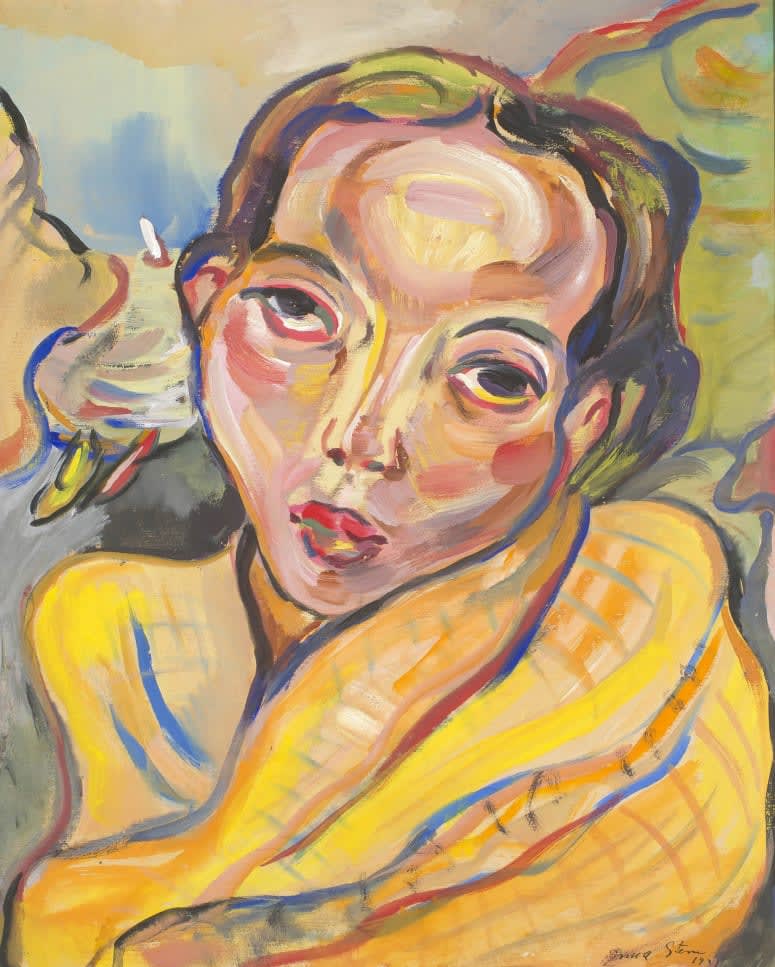
(fig 1) Madeira Portrait (1931) Strauss & Co, Cape Town, 10 August 2021, lot 282, Sold R 432 440.00 (USD 26 742).
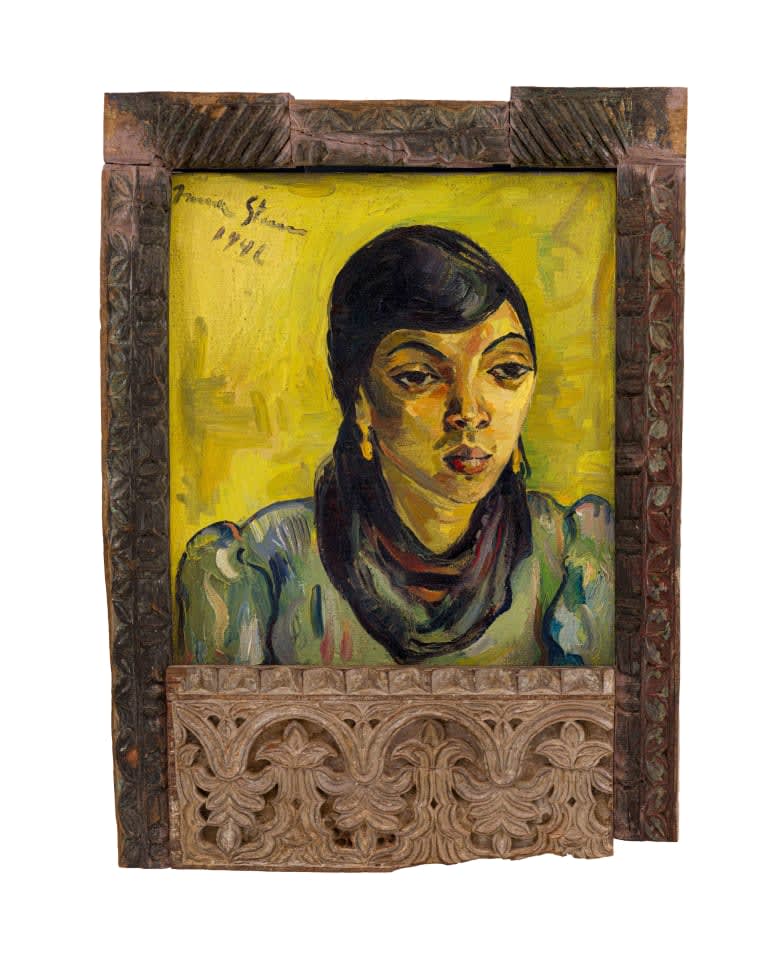
(fig 2) Malay (Black Headdress) (1946) Strauss & Co, Cape Town, 28 October 2025, lot 151, Sold R 21 731 250.00 (USD 1,336,282.81).
More from Evening Sale