William Kentridge
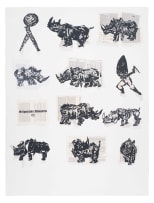
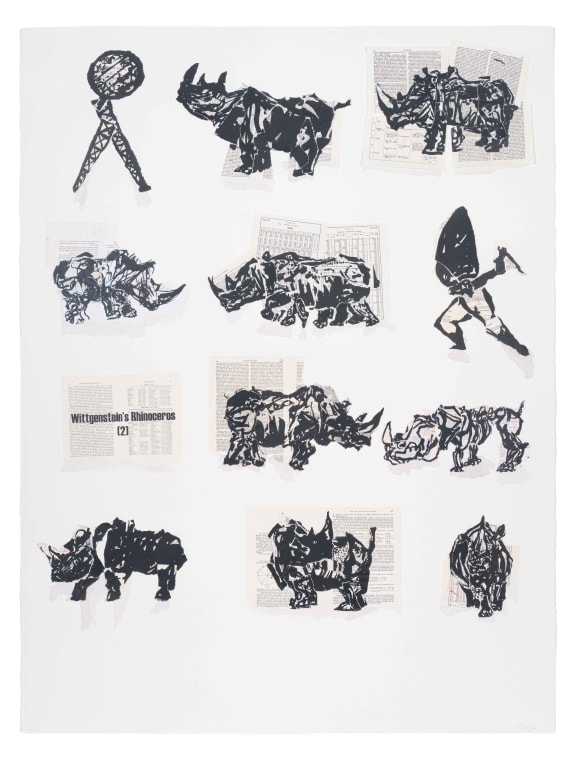
Wittgenstein's Rhinoceros
LOT 115
William Kentridge
Wittgenstein's Rhinoceros
Incl. Buyer's Premium & VAT
About this Item
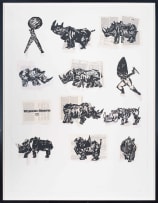
signed, numbered 26/35 in pencil and embossed with the The Artists’ Press and Goodman Gallery chopmarks in the margin; inscribed with the artist's name, the title and medium as 'two colour lithograph and collage on paper' on an Everard Read label adhered to the reverse
Notes
Printed by Mark Atwood at The Artist's Press.
'The rhino was a symbol of power and kingship in Europe for centuries, most remarkably exemplified by Clara, a three-ton Indian rhinoceros brought to Europe in 1741, who toured the continent in a horsedriven carriage for seventeen years, becoming a favourite of Fredrick the Great and Louis XV and a popular motif on Meissen's eighteenth-century porcelain dinner services. Clara was immortalised by Jean-Baptiste Oudray in 1749 in his life-sized oil portrait, and in Roberto Lhongi's Exhibition of a Rhinoceros at Venice, 1751. Both were corrective images of Dürer's fearsome beast, and dispelled the fallacy attributed to Pliny and Gesner among others, which claimed the rhinoceros as a formidable creature that fought with elephants and was descended from the unicorn. Kentridge's prints recall Dürer - and also Burgkmair's fantastical sixteenth-century armoured beasts - but transform him from a regal motif of power into a domesticated creature. This rhino is rather a symbol of a romantic, exploitative colonialist view of Africa (developed previously in an earlier animation film, Mine (1991), in which Soho Eckstein, the mine owner, digs up a whole social and ecological history out of the earth and receives a miniature rhino from the miners as he drinks his first cup of coffee).'1
1. Kate McCrickard (2007) I am the Bird Catcher, in Bronwyn Law-Viljoen (ed), William Kentridge: Flute, Johannesburg: David Krut, page 150.
Literature
Bronwyn Law-Viljoen (ed) (2007) William Kentridge: Flute, Johannesburg: David Krut Publishing, another example from the edition illustrated in colour on page 153 with the title Rhinos.
Exhibited
Goodman Gallery, Johannesburg, What Will Come, 10 November to 14 December 2007, another example from the edition exhibited.
Marian Goodman Gallery, New York, William Kentridge, 16 January to 16 February 2008, another example from the edition exhibited.
More from Evening Sale