Robert Hodgins
Oh, Oh, Oh She Cried in a Cracked Voice, diptych
LOT 56
Robert Hodgins
Oh, Oh, Oh She Cried in a Cracked Voice, diptych
About this Item
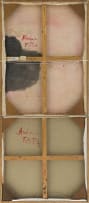
signed, dated 83/84 twice and inscribed cat. c 10 on the reverse
Provenance
Estate Late Dr Rayda Becker.
Literature
Brenda Atkinson (2002) Robert Hodgins, Cape Town: Tafelberg, illustrated in colour on page 90.
Notes
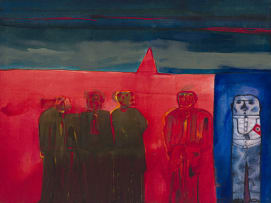
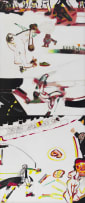
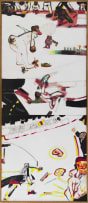
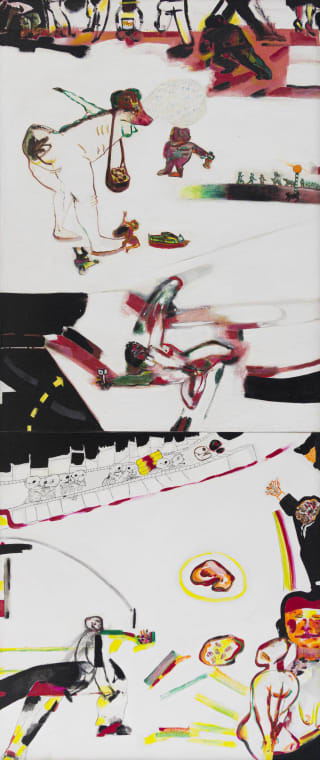
Oh, Oh, Oh She Cried in a Cracked Voice is a seminal diptych from a pivotal era in Robert Hodgins’s career, exposing a South Africa in the grip of crisis. Painted between 1983 and 1984, this highly acclaimed work serves as a billboard-like medium for protest, resistance, and activism. Through an allegorical lens, Hodgins critiques the inhumane system of apartheid, much as William Kentridge’s early works referenced the Weimar Republic to reflect on a post-war world.
During the 1980s Hodgins frequently drew parallels between the humanistic atrocities of apartheid and the political commentary found in the works of Francisco Goya. His visual language in this period is also deeply rooted in the imagery of Francis Bacon and William Blake.
The work is populated by figures defined by disfigurement, distortion and the grotesque, reflecting a state of visceral panic and chaos. Hodgins employs a dramatic palette of reds, yellows, and whites – colours characteristic of his output during this turbulent decade.
Much like his 1986 work, A Beast Slouches, held at the Wits Art Museum. Like the 1986 seminal painting the present lot captures an "apocalyptic state of the nation". As noted by Dr Rayda Becker, while Hodgins's earlier works were often silent and contemplative, his later paintings "scream at you".
The title of the work evokes the dramatic and haunted voices found in the poetry of W.B. Yeats. Although the phrase "oh oh oh she cried in a cracked voice" is not a direct quotation from Yeats, it strongly echoes his use of theatricalised voices to represent tormented souls and intense, tragic emotions. This connection highlights Hodgins's identity as a "European in Africa," whose work is inextricably influenced by both European history and the specific South African landscape.
Provenance for this lot is particularly notable, coming from the estate of the late Dr Rayda Becker. Becker was a contributing writer to the 2002 monograph on Hodgins, in which this specific diptych was featured. The work remains profoundly relevant today as a reflection of the "pathos of man" and a haunting icon of social distortion.
1. Rayda Becker (2002) Made in Africa? In Brenda Atkinson (2002) ‘Robert Hodgins’, Cape Town: Tafelberg, page 32.
Thanks to Phillipa Duncan for contributing to the exhibition history on this lot.
Exhibited
Grahamstown Arts Festival and South African National Gallery, Robert Hodgins: Images 1953-1986, Touring Exhibition, 1986.
More from Evening Sale