Gerard Sekoto
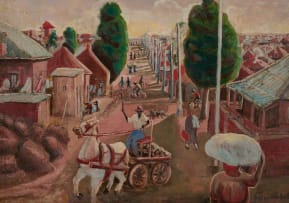
Horse and Cart, Sophiatown
LOT 23
Gerard Sekoto
Horse and Cart, Sophiatown
Incl. Buyer's Premium & VAT
About this Item
signed
Notes
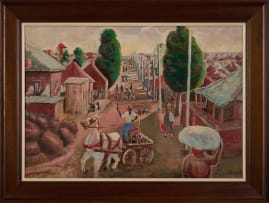
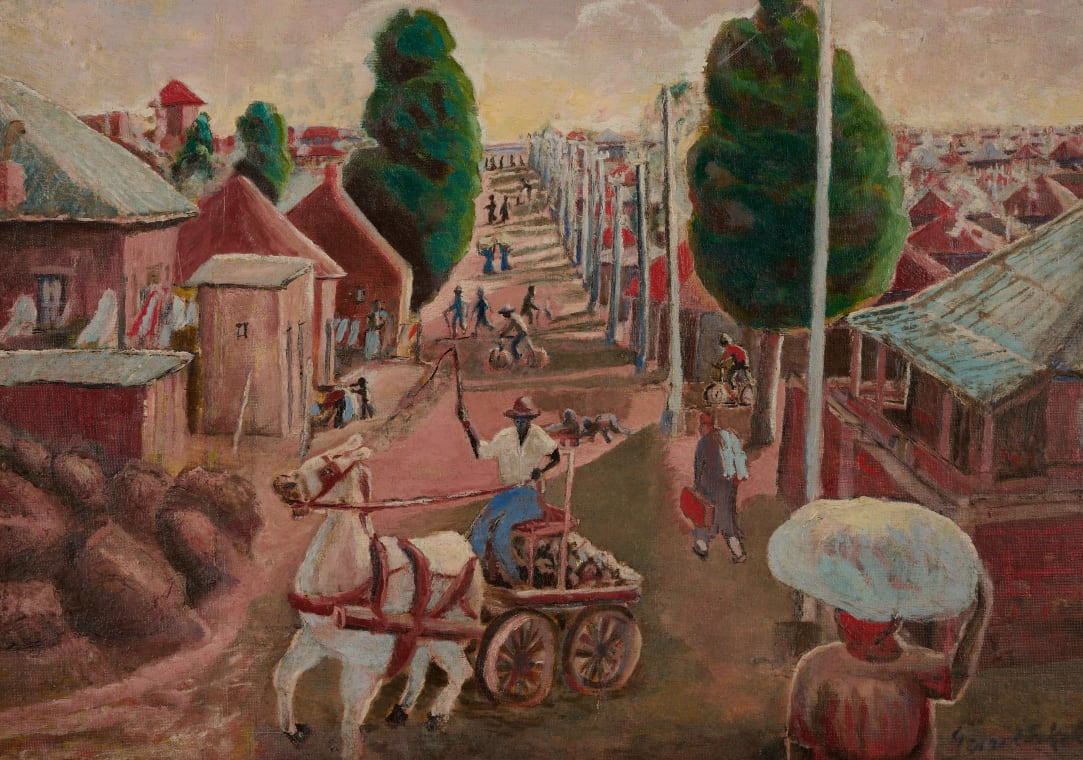
Horse and Cart, Sophiatown, with spatial depth and clear sense of linear perspective, has reference to the commonplace black urban life, which was subtly marked by economic inequalities.
This is one of the first paintings produced by Sekoto after six weeks’ training by Judith Gluckman who introduced him to oil painting techniques in 1939. He had learnt to create three dimensional illusion on a two dimensional surface – one of the basic pillars of realistic drawing and painting – and the road in Horse and Cart, Sophiatown facilitates the recession of the viewer’s eye into the background. The hive of activity in this urban environment marks the artist’s focus on the human element in his work, simultaneously referring to subtle separation of labour along gender lines This work is a visual reference to a specific place, not just a space of human existence and activity; the road depicted in the painting is in fact identifiable today. Horse and Cart, Sophiatown is the artist’s reflection of his personal experience of the place, which may suggest his identification with the daily realities of the people of Sophiatown. The foreground, with a figure of a woman carrying a burden on her head and a man on a horse-drawn cart, introduces the viewer to the township scene. The painting itself serves as a microcosmic reflection of the inevitable consequences of the metropole-colonial relationship stemming from various aspects of human inequality. What is noticeable in Sekoto’s compositions that feature his South African experiences is the prevalence of black people.
- Mzuzile Mduduzi Xakaza, 2013
Exhibited
The Johannesburg Art Gallery, Johannesburg, Gerard Sekoto: Unsevered Ties, 1 November 1989 to 10 February 1990, cat no. 11.
Wits Art Museum, Johannesburg, Song for Sekoto: Gerard Sekoto 1913-2013, 25 April to 2 June 2013.
Strauss & Co, Johannesburg, Working Life in South Africa: Gerard Sekoto and Lena Hugo, 1 April to 4 June 2025.
Literature
Lesley Spiro (1989) Gerard Sekoto: Unsevered Ties, exhibition catalogue, Johannesburg: The Johannesburg Art Gallery, illustrated in colour on page 23.
Barbara Lindop (1988) Gerard Sekoto, Johannesburg: Dictum, illustrated in colour on page 56.
Ivan Vladislavic, Barbara Lindop & Michelle Jerskey (1995) Gerard Sekoto: My Life and Work, Johannesburg: Viva books, illustrated in colour on page 44.
Barbara Lindop and Chloë Reid (eds) (2013) Song for Sekoto: Gerard Sekoto 1913-2013, Johannesburg: The Gerard Sekoto Foundation, illustrated in colour on page 86.
Strauss & Co (2025) Working Life in South Africa: Gerard Sekoto and Lena Hugo, exhibition catalogue, Johannesburg: Strauss & Co, illustrated in colour on page 14.
More from Evening Sale