Greg Marinovich
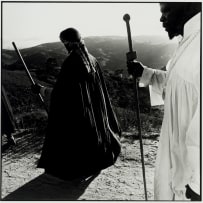
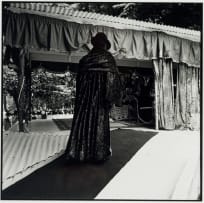
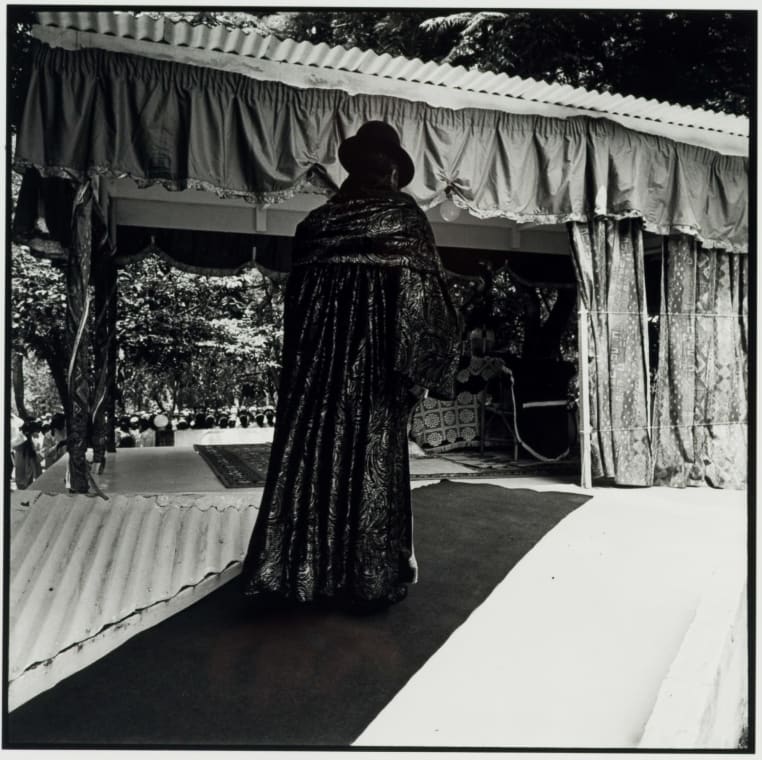
Ubaba, Leader and Descendants of the Founder of the Nazareth Baptist Church – Shembe – at the Headquarters in KwaMashu, KZN
About the SessionFraming a Nation: The Garth Walker Photography Collection and Other Properties presents a selection of photographs from the personal archive of acclaimed graphic designer and photographer Garth Walker. Born in Pretoria, he trained at Technikon Natal in the 1970s, where he met artist Stephen Inggs, a life-long friend. Walker emerged as a pivotal figure in South African graphic design and visual culture in the 1990s through his design firm Orange Juice Design. In 1995 he launched the influential print magazine i-jusi as a platform to showcase new graphic design, typography and illustration. Later issues were sometimes exclusively devoted to photography.
Prominent artists featured in i-jusi included Roger Ballen, Conrad Botes, David Goldblatt and Anton Kannemeyer. It has been exhibited in over 25 countries and is held in the collections of the Museum of Modern Art, New York, Victoria and Albert Museum, London, and Bibliotèque Nationale d'France, Paris. Beyond the magazine, Walker is best known for the unique, custom typeface he produced for the Constitutional Court of South Africa in 2004. Inspired by street typography and prison graffiti, his typography is featured on the court’s building façade.
A longstanding collector, notably of Zulu headrests and nineteenth-century KwaZulu-Natal photography, Walker began acquiring contemporary South African photography in the early 2000s. His choices were instinctual and guided by his interest in vernacular design and the country’s rich documentary photography tradition. He acquired early works by Pieter Hugo, Zanele Muholi and Guy Tillim, before their international rise to prominence. His collection includes personal documentary work by the award-winning photojournalists Jodi Bieber and Greg Marinovich, as well as an important photo from 1965 by David Goldblatt taken at Hartebeespoort Dam north of Johannesburg. The influence of American documentary registers in his holdings of Stephen Shore and Rosalind Fox Solomon.
A highlight of this auction is the inclusion of i-jusi Portfolios #1, #2 and #3, produced to sustain the magazine’s independent publication and featuring seminal works by South African artists. Portfolio #3, with a photographic focus curated by Pieter Hugo, underscores the collaborative impulse shaping this material. The collection offers a rare opportunity to acquire works from a defining moment in the evolution of post-apartheid visual culture.
LOT 44
Greg Marinovich
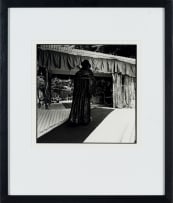
Ubaba, Leader and Descendants of the Founder of the Nazareth Baptist Church – Shembe – at the Headquarters in KwaMashu, KZN
About this Item
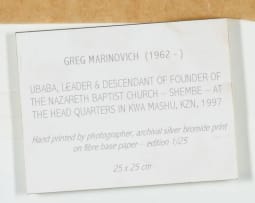
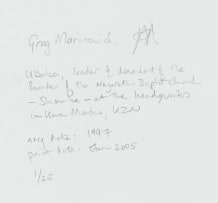
signed, dated 1998 (negative) and Jan 2005 (print), numbered 1/25 and inscribed with the title in pencil on the reverse of the print; inscribed with the artist's name, the title and the medium on a label adhered to the reverse of the frame
Notes
Printed by Greg Marinovich.
“Isaiah Mloyiswa Mdliwamafa Shembe was born in the Drakensberg area of Natal in 1865. His father was a tenant farmer and initially Shembe followed in his footsteps, but later he was baptised as an evangelist and a preacher. Shembe claimed that God's Word told him to go to Natal and free his people of the yoke of the white man. He resisted until a lightning strike to his leg prompted his obedience. Blending Zulu traditions and culture with elements of the Old and New Testaments, under his charismatic leadership the Nazareth Baptist Church, known more commonly as AmaNazaretha or simply Shembe, saw a rapid growth. It is said that Shembe had a trusted messenger enter an area a day or two prior to his own arrival and herald the coming of a great prophet of God; he seldom disappointed. By 1911, Shembe had established a sacred site at eKuphakameni (Place of Spiritual Upliftment) which has become the church headquarters.
One of the ceremonies Shembe initiated was a three day pilgrimage to the Holy Mountain, Nhlangakazi, in the KwaZulu-Natal hinterland. The barefoot walk is the highlight of the Nazaretha religious calendar.
This massive and growing church, said to have some five million followers, is staunchly traditionalist and closely tied to Zulu society and culture. In the verdant rolling valleys outside the sanctity of the whitewashed stones that demarcate Shembe sacred ground, modern-day warriors, who were church members, fought and died in ferocious clashes in the internecine Zulu war of the 1980s and 1990s, yet both IFP and ANC leaders would attend the same church service.” —Greg Marinovich
More from Framing a New Nation