Guy Tillim
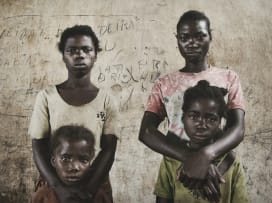
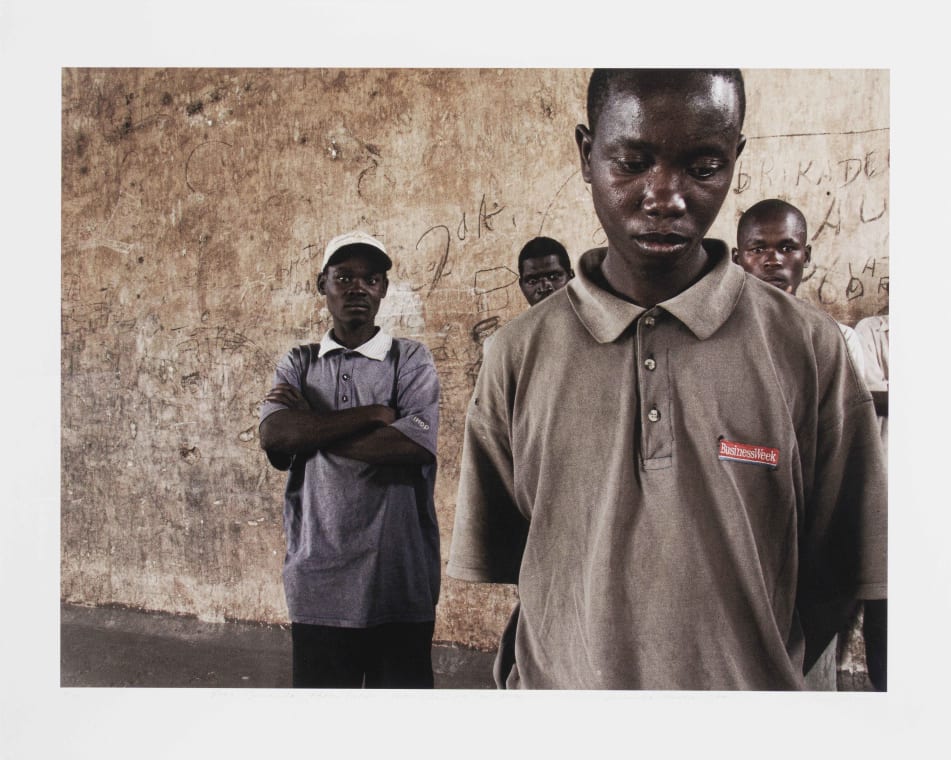
Arao Shingawule, Adrian Pacasi, Pedro Gitali and Jose Arao, Kunhinga, Angola, 2002
About the SessionFraming a Nation: The Garth Walker Photography Collection and Other Properties presents a selection of photographs from the personal archive of acclaimed graphic designer and photographer Garth Walker. Born in Pretoria, he trained at Technikon Natal in the 1970s, where he met artist Stephen Inggs, a life-long friend. Walker emerged as a pivotal figure in South African graphic design and visual culture in the 1990s through his design firm Orange Juice Design. In 1995 he launched the influential print magazine i-jusi as a platform to showcase new graphic design, typography and illustration. Later issues were sometimes exclusively devoted to photography.
Prominent artists featured in i-jusi included Roger Ballen, Conrad Botes, David Goldblatt and Anton Kannemeyer. It has been exhibited in over 25 countries and is held in the collections of the Museum of Modern Art, New York, Victoria and Albert Museum, London, and Bibliotèque Nationale d'France, Paris. Beyond the magazine, Walker is best known for the unique, custom typeface he produced for the Constitutional Court of South Africa in 2004. Inspired by street typography and prison graffiti, his typography is featured on the court’s building façade.
A longstanding collector, notably of Zulu headrests and nineteenth-century KwaZulu-Natal photography, Walker began acquiring contemporary South African photography in the early 2000s. His choices were instinctual and guided by his interest in vernacular design and the country’s rich documentary photography tradition. He acquired early works by Pieter Hugo, Zanele Muholi and Guy Tillim, before their international rise to prominence. His collection includes personal documentary work by the award-winning photojournalists Jodi Bieber and Greg Marinovich, as well as an important photo from 1965 by David Goldblatt taken at Hartebeespoort Dam north of Johannesburg. The influence of American documentary registers in his holdings of Stephen Shore and Rosalind Fox Solomon.
A highlight of this auction is the inclusion of i-jusi Portfolios #1, #2 and #3, produced to sustain the magazine’s independent publication and featuring seminal works by South African artists. Portfolio #3, with a photographic focus curated by Pieter Hugo, underscores the collaborative impulse shaping this material. The collection offers a rare opportunity to acquire works from a defining moment in the evolution of post-apartheid visual culture.
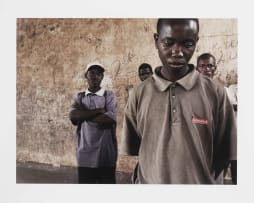
LOT 29
Guy Tillim
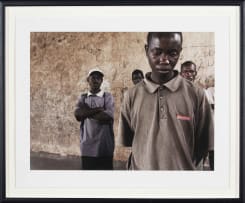
Arao Shingawule, Adrian Pacasi, Pedro Gitali and Jose Arao, Kunhinga, Angola, 2002
About this Item
signed, numbered 4/12 and inscribed with the title in pencil in the margin
Exhibited
Michael Stevenson, Cape Town, Guy Tillim: Kunhinga portraits, 18 June to 19 July 2003.
Notes
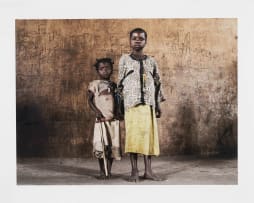
The present lot, as well as lot 10 and 30 form part of Guy Tillim’s Kunhinga Portraits series. Taken in February 2002 near the city of Kuito in central Angola, the series documents refugees who, in the months preceding the end of the Angolan Civil War (1975–2002), walked for five days from Monge in the north-eastern province of Lunda Norte to seek refuge in the small town of Kunhinga, where foreign aid agencies were stationed. The refugees came from a region that had provided cover for rebel UNITA forces and were consequently subjected to government retaliation from the Angolan national army.1
This series marked a notable departure in Tillim’s career, as he shifted to working in colour after being previously known for his black-and-white reportage, particularly in conflict zones. His approach to portraiture is characterised by a direct, frontal engagement with the subjects’ gaze and presence, emphasising their individuality, resilience, and dignity rather than reducing them to statistics or anonymous victims.
1. DaimlerChrysler South Africa (ed) (2004) Guy Tillim, Pretoria: DaimlerChrysler Award for South African Photography, unpaginated.
More from Framing a New Nation