Zanele Muholi
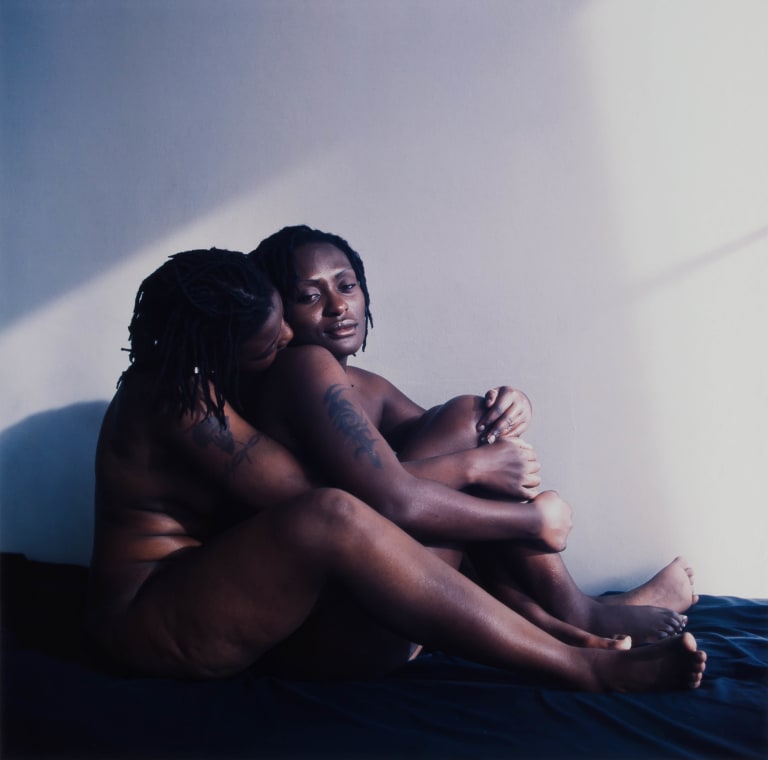
Musa Ngubane and Mabongi Ndlovu, Hillbrow, Johannesburg 2007, Being Series
About the SessionFraming a Nation: The Garth Walker Photography Collection and Other Properties presents a selection of photographs from the personal archive of acclaimed graphic designer and photographer Garth Walker. Born in Pretoria, he trained at Technikon Natal in the 1970s, where he met artist Stephen Inggs, a life-long friend. Walker emerged as a pivotal figure in South African graphic design and visual culture in the 1990s through his design firm Orange Juice Design. In 1995 he launched the influential print magazine i-jusi as a platform to showcase new graphic design, typography and illustration. Later issues were sometimes exclusively devoted to photography.
Prominent artists featured in i-jusi included Roger Ballen, Conrad Botes, David Goldblatt and Anton Kannemeyer. It has been exhibited in over 25 countries and is held in the collections of the Museum of Modern Art, New York, Victoria and Albert Museum, London, and Bibliotèque Nationale d'France, Paris. Beyond the magazine, Walker is best known for the unique, custom typeface he produced for the Constitutional Court of South Africa in 2004. Inspired by street typography and prison graffiti, his typography is featured on the court’s building façade.
A longstanding collector, notably of Zulu headrests and nineteenth-century KwaZulu-Natal photography, Walker began acquiring contemporary South African photography in the early 2000s. His choices were instinctual and guided by his interest in vernacular design and the country’s rich documentary photography tradition. He acquired early works by Pieter Hugo, Zanele Muholi and Guy Tillim, before their international rise to prominence. His collection includes personal documentary work by the award-winning photojournalists Jodi Bieber and Greg Marinovich, as well as an important photo from 1965 by David Goldblatt taken at Hartebeespoort Dam north of Johannesburg. The influence of American documentary registers in his holdings of Stephen Shore and Rosalind Fox Solomon.
A highlight of this auction is the inclusion of i-jusi Portfolios #1, #2 and #3, produced to sustain the magazine’s independent publication and featuring seminal works by South African artists. Portfolio #3, with a photographic focus curated by Pieter Hugo, underscores the collaborative impulse shaping this material. The collection offers a rare opportunity to acquire works from a defining moment in the evolution of post-apartheid visual culture.
LOT 21
Zanele Muholi
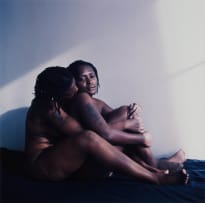
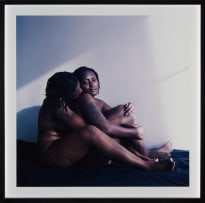
Musa Ngubane and Mabongi Ndlovu, Hillbrow, Johannesburg 2007, Being Series
About this Item
from an edition of 8 + 2AP
Exhibited
Stevenson, Johannesburg, Being, 4 June to 7 July 2007, another example from the edition exhibited.
Provenance
The Gary Eisenberg Collection.
Notes
"Being is an exploration of both our existence and our resistance as lesbians/women loving women, as black women living our intersecting identities in a country that claims equality for all within the LGBTI community, and beyond."1
Zanele Muholi gained prominence in the mid-2000s with photographs that documented and affirmed the lives of Black lesbians in South Africa. As a member of the Forum for the Empowerment of Women, a support organisation for Black lesbians, Muholi highlighted the injustices faced by this community. Their growing body of work rejected photographic clichés and binaries often associated with Black women, instead focusing on intimate and loving representations of their community. Starting in 2003, Muholi made portraits of lesbian couples in Gauteng. Often made indoors and on beds, the improvised quality of these early portraits yielded to a more formal approach in which subjects posed outdoors. This portrait blurs these finer distinctions, and in turn reflects Muholi's dynamic approach to collaboration, as well as ethics. "I have never approached a stranger to come and be part of my photography," Muholi, then a Hillbrow resident, explained.2
1. Stevenson (no date) Zanele Muholi Being, online, https://archive.stevenson.info/exhibitions/muholi/being.htm, accessed 1 April 2026.
2. Sean O'Toole (2006) 'Zanele Muholi: Are You Feeling A Little Uncomfortable?' Business Day Art, March, page 12.
More from Framing a New Nation