Karel Nel
The Worlds Between
LOT 15
Karel Nel
The Worlds Between
About this Item
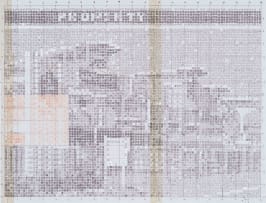
accompanied by an illustration of Signs in the World from University of Witwatersrand, Johannesburg, Exhibition of Recent Drawings
Notes
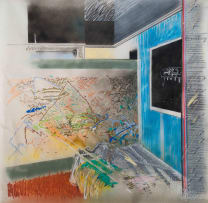
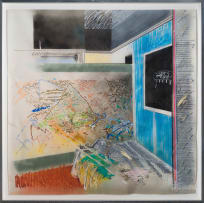
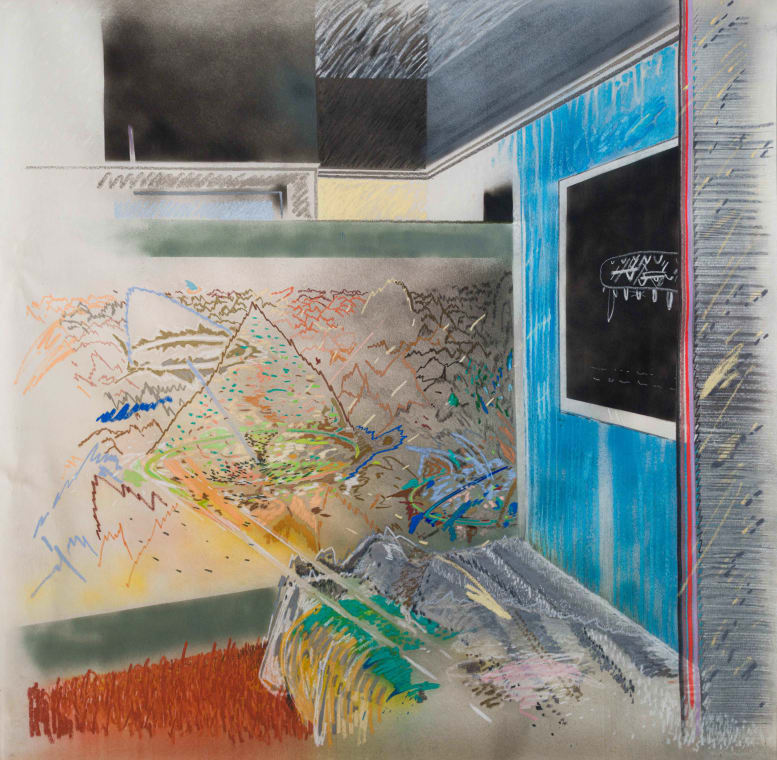
An important figure in South African contemporary art, Karel Nel is best known for large-scale drawings that reference as well as synthesise his interest in art history, religions, material cultures and science. This work, widely known as The Worlds Between but also titled Place of Phosphorescence, dates from a period of intense creative labour. In 1984 Nel was awarded a public commission to produce a monumental drawing for the Sand du Plessis Theatre in Bloemfontein. The scale of his work Inner Dance required that Nel relocate to a temporary studio on Wits University’s west campus, where he worked in isolation at night after his teaching duties.
This drawing forms part of a suite of drawings made immediately after the completion of the physically and emotionally demanding commission. Nel returned to his family home in Rivonia, north of Johannesburg, occupying a narrow outside room that functioned as both studio and bedroom.1 A five-metre drawing board was leaned against cupboards and bookshelves, extending from the entrance into the bathroom. As before, Nel worked at night, his seclusion and devotion to his artistic work palpable in the description of a single bed surrounded by works in progress.
The drawing is executed in pastel and sprayed pigment bonded onto fibre fabric. Critic Michael Smith observed that this fabric is sympatico with pastel, “ensuring an immediacy of mark and an intensity of colour”2 that demands discipline, as marks cannot be erased. The Worlds Between formed part of Nel’s Quiet Lives series, exhibited at the Gertrude Posel Gallery in 1986. His large-scale drawings were formally occupied with the still life, but included a number of drawings that quoted the jagged tapering forms appearing in earlier works like Inner Dance and The Phaedriades (1983-84). In 1982-83, Nel visited Delphi, observing a conical stone considered the navel of Gaia, the world. It shortly entered his visual language. The large scale of Nel’s drawing is purposeful. As Elizabeth Burroughs notes, it creates a sense of “intimate observation”, transforming the still life into a charged site of numinous encounter.
1.Elizabeth Burroughs (2025) Karel Nel: Close and Far, Singapore: Palimpsest, page 17.
2. Michael Smith, Artthrob, Karel Nel, online, accessed 23 January 2026.
Literature
Michael Stevenson (ed) (2001) Works From A Private Collection of Contemporary South African Art on Permanent Loan to The Chancellor Oppenheimer Library, University of Cape Town, Cape Town: University of Cape Town, illustrated in black and white, unpaginated, cat. no. 31.
Elizabeth Burroughs (2025) Karel Nel: Close and Far, Singapore: Palimpsest, illustrated on page 17 with the title 'Place of Phosphorescence'.
Tessa Dreyer (1996) Die Stillewemotief in die Suid-Afrikaanse Grafiese Kuns, unpublished, Master of Arts dissertation, University of Pretoria, illustrated on page 62 with the title 'The Worlds Between' and dated 1984-86.
Inge-Lore Hyson (2009) Representation as Cultural Construct in Two Johannesburg Gardens and Selected Artworks, unpublished, Master of Arts dissertation, University of Johannesburg, illustrated on page 73 with the title The Worlds Between and dated 1984-86.
Provenance
Die Kunskamer, Cape Town.
Property of a Gentleman.
More from Portway to Cohen: A Collector’s Legacy and Other Properties