Breyten Breytenbach
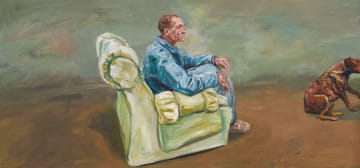
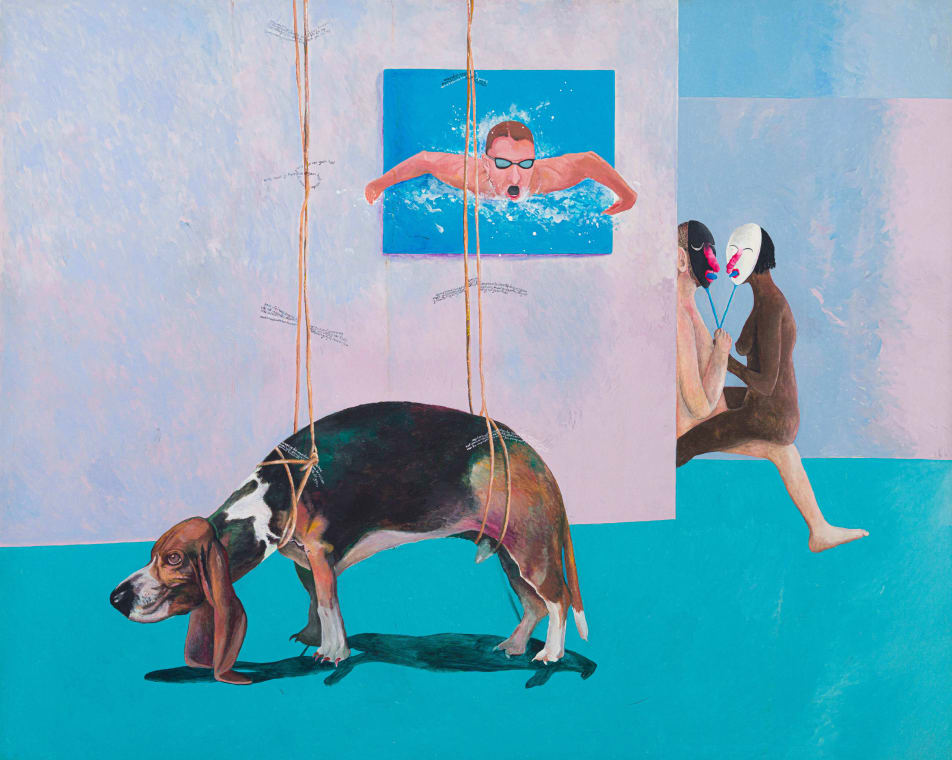
Hovering Dog
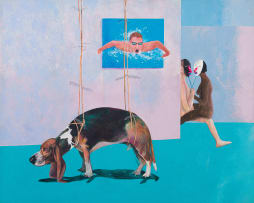
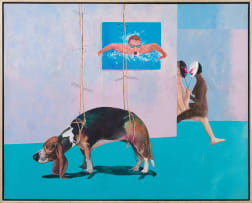
LOT 16
Breyten Breytenbach
Hovering Dog
Incl. Buyer's Premium & VAT
About this Item
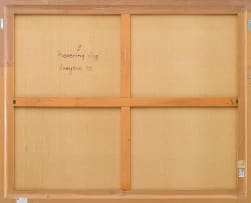
signed, dated 85, inscribed with the title and numbered 7 on the reverse
Provenance
Association for Visual Arts Gallery, Cape Town, 22 January 1994.
Property of a Gentleman.
Notes
Best known in South Africa as a poet and dissident public intellectual, Breyten Breytenbach was equally committed to painting, a practice that formed the basis of his formal artistic training and sustained a parallel international career. He studied at the Michaelis School of Art in Cape Town, where the sculptor Lippy Lipschitz was a formative mentor, and moved within a close-knit circle that included writers Jan Rabie and artists Marjorie Wallace and Peter Clarke. In the early 1960s Breytenbach travelled through Europe, eventually settling in Paris in 1962, where he committed himself primarily to painting.
His first solo exhibition was held in 1964 at Galerie Espace in Amsterdam, which at the time also showed work by Karel Appel and Francesco Clemente. That same year he published his debut poetry collection Die ysterkoei moet sweet and the prose volume Katastrofes, both of which received the APB Prize in 1966. While his literary reputation in South Africa grew rapidly, knowledge of his visual work remained limited for decades, largely confined to drawings reproduced in banned publications such as Skryt: Om ’n sinkende skip blou te verf (1972) and to the use of his paintings as book covers.
Breytenbach’s South African exhibition Painting the Eye (1993) marked a fuller introduction to his work as a painter. Stylistically, his paintings are redolent of Marc Chagall’s mysticism, Picasso’s melancholic Rose period (1904-06) and the associative logic of Surrealism and metaphysical painting. Like Gregoire Boonzaier, he frequently portrayed himself, though in more enigmatic pose and settings, often incorporating windows and animals, most commonly birds, but also dogs, fish and insects. Eroticism is a recurring interest, but operates within a broader continuum that also encompasses Zen Buddhism, a frequent point of reference in his work.
Although often described as having two vocations, Breytenbach insisted on their interdependence. As he wrote in 1991, “writing is a continuation of painting just as painting is a prolongation of writing … These two disciplines of being share the same means.”1 His paintings are held in major public collections in Belgium, France and the Netherlands and a large mural commissioned by the Poetry International Foundation remains installed on Gaffel Street in Rotterdam. In 1995 he received the Jacobus van Looy Prize for painter-poets, accompanied by a survey exhibition at the Frans Hals Museum, Haarlem.
1. Breyten Breytenbach (1991) Har-Lam, Johannesburg: Taurus, page 72.
Literature
Michael Stevenson (ed) (2001) Works From A Private Collection of Contemporary South African Art on Permanent Loan to The Chancellor Oppenheimer Library, University of Cape Town, Cape Town: University of Cape Town, illustrated in black and white, unpaginated, cat. no. 4.
More from Portway to Cohen: A Collector’s Legacy and Other Properties