Irma Stern
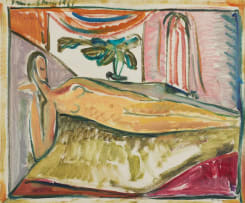
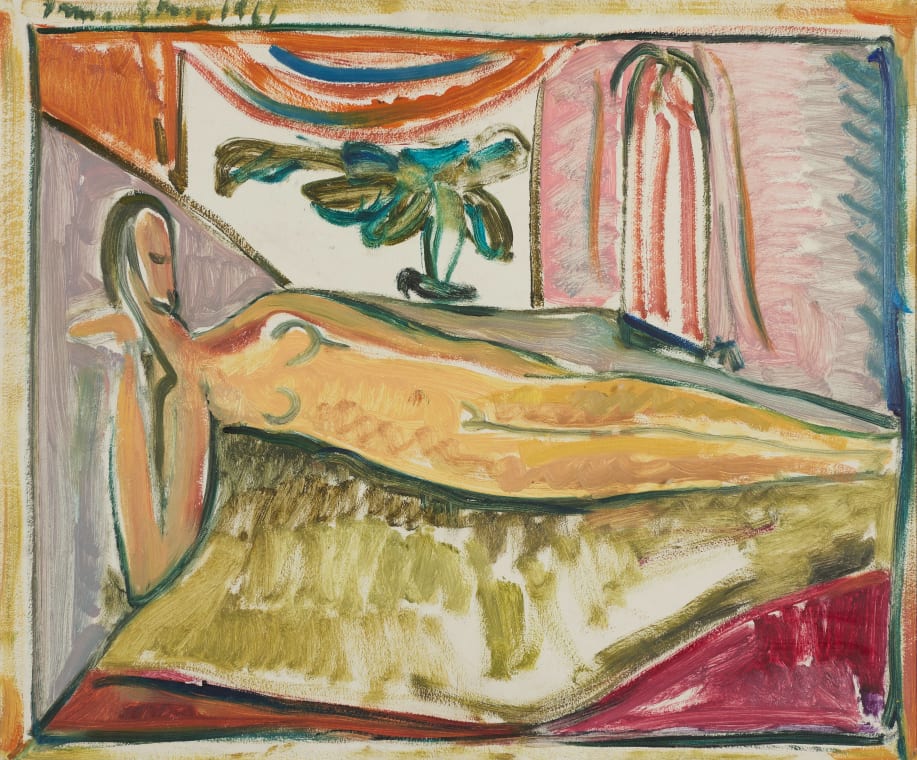
Slender Nude
LOT 519
Irma Stern
Slender Nude
Incl. Buyer's Premium & VAT
About this Item
signed and dated
Notes
Irma Stern produced nudes throughout her prolific career, from her student years in Germany in the 1910s, through her decades of experiment and consolidation in South Africa, to the life-affirming Mediterranean nudes of the 1960s. Despite their consistency within her oeuvre, this aspect of her production has only recently received sustained scholarly attention. The nude, writes art historian Michael Godby in a 2021 study on the subject, lay “close to the centre” of Stern’s identity as an artist and was also “foundational” to it.1 “Life drawing of the nude was the basis of her academic training and remained throughout her life both a trigger for her practice and her most common subject.”2
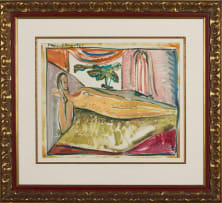
Stern’s treatment of the nude changed considerably over time. The present lot, depicting a reclining nude, is very likely linked to her first stay in the Spanish port city of Alicante in late 1960 and early 1961. Two years before her arrival, The New York Times reported that the Costa Blanca, a sun-drenched stretch of Mediterranean coastline in the Alicante province, was among the “swiftest developing resort areas” in Spain.3 Notwithstanding its archaeological wealth, including Roman temples, Moorish fortresses, medieval castles and Gothic cathedrals, the region’s principal attraction for tourists was its beaches.
The catalogues for two exhibitions in 1961 devoted to Stern’s new Spanish work list only one oil depicting a beach scene and no nudes. The style of the present work is more closely aligned with a later series of abstracted nudes from 1962, produced during a second visit to Alicante, in which Stern similarly presents a graphically simplified female figure within a painted picture frame. The economy of means underpinning this new work has its origins in her nudes of the 1950s, when she came to favour “simplified linear description”4 over the naturalism and specificity of her nudes from the late 1940s.
While Alicante’s resort culture resonated with pleasures familiar from Stern’s beach holidays in Natal in the 1920s and her fondness for sunbathing in Cape Town, the influence of Pablo Picasso on the appearance of this work cannot be discounted. In 1960, during a visit to London, Stern attended Picasso’s exhibition at the Tate Gallery. “I saw it four times in three days,” she told the Cape Times.5 The poster for the exhibition featured Nude with Towel (1907), a pivotal proto-Cubist work painted shortly after Les Demoiselles d’Avignon (1907). Stern also visited a Picasso exhibition in Barcelona before eventually taking up residence in a hotel in Alicante.
Much like Picasso in 1906–07, Stern’s nudes from the period 1961–62 underwent structural transformation. Where Picasso’s radical deformation sought to disrupt traditional representation through angular and fragmented form, Stern’s somnolent nudes of the early 1960s locate innovation in graphic simplification and colour. Godby helpfully summarises their innovation when he writes that, compared with the nudes of the 1940s, which celebrated the sheer physicality of the model in terms of both surface texture and three-dimensional form, “the late nudes somehow present the idea of sensuality without realising it physically.”6
1. Michael Godby (2021) Irma Stern Nudes, 1916-1965, Cape Town: Primavera Publishing, page 143.
2. Ibid., page 143.
3. Sergei Lenormand (1958) 'The Costa Blanca: Resorts Along Spain’s Mediterranean Shore Await Summer Invasion', New York Times, 30 March, page 21.
4. Godby, Irma Stern Nudes, page 41.
5. 'Artist was Inspired by the Spanish Scene', Cape Times, 7 July 1961.
6.Godby, Irma Stern Nudes, pages 42-43.
Provenance
Stephen Welz & Co in Association with Sotheby’s, Johannesburg, 6 November 1995, lot 413.
More from Evening Sale