Irma Stern
Mantilla
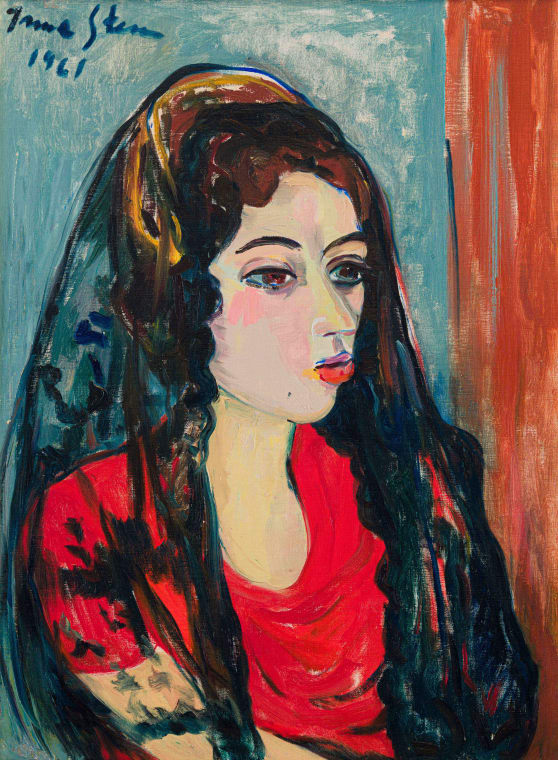
LOT 524
Irma Stern
Mantilla
Incl. Buyer's Premium & VAT
About this Item
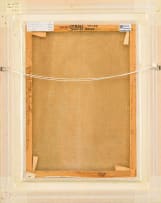
signed and dated; inscribed with the artist's name, the medium and 'Spanish Bride' on an Everard Read label adhered to the reverse; inscribed with the artist's name, 'Spanish Bride' twice and 'The Firs, Chapel Rd. Rosebank' and further indistinctly inscribed on the reverse
Provenance
Everard Read, Johannesburg.
Private Collection.
Exhibited
Association for Visual Arts Gallery, Cape Town, Paintings from Spain, August 1961, cat. no. 9.
Adler Fielding Galleries, Johannesburg, November 1961, cat. no. 40.
Lidchi Gallery, Johannesburg, 13 to 26 February 1962.
Literature
South African National Library, Cape Town, Irma Stern Archive, Photograph, MSC 31 Folio 19, page 202, with the title The Mantilla.
Jewish Affairs, Volume 18, Number 11, November c. early 1960’s, illustrated in black and white.
Notes
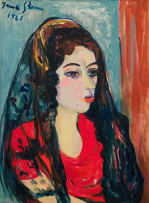
This sensitively rendered portrait of a woman wearing a traditional Iberian head covering dates from Irma Stern’s celebrated Spanish period of the 1960s, when she lived and worked for extended periods along the Mediterranean coast. Works from this late phase are admired for their loose composition, focus on traditional European subjects and engagement with the example of Pablo Picasso. Stern’s decision to paint in Spain was spontaneous. In July 1960, the Cape Argus reported that the artist had been in poor health and would travel to Europe for “a long recuperative holiday”.1 She initially went to Basel, Switzerland, where doctors advised her to “go somewhere warm”.2
After an extended tour of Europe, including visits to Ghent, Salzburg, Venice, Zurich and London, where she attended the Tate Gallery’s major Picasso exhibition three times in four days, Stern settled in the historic Spanish port city of Alicante.3 Freed from the demands of managing her large home in Cape Town, she converted the sitting room of her hotel suite into a studio. A productive routine followed. Stern alternated between media such as oil, tempera and crayon. Her subjects varied.
Some subjects were immediate: the harbour visible from her window, Alicante’s busy beach and Santa Bárbara Castle, the ninth-century Moorish fortress overlooking the city.
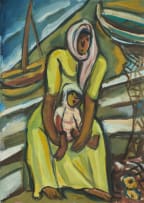
Stern however also travelled to nearby villages and farms, observing pilgrims at the Monastery of Santa Faz and workers engaged in the region’s longstanding maritime and agricultural labours. Oils from this period depict wood gatherers, net makers, tomato pickers and sugarcane harvesters. As throughout her career, women formed the focus of her more ambitious compositions. Alongside the present lot, Stern produced a number of mother and child paintings, among them Gypsies (1961), acquired by the prominent collector John Schlesinger.
Exhibited in Cape Town and Johannesburg, Stern’s new Spanish works were warmly received. “She is using less palette knife than before, and less impasto,” observed Neville Dubow. “In many cases the paint has been sufficiently thinly applied to allow the canvas to show through – an old trick this, and abused by many a lesser artist.”4 Similarly impressed by her “astonishing self-assuredness”, Matthys Bokhorst wrote that her “handling of paint may be almost as good as Van Gogh”.5 The only contemporaneous reference to the present work appeared in Die Burger, whose critic singled out Stern’s depiction of a “Spanish beauty” wearing a mantilla as one of five outstanding oils in her Cape Town exhibition.6
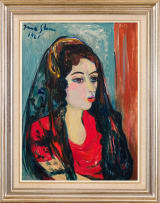
Notwithstanding the widely noted thinness of her paint application, this portrait is distinguished by the attention devoted to the sitter’s face. Contoured in ultramarine, the features are modelled in pale rose and muted yellow, animated by touches of white, orange and turquoise. Unlike Gypsies, which recalls the more loosely handled descriptions of her Madeira period and more readily invites comparison with Van Gogh, the present work suggests the sustained impact of Picasso. Stern spoke admiringly of his work following a 1948 visit to Europe, and her contribution to the 1958 Venice Biennale strongly referenced his transitional Iberian-inspired style of the years before 1907.
Unlike Stern’s later Woman with Mantilla (1964), which portrays her patron Pamela Frampton in a related mode, the identity of the sitter here is not known.7 More significant, however, is the work’s resonance with Spanish art history. The mantilla, a traditional lace head covering worn for religious and formal occasions, appears in portraits by numerous Spanish painters. Picasso portrayed his mistress Fernande Olivier in a mantilla in an expressionistic oil from 1905, while Goya’s widely known The Duchess of Alba in a Mantilla (1797) depicts the artist’s close friend and patron. This work reflect Stern’s cosmopolitan outlook and sustained engagement with European art, which in its last phase engaged Spanish painting, not for the sake of quotation but as a means of advancing her always-evolving painterly language.
1. 'Miss Irma Stern Wins Prize on Eve of Holiday', Cape Argus, 15 June 1960.
2. 'Spanish Tomato Girls were her Liveliest Models for Pictures', Cape Argus, 28 August 1961.
3. 'Artist was Inspired by the Spanish Scene', Cape Times, 7 July 1961.
4. Neville Dubow (1961) 'Irma Stern Paints with More Economy but Undiminished Power', Cape Argus, 31 August.
5. Matthys Bokhorst (1961) 'Art Show is the Result of Six Months’ Activity', Cape Times, 5 September.
6. W E G L (1961) 'Spanje Het Haar in Roes van Inspirasie Laat Werk', Die Burger, 15 August.
7. Christopher Peter (2015) 'Woman with Mantilla', in Brushing Up on Stern, Cape Town: Iziko South African National Gallery, page 99.
More from Evening Sale