Gerard Sekoto
Man with a Stick

LOT 150
Gerard Sekoto
Man with a Stick
Incl. Buyer's Premium & VAT
About this Item
signed and dated '76
Literature
Barbara Lindop, Gerard Sekoto, Bruce and Mark Attwood, Broedestroom Press, Johannesburg, 1988, page 284, illustrated in colour.
Provenance
Mr L J Falkson.
Aspire, Johannesburg, 28 October 2018, lot 2, with the title Man with Cane.
My present work is a little different from the earlier in technique and sometimes, also in colour. Although both periods still retain the endeavour to express the movement and the desire to search into the innermost feelings of my subjects. —Gerard Sekoto
Notes
Gerard Sekoto’s artistic expression reflects the journey of his personal life. Man with a Stick (1976), a gouache on paper, draws on earlier experiences and influences, evoking deeply rooted memories of township life that stayed with him throughout his career. His upbringing in Botshabelo, the German Mission station in rural Mpumalanga and later Limpopo was formative to both his visual and musical development. He later returned to Seshego, a township in Polokwane, where he taught at Seshego Primary School.
In Johannesburg, he lived in Sophiatown, a vibrant community shaped in part by the Church of Christ the King, where Father Trevor Huddleston served as rector and which appears prominently in what may have been the artist's first oil painting. In 1942, he moved to District Six, in Cape Town, another lively community, before returning to reconnect with his family in Eastwood, on the outskirts of Pretoria. There, already recognised as an established and admired artist, he painted some of his most lyrical and moving depictions of his family and neighbours. The rolling hills of Eastwood recur often in his later “memory” landscapes.
By the time Sekoto went into self-imposed exile in 1947, never to return to South Africa, he was established in well-patronised galleries in Johannesburg, Cape Town and Pretoria, had achieved strong sales, and had been invited by Walter Battiss to join The New Group. Arriving in Paris in the winter of 1947, however, he lost confidence. Unable to speak French, poor and alone, he struggled until a French art gallerist offered him an exhibition in rue des Beaux-Arts in 1949.
In Paris, he first painted his surroundings and local people, as he had in South Africa, but his work showed greater distance from his home country and less individual specificity. In the 1950s, he developed “series” paintings, repeating similar themes through variations in colour and composition. By the 1960s, as his life became more settled and his friendships and recognition grew, he produced more portraits and landscapes. He also worked in a fashionable night café, playing piano, composing and singing his own lyrics; this musicality increasingly shaped his paintings. A visit to Senegal in the early 1960s gave his work new energy, later absorbed into the paintings of the 1970s.
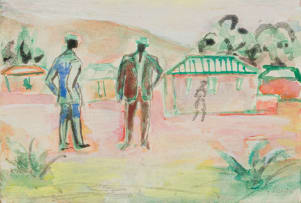
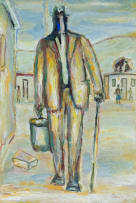
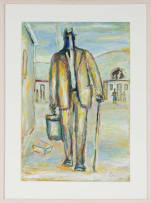
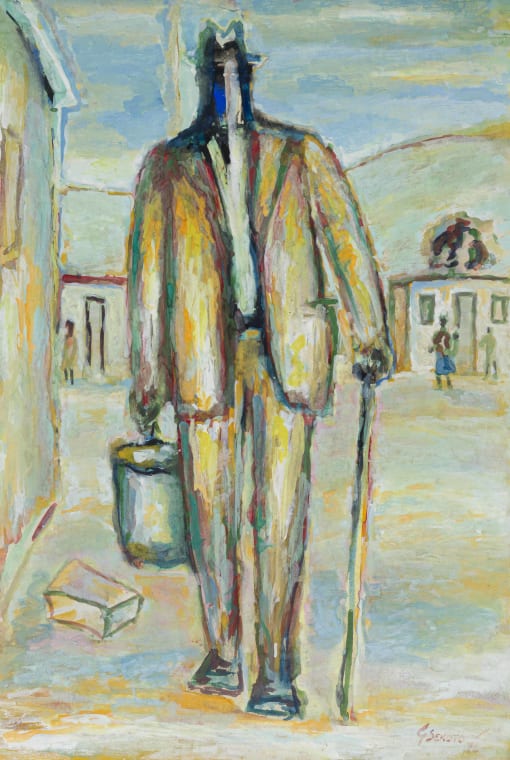
Man with a Stick presents a tall, imposing suited man walking through a sun-filled street, his upright stance and walking stick lending the figure both physical presence and a quiet sense of dignity. The large figure dominates the open landscape, where flowing hills recall earlier Eastwood compositions and dwarf the small brick-and-tin houses. Unlike today’s overcrowded townships, this scene feels spacious and quiet. The scene is bathed in subdued hues of yellow, blues and greens applied in broken strokes, while the pale blue sky and sun-bleached pavement establish an atmosphere in which the viewer encounters an archetypal passer-by.
The figure's obscured, anonymous face—blurred by shadow and light—is significant, creating a sense of anonymity and alienation brought about by a life lived in exile. Unlike pre-exile Eastwood works, where subjects were recognisable, this work filters observation and memory while remaining deeply connected to an enduring preoccupation with the everyday human experience.
There is also a musical quality to the piece. The repeated verticals of the figure, cane, buildings and distant architectural elements establish a rhythm across the composition, while the rapid, syncopated brushstrokes animate the surface. A lifelong engagement with music—particularly jazz—has often been associated with this rhythmic approach to painting, in which colour and gesture seem to operate almost as musical notes.
Sekoto remains one of the pivotal figures in South African modernism. His paintings of everyday life, like the present lot, established an enduring visual record of ordinary lives while simultaneously developing a highly personal expressionist vocabulary.
–Barbara Lindop, 2026
More from Evening Sale