Cecil Skotnes
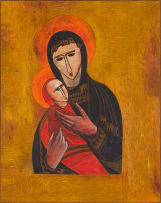
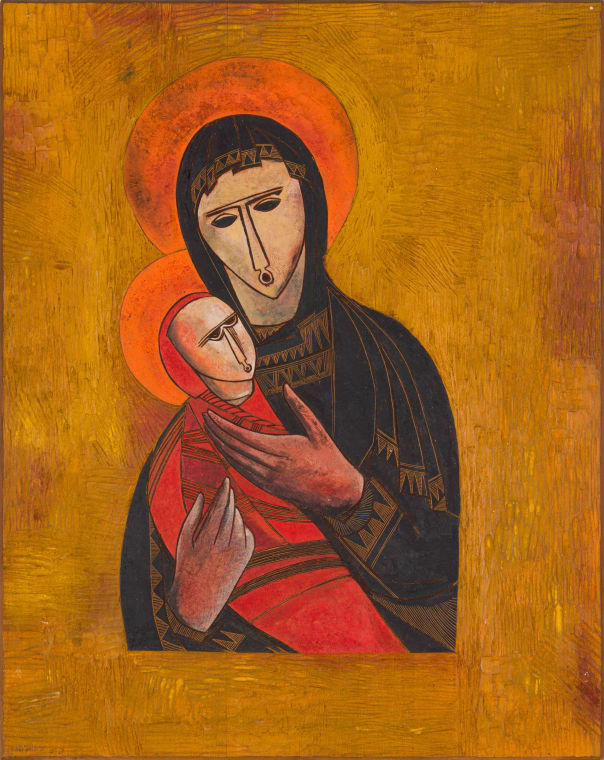
Madonna and Child
LOT 138
Cecil Skotnes
Madonna and Child
Incl. Buyer's Premium & VAT
About this Item
signed and dated 72
Notes
Cecil Skotnes was born to missionary parents, both officers in the Salvation Army, though he never found himself attracted to the idea of worship. Instead, he valued the church for its sponsorship of artists and for the astonishing churches and cathedrals that first inspired him as a soldier at the end of World War Two.
Cecil’s regiment, the 6th South African Armoured Division, had liberated Florence in August 1944, and at the end of the war he returned there, avoiding any ship home to experience the post-war work of unpacking the artwork and treasures of the city. Later he brought his wife, Thelma, to Florence, first visiting the city of Siena, where he developed a life-long love of the work of Duccio di Buoninsegna and in particular his Maesta (1308-1311).
Cecil created many works on religious themes, and secured commissions for his Polly Street students to make crucifixes or stations of the cross. The Church of St Peter Claver in Seeisoville, Kroonstad is a wonderful example of the collaboration between the artist and Sydney Khumalo in 1957. Annunciations and images of Mary (mother of Jesus of Nazereth) were particular favourites of his. His wife, Thelma, was a border at St Ursula’s Convent in Krugersdorp and, when her mother was unable to pay the fees, the nuns kept her on for free. Later as a successful artist, he returned to the convent and asked if he could buy them a set of encyclopedias or make a donation to the library. 'No!' they said, we want an artwork. He made them an Annunciation and a portrait of St Ursula in his own characteristic style.
The present lot, Madonna and Child, is reminiscent of Duccio’s in the Museo dell’Opera del Duomo in Siena, showing a similar linear but stylised veil and cloak, and gesture of the hands. In Cecil’s interpretation, the gold leaf is translated into cut wood, coloured with raw sienna and yellow ochre pigmented acrylic, and the design on the cloak closer to the chevron motif of the isiZulu ukhamba or the walls of Great Zimbabwe. Faithful to its roots in Italy, the work is undoubtedly African rather than European in feel and spirit.
Professor Pippa Skotnes
Literature
Frieda Harmsen (ed) (1996) Cecil Skotnes, exhibition catalogue, Cape Town: South African National Gallery, illustrated in colour on page 141.
Provenance
Acquired from the artist, c.1972, and thence by descent.
More from Evening Sale