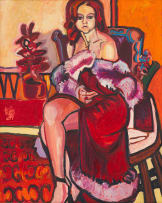
Michael Hallier
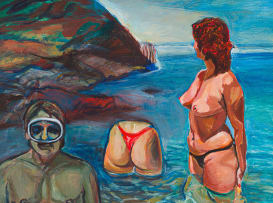
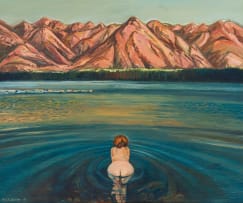
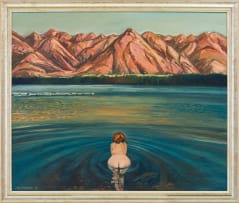
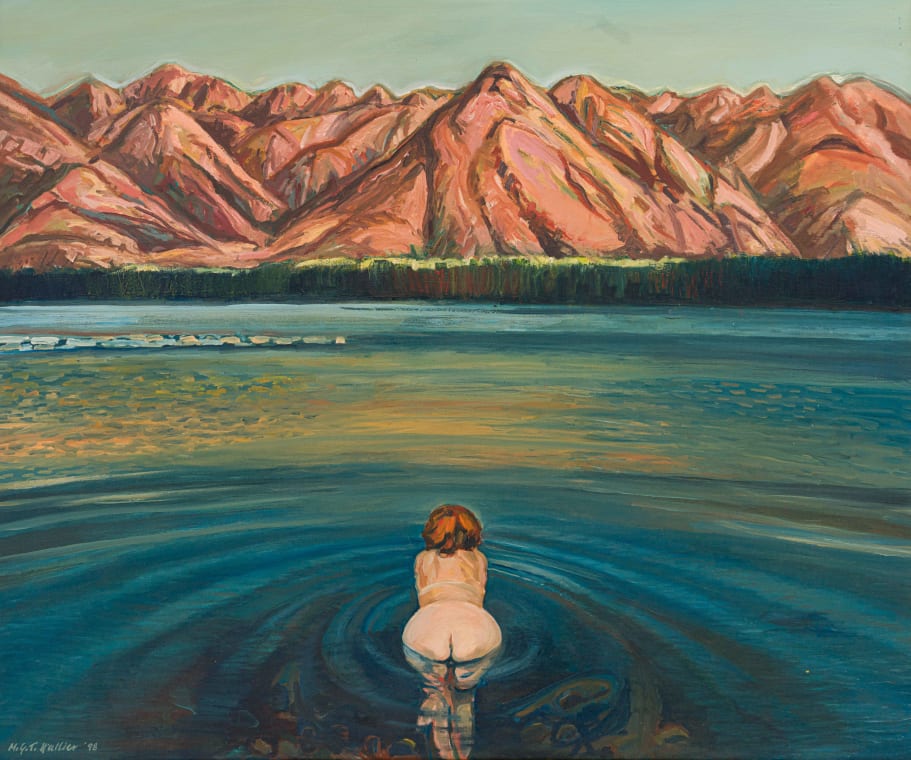
Richtersveld Bather
About the SessionDubbed the Cinderella Province, the Eastern Cape has long been a fertile creative hub for nascent poets, playwrights, musicians, painters, sculptors, photographers and craftspeople. It has had an established fine art community stemming from its 1820 Settler beginnings which list illustrious national names like Thomas Baines, Frederick I’ons and Thomas Bowler who visually documented the frontier landscape, flora and colonial life in the Western painting tradition.
After the Second World War, teaching institutions like Rhodes University, The Port Elizabeth Art School (subsequently the PE Technikon – now the Nelson Mandela University) and Fort Hare University were largely staffed with British teachers who brought with them the traditions of the Royal Academy. Influential artists like Dorothy Kay, Betsy Fordyce, Joan Wright, Fred Page, Stuart Titcombe and Herbert McWilliams all belonged to the Eastern Province Society of Arts and Crafts (EPSAC), a cultural society which was a forum and meeting place for artists, music lovers and theatre goers. McWilliams was associated with the development and art education of Black South Africans at both Fort Hare and Lovedale, institutions which mentored artists like George Pemba and Gerard Sekoto. In 1956 an Arts Hall (King George VI Art Gallery) was opened which later became the Nelson Mandela Metropolitan Art Museum. The Museum’s comprehensive holdings include an unrivalled specialist collection of traditional Xhosa beadwork and specialist collection Chinese artifacts which reflect the immigrant community’s early existence and presence in the city. There are also major permanent holdings which include the Keiskamma Art Project Tapestry which is a visual portrayal of the AmaXhosa history of the Eastern Cape and Hillary Graham's SS Mendi paintings which document the forgotten role of Black African soldiers in WW1. The Grahamstown Group, the GAP Group and many regional artists like Fred Page, Walter Battiss, Norman Catherine, Alexander and Marianne Podlashuc, Hunter and Ruth Nesbit, Neil Rodger, Penny Siopis, Brian Bradshaw, Josua Nell, and Lynnley Watson all form part of the Museum’s local provenance. Today, the Museum has a progressive outreach programme which is defining cultural change.
There also have been many unknown artists of calibre like Jennifer Ord, Ethna Frankenveld and Tim Hopwood who have seldom exhibited outside the Province. Most artists who have either incubated or developed their skills - like Phil Kolbe, Anne Marais, Meshak Masuku, Anton Momberg, Hylton Nel, Obie Oberholzer, Brent Meistre, TJ Lemon, Christine Dixie, Vusi Khumalo (at Dakawa), Beth Armstrong, Andile Dyalvane (in collaboration with Zizipho Poswa), and textile designer Laduma Ngxokolo - have had to move away to more cosmopolitan centres to gain wider exposure for their work.
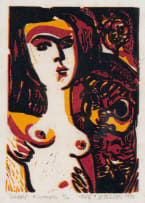
Jeanne Wright
About this Item
signed and dated '98; signed, dated and inscribed with the title on the reverse; inscribed with the artist's name on the reverse; accompanied by the artist's biography adhered to the reverse
Provenance
The artist's collection and thence by descent.
“Each work is a dialogue between a painter and his time”.
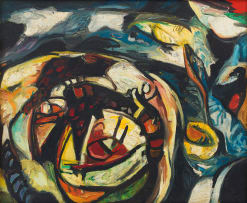
Brian Bradshaw founded the Grahamstown Group at Rhodes University in May of 1964. This collective was the first cohesive indigenous art movement to emerge on the South African art scene which established a style and aesthetic based on landscape painting. From 1964 to1971, the original group, which consisted then of about 21 members of invited student members and staff, exhibited at various exhibitions around the country. Under Bradshaw’s philosophical and intellectual stewardship, the group was described at the time as “bold, vigorous, powerful, with its uncompromising character making a then unique influence on the art of South Africa”. The group’s distinctive style was shaped by Bradshaw’s rigorous academic English training and dominated by his powerful personality. It was immediately recognisable for its dark tones, vigorous brushwork and thick black calligraphic line. When he left the University in 1978 they formally disbanded. Founding members Tom Matthews, Robert Brooks, Hylton Nel, Jennifer Crooks, Hilary Graham, Estelle Marais, Cleone Cull, Michael Hallier, Noel Hodnett, Neil Rodger and Joshua Nell continued to teach at Rhodes, the Port Elizabeth Technikon, Fort Hare and many other art departments in the Eastern Cape well into the 1980’s.
During the group's active period, it was regarded as adversarial, narrow–minded, parochial and out of step with the ‘progressive’ attitudes of other English speaking universities. It elicited controversy everywhere because of its uncompromising stance and elitist nature. Press and critical reaction was mixed and sometimes hostile, criticism ranging from the derisive to the euphoric. Bradshaw’s particular philosophical and intellectual understanding of the culture of landscape painting defined painting as a search for reality rather than of possession, fashion, or self-absorption - an open-ended dialogue between the artist, nature, and of his time, free from convention or “taste.”
This approach adjudicated by the treatment of the painted surface and defined by knowledgeable draughtsmanship continued to be taught by Robert Brooks who became the incumbent following Bradshaw. His peer group members and the generation of students taught by them continued to filter through art schools and fine art aesthetics in the Eastern Cape for a further fifty odd years. The most remarkable aspect of the group’s influence is the enduring use of landscape and figurative forms which all painters who trained then at the Rhodes Art School used as a basis for their work. Those who have moved into either abstract of conceptual modes are usually easily identified by their physical use of paint and the disperse of visual balance within format which is a signature Bradshaw tenet.
Contemporary artists who trained under both men include Penny Siopis, Nigel Mullins and Tanya Poole-Mullins, Carl Bekker, Dominic Thorburn, Cyril Coetzee, George and Ben Coutouvidis, Sarah Ballam, Helen Timm, Margie Britz, Craig Wylie, Lola Frost, Diana Page and Diane McLean, among others.
Note: Of the works on offer Matthews, Brooks, Crooks, Graham, Josua Nell, Hallier and Hodnett were all at the Art School at about the same time and were closely associated with Brian and Maureen Bradshaw forming part of an inner social circle.
- Jeanne Wright
More from Eastern Cape Echoes