Brian Bradshaw
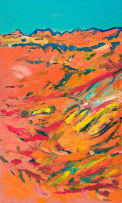
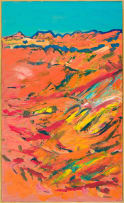
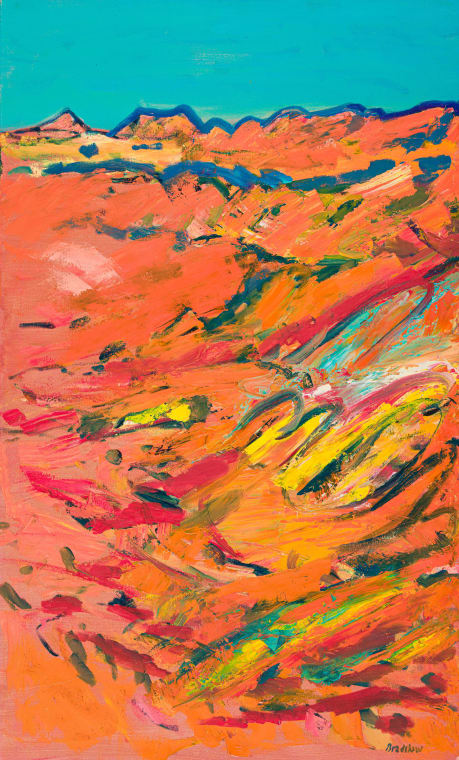
Desert Dunes
LOT 639
Brian Bradshaw
Desert Dunes
Incl. Buyer's Premium & VAT
About this Item
signed
“Each work is a dialogue between a painter and his time”.
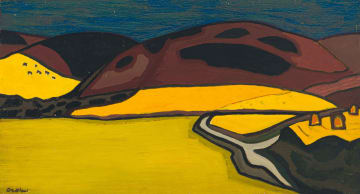
Brian Bradshaw founded the Grahamstown Group at Rhodes University in May of 1964. This collective was the first cohesive indigenous art movement to emerge on the South African art scene which established a style and aesthetic based on landscape painting. From 1964 to1971, the original group, which consisted then of about 21 members of invited student members and staff, exhibited at various exhibitions around the country. Under Bradshaw’s philosophical and intellectual stewardship, the group was described at the time as “bold, vigorous, powerful, with its uncompromising character making a then unique influence on the art of South Africa”. The group’s distinctive style was shaped by Bradshaw’s rigorous academic English training and dominated by his powerful personality. It was immediately recognisable for its dark tones, vigorous brushwork and thick black calligraphic line. When he left the University in 1978 they formally disbanded. Founding members Tom Matthews, Robert Brooks, Hylton Nel, Jennifer Crooks, Hilary Graham, Estelle Marais, Cleone Cull, Michael Hallier, Noel Hodnett, Neil Rodger and Joshua Nell continued to teach at Rhodes, the Port Elizabeth Technikon, Fort Hare and many other art departments in the Eastern Cape well into the 1980’s.
During the group's active period, it was regarded as adversarial, narrow –minded, parochial and out of step with the ‘progressive’ attitudes of other English speaking universities. It elicited controversy everywhere because of its uncompromising stance and elitist nature. Press and critical reaction was mixed and sometimes hostile, criticism ranging from the derisive to the euphoric. Bradshaw’s particular philosophical and intellectual understanding of the culture of landscape painting defined painting as a search for reality rather than of possession, fashion, or self-absorption - an open-ended dialogue between the artist, nature, and of his time, free from convention or “taste.”
This approach adjudicated by the treatment of the painted surface and defined by knowledgeable draughtsmanship continued to be taught by Robert Brooks who became the incumbent following Bradshaw. His peer group members and the generation of students taught by them continued to filter through art schools and fine art aesthetics in the Eastern Cape for a further fifty odd years. The most remarkable aspect of the group’s influence is the enduring use of landscape and figurative forms which all painters who trained then at the Rhodes Art School used as a basis for their work. Those who have moved into either abstract of conceptual modes are usually easily identified by their physical use of paint and the disperse of visual balance within format which is a signature Bradshaw tenet.
Contemporary artists who trained under both men include Penny Siopis, Nigel Mullins and Tanya Poole-Mullins, Carl Bekker, Dominic Thorburn, Cyril Coetzee, George and Ben Coutouvidis, Sarah Ballam, Helen Timm, Margie Britz, Craig Wylie, Lola Frost, Diana Page and Diane McLean, among others.
Note: Of the works on offer Matthews, Brooks, Crooks, Graham, Josua Nell, Hallier and Hodnett were all at the Art School at about the same time and were closely associated with Brian and Maureen Bradshaw forming part of an inner social circle.
- Jeanne Wright
More from Eastern Cape Echoes