Thomas Bowler
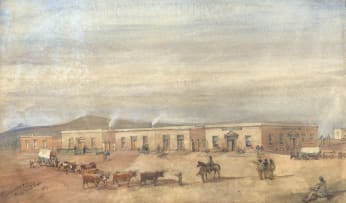
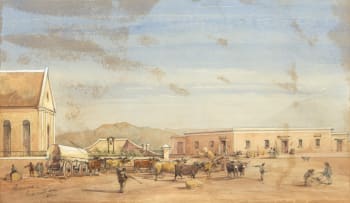
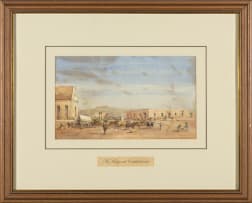
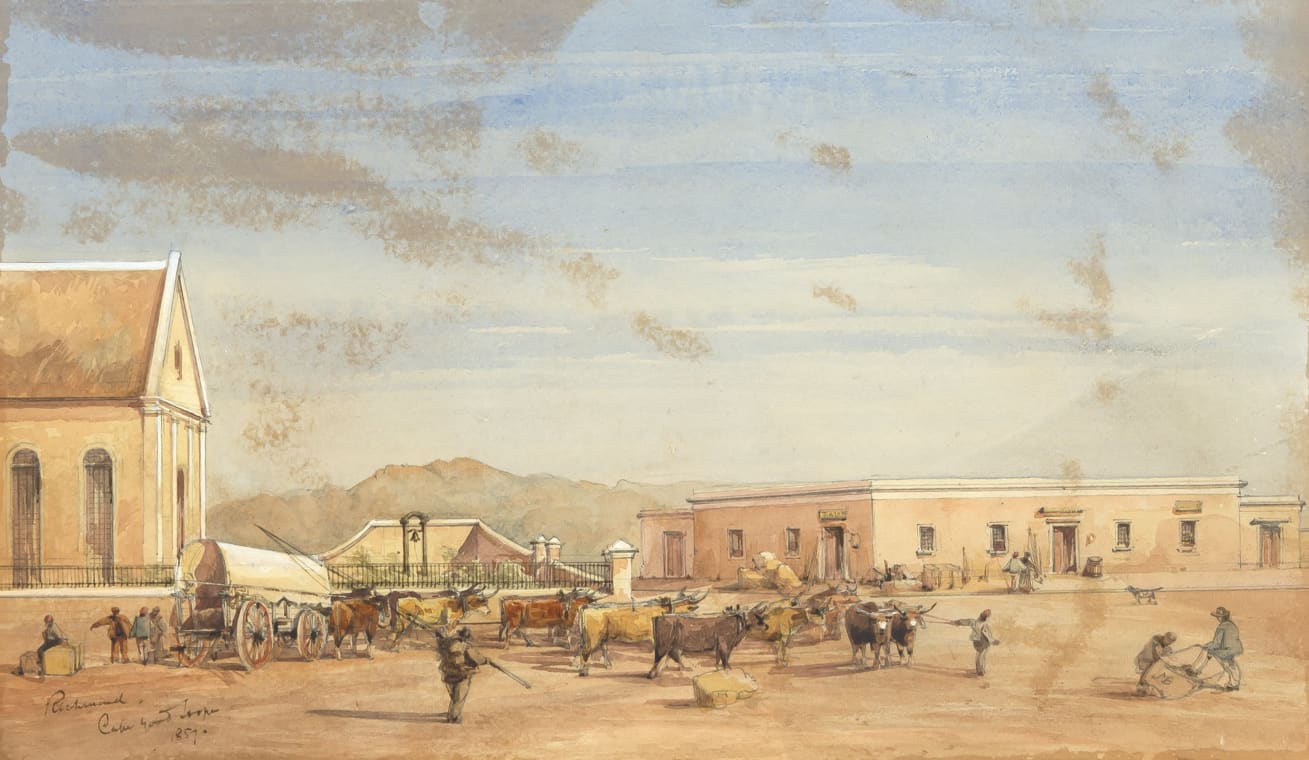
Richmond, Cape of Good Hope, from the Mosenthal Establishments Commission
About the SessionDubbed the Cinderella Province, the Eastern Cape has long been a fertile creative hub for nascent poets, playwrights, musicians, painters, sculptors, photographers and craftspeople. It has had an established fine art community stemming from its 1820 Settler beginnings which list illustrious national names like Thomas Baines, Frederick I’ons and Thomas Bowler who visually documented the frontier landscape, flora and colonial life in the Western painting tradition.
After the Second World War, teaching institutions like Rhodes University, The Port Elizabeth Art School (subsequently the PE Technikon – now the Nelson Mandela University) and Fort Hare University were largely staffed with British teachers who brought with them the traditions of the Royal Academy. Influential artists like Dorothy Kay, Betsy Fordyce, Joan Wright, Fred Page, Stuart Titcombe and Herbert McWilliams all belonged to the Eastern Province Society of Arts and Crafts (EPSAC), a cultural society which was a forum and meeting place for artists, music lovers and theatre goers. McWilliams was associated with the development and art education of Black South Africans at both Fort Hare and Lovedale, institutions which mentored artists like George Pemba and Gerard Sekoto. In 1956 an Arts Hall (King George VI Art Gallery) was opened which later became the Nelson Mandela Metropolitan Art Museum. The Museum’s comprehensive holdings include an unrivalled specialist collection of traditional Xhosa beadwork and specialist collection Chinese artifacts which reflect the immigrant community’s early existence and presence in the city. There are also major permanent holdings which include the Keiskamma Art Project Tapestry which is a visual portrayal of the AmaXhosa history of the Eastern Cape and Hillary Graham's SS Mendi paintings which document the forgotten role of Black African soldiers in WW1. The Grahamstown Group, the GAP Group and many regional artists like Fred Page, Walter Battiss, Norman Catherine, Alexander and Marianne Podlashuc, Hunter and Ruth Nesbit, Neil Rodger, Penny Siopis, Brian Bradshaw, Josua Nell, and Lynnley Watson all form part of the Museum’s local provenance. Today, the Museum has a progressive outreach programme which is defining cultural change.
There also have been many unknown artists of calibre like Jennifer Ord, Ethna Frankenveld and Tim Hopwood who have seldom exhibited outside the Province. Most artists who have either incubated or developed their skills - like Phil Kolbe, Anne Marais, Meshak Masuku, Anton Momberg, Hylton Nel, Obie Oberholzer, Brent Meistre, TJ Lemon, Christine Dixie, Vusi Khumalo (at Dakawa), Beth Armstrong, Andile Dyalvane (in collaboration with Zizipho Poswa), and textile designer Laduma Ngxokolo - have had to move away to more cosmopolitan centres to gain wider exposure for their work.
Jeanne Wright
LOT 602
Thomas Bowler
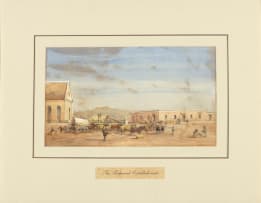
Richmond, Cape of Good Hope, from the Mosenthal Establishments Commission
Incl. Buyer's Premium & VAT
About this Item
signed with the artist's initials, dated and inscribed with the title; inscribed 'The Richmond Establishment' on the mount
Notes
In the depiction of the Richmond Establishment, it is interesting to note the differing kinds of merchandise and equipment stacked against the wall of the shop. This scene is a depiction of a typical small Karoo town during the 19th Century.
Mosenthal collection
The present lot comes from The Mosenthal Establishments Commission, a Jewish family of businessmen who played a significant role in establishing South Africa's wool industry and launching various trading stores across the country's hinterland.
In late 1856, Julius Mosenthal decided to commemorate the Mosenthal Establishments and commissioned Bowler to create seven watercolours depicting its properties and business ventures.
These watercolours showcase the early development of streets and buildings in Cape Town and Port Elizabeth (now known as Gqeberha), as well as the bustling activity in the various Mosenthal-owned trading posts in outposts such as Graaff-Reinet, Murraysburg, and Hope Town.
Before photography became widespread, artists like Thomas Bowler and contemporaries like Thomas Baines played the role of photojournalists. Their paintings, capturing landscapes and scenes encountered during global exploration, were widely reproduced as lithographs and featured in publications.
While these works arguably reflect a Western colonial perspective, they remain valuable historical records offering insights into the lifestyles and customs of European settlers of the Cape during the Victorian era.
Literature
Frank R Bradlow et al (1967) Thomas Bowler: His Life and Work, Cape Town: A A Balkema, illustrated on page 138.
More from Eastern Cape Echoes