Gerard Bhengu
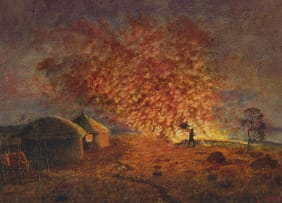
Burning Firebreak
LOT 2
Gerard Bhengu
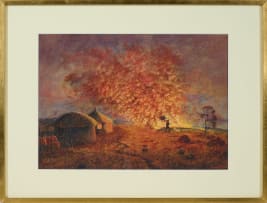
Burning Firebreak
Incl. Buyer's Premium & VAT
About this Item
signed
Notes
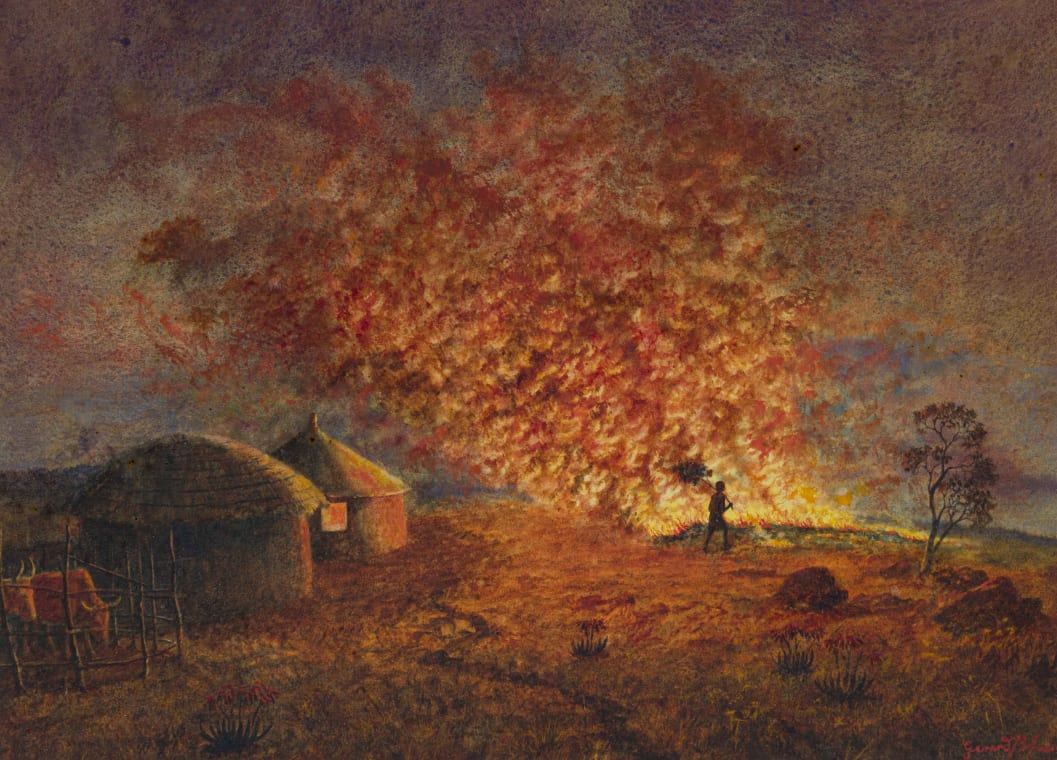
Gerard Bhengu is a celebrated South African artist known for his photorealistic portraits and watercolour landscapes. While Bhengu drew on a tradition of European landscape painting and portraiture in his work, his scenes depict a distinct image of the people and village life in Southern Natal, where he grew up. Bhengu made a number of veld fire paintings between 1930 and 1940. These works are significant as the establishment of the veld fire motif in the South African landscape genre is attributed to Bhengu.1 The present lot portrays a determined figure cautiously wrestling with a blaze. The fire threatens the protective threshold of the firebreak that cuts across the foreground. Rising flames cast an amber glow across the scene and blanket the purple sky in a cloud of smoke. As the fire worryingly tilts towards two rondavel huts and a cattle kraal, the calm typical of Bhengu’s pastoral scenes is disrupted. Considering Bhengu’s awareness of South Africa’s political climate, the looming destruction in the unruly fire could represent the segregation
and loss caused by the land acts that preceded apartheid. At the same time, Juliette Leeb-du Toit explores how intentional grass burning was an important practice in the rural KwaZulu-Natal context of Bhengu’s work.2 Seasonal fires were lit to rid the grasslands of pests and to safeguard homesteads. Therefore, for Bhengu, the burning of grass is also symbolically significant for its association with transformation and renewal. ‘Evil was burnt to ashes, circumstances would change. The firelighters had to prevent the fire from destroying that which was good,’ the artist is quoted as saying.3
1. Juliette Leeb-du Toit, (2022) ‘The Temporality of Gerard Bhengu’s Landscape,’ in Juliette Leeb-du Toit (ed) Gerard T. Bhengu, Johannesburg: Staging Post, page 123
2. Ibid.
3. Ibid.
More from Evening Sale