Serge Alain Nitegeka
Fragile Cargo VIII
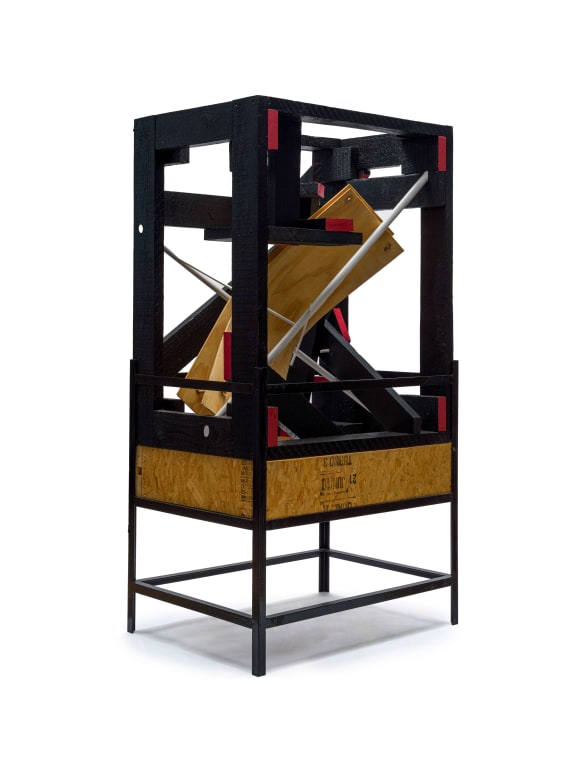
LOT 67
Serge Alain Nitegeka
Fragile Cargo VIII
About this Item
inscribed with the artist's name, the date, title and medium on a Stevenson label adhered to the interior
Provenance
Stevenson, Cape Town, 25 January 2011.
Property of a Gentleman.
Exhibited
Stevenson, Cape Town, Black Cargo, 17 January to 23 February 2013.
Notes
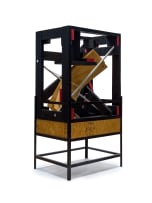
Serge Alain Nitegeka’s practice as a painter, sculptor and installation artist is shaped by his experience of forced migration. He was eleven years old during the 1994 genocide in Rwanda, when his family fled the country with little warning.1 After a period in a displacement camp in Goma, on the Congolese border, the family moved to Kenya before settling in South Africa in 2003. Nitegeka later completed his art studies at the University of the Witwatersrand.
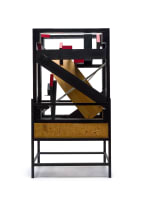
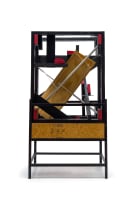
Nitegeka addresses displacement through metaphor and abstraction rather than narrative. He frequently employs materials associated with transport and transience, including wooden crates and industrial paint, to construct formal compositions that speak to fracture, adaptation and endurance. His sculptural language is pared back and largely non-representational, allowing colour, weight and spatial tension to carry meaning. Black is a dominant presence in his work, a choice informed by both memory and material encounter, including his exposure to the volcanic soil of eastern Congo.2
This sculpture was exhibited in Black Cargo (2013), a striking body of work that brought together paintings, sculptures and site-specific interventions. The exhibition examined black subjectivity in relation to forced migration, focusing on states of suspension, adjustment and survival within unstable environments. Lattices of intersecting black lines, their projecting ends recalling the modernist furniture of Gerrit Rietveld, recur in his paintings and sculptures. Works also quoted one another, the painting Fragile Cargo IV: Studio Study III portraying this lot.
Nitegeka has described black as a colour that absorbs and commands, lending his works a quiet authority. “It pulls into itself, drawing in everything around it, making a spectacle especially on a sculpture. It bestows whatever it is on a sense of commanding presence.”3 Here, material restraint and tonal concentration underscore the work’s broader concern with movement, containment and the negotiation of space under conditions of displacement.
1.Siddhartha Mitter, (2020) New York Times, An Artist’s New Migration Song, online, accessed 23 January 2026.
2. Serge Alain Nitegeka (2020) Frieze, Serge Alain Nitegeka’s New Soil, online, accessed 22 January 2026.
3. Serge Alain Nitegeka (2013) My Joburg, exhibition catalogue, Paris: La Maison Rouge, page 172.
More from Portway to Cohen: A Collector’s Legacy and Other Properties