Deborah Poynton
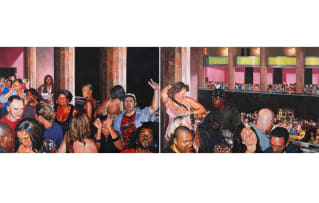
For Ever and Ever, diptych


LOT 49
Deborah Poynton
For Ever and Ever, diptych
About this Item
signed, dated and inscribed with the title on the reverse of the first
Provenance
Stevenson, Cape Town.
Property of a Gentleman.
Exhibited
Stevenson, Cape Town, Safety and Security, 18 January to 18 February 2006.
Notes
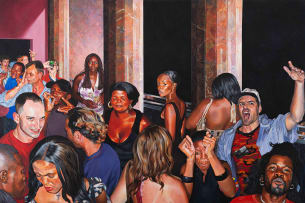
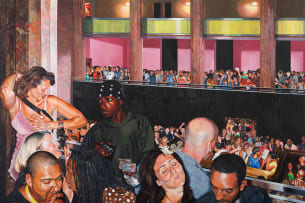
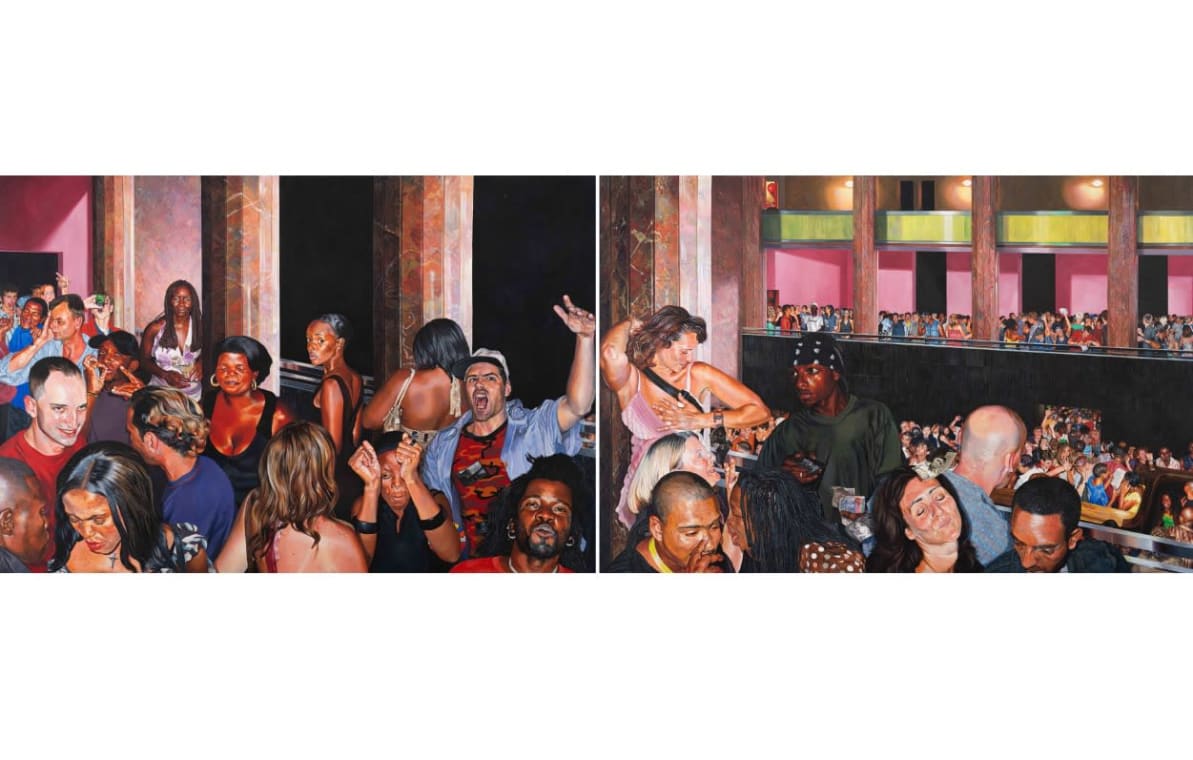
This ambitious diptych formed part of Deborah Poynton’s 2006 exhibition Safety and Security, which included three new multi-panel paintings of crowds assembled at specific Cape Town sites, engaged in ritualised forms of behaviour. The present work is the most declaratory of the group. It depicts a mixed-race gathering partying in the former banking hall of Mutual Heights, the Art Deco landmark that was once the tallest building in Africa. The grand interior, with its triple-volume ceiling, marble columns and geometric detailing, provides a charged setting for a scene of collective abandon and private absorption.
Some two-dozen figures dominate the foreground. A handful acknowledge the viewer’s presence, but most are turned inward, absorbed by pleasure, money or self-regard. The elevated vantage point places the viewer at a distance, recalling a long Western tradition of convivial crowd scenes observed from above. Poynton’s dense figuration and descriptive precision suggest kinship with painters of the Flemish Renaissance, notably Pieter Bruegel the Elder and Peter Paul Rubens, yet her vision is distinctly contemporary.
While photography underpins her compositions, she consistently resists the conventions of photorealism, introducing disquieting perspectives and surreal interruptions. Here, these take the form of small black-and-white images comingling with the figures in the foreground, particularly around the man wearing a black bandana and clutching two banknotes at right. Among them is a quotation from Hans Baldung Grien’s Death and the Maiden (1517), invoking a Renaissance memento mori within a scene of modern excess.
Writing in the exhibition essay, Peter Rech observed that these and other details are “at first hardly noticeable” but crucial to the work’s impact: “The burden of life emerges under exacting observation, with respect to the sensual impressions, the thoughts and conclusions.”1 The outcome is a painting that describes pleasure and alienation simultaneously, using spectacle, scale and historical reference to probe the boundary between celebration and disconnection.
1. Peter Rech (2006) Deborah Poynton, 2005 “On Being Painted”, catalogue essay, Professor Peter Rech, University of Cologne, online, accessed 21 January.
Literature
Lloyd Pollack (2006) ArtThrob, Deborah Poynton at Stevenson, online, accessed 6 January 2026.
Peter Rech (2006) Deborah Poynton, 2005 “On Being Painted”, catalogue essay, Professor Peter Rech, University of Cologne, online, accessed 21 January.
More from Portway to Cohen: A Collector’s Legacy and Other Properties