William Kentridge
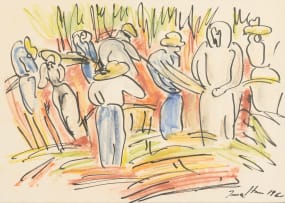
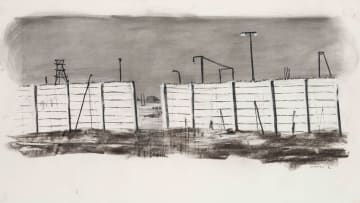
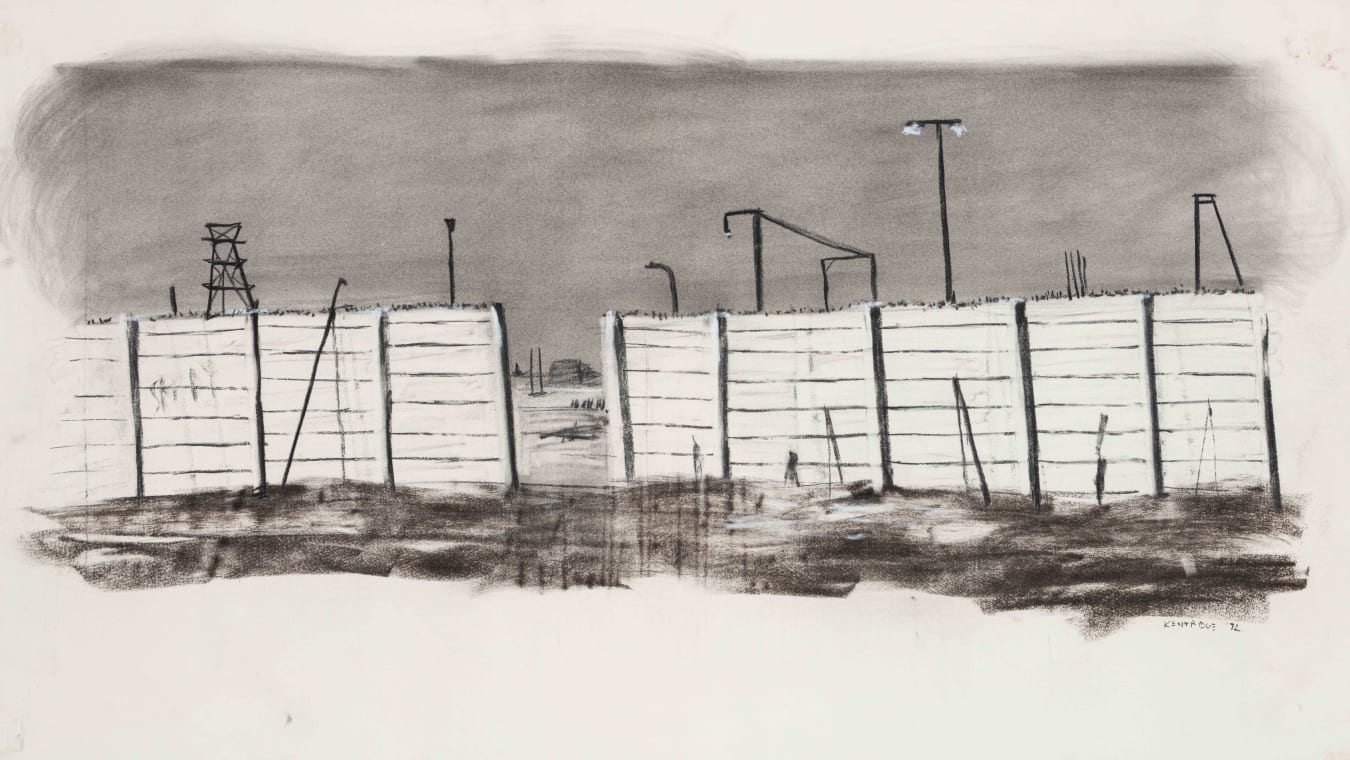
Preparatory Sketch for Woyzeck on the Highveld (recto) Mine Compound (verso)
LOT 574
William Kentridge
Preparatory Sketch for Woyzeck on the Highveld (recto) Mine Compound (verso)
About this Item
signed and dated 92 on the recto
Notes
In 1992, William Kentridge collaborated with Basil Jones and Adrian Kohler of Handspring Puppet Company on the stage production Woyzeck on the Highveld, which he adapted from an unfinished play by the German dramatist Georg Büchner. Chronicling the mental disintegration of a migrant worker in 1950s Johannesburg, the production combined a live actor with four puppets and a rear-projected animation composed of Kentridge’s ink-drawn silhouettes and charcoal landscapes. Performed in Grahamstown and Johannesburg, the work was widely acclaimed and received a Vita Award for Best New Production in 1992–93. It was updated for a revival that performed in Cape Town in 2008 and various European cities in 2009–13.
The original production was generative for Kentridge’s theatre practice and also for his approach to drawing. “This is my first experience of working with puppets and the discoveries have been enormous,” he wrote in his director’s notes of 1992. “Each day of rehearsal has brought revelations of the things that puppets can do better than their living counterparts (try training a rhinoceros to write or an infant to fly on cue).”1 Although he initially sought to conceal the puppet manipulators, he came to recognise that their visible presence was “central to the meaning of the work”, foregrounding the constructed nature of the performance.2
The production also prompted a reassessment of what Kentridge in 1992 described as his “cumbersome and archaic technique of charcoal drawing and erasure”.3 In 1999, he observed that the play’s layered physical structure made “a different kind of drawing … both possible and necessary”.4 Among the projected sequences were expansive horizontal landscapes describing scarred industrial terrain and mining infrastructure. These scenes loosely drew upon the intensively mined regions south of central Johannesburg, with recurring motifs of headgear, pylons, plinth-like forms and pre-cast concrete walls.
Landscape occupies a charged position within South African art history and indeed also within Kentridge’s own formation as an artist. As a child, he was given a book reproducing landscape paintings by, among others, John Constable, Jean-Baptiste-Camille Corot and Meindert Hobbema. Their pastoral vistas bore little resemblance to the flat, dusty topography of Johannesburg. “Throughout my childhood the only mountains we had were the mine dumps,” Kentridge recalled in conversation with Okwui Enwezor in 1998. “So this sense of the contingency of the landscape is built into the history of Johannesburg itself. It is not a naturally formed landscape; it has been made by the tractors of civil engineering.”5
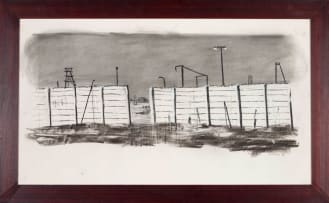
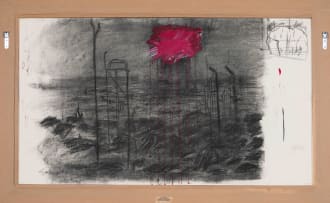
This recto/verso drawing of a utilitarian landscape captures an artist and theatre director creatively working through the problems of making Johannesburg legible. In the partially obscured mine compound on the recto, industrial structures are rendered as both specific sites and mutable stage sets. As in many landscapes from this period, Kentridge treats the terrain not as backdrop but as protagonist: a constructed ground upon which histories of labour, extraction and brute human will are inscribed. He would continue to develop this genre of his drawing practice throughout the 1990s.
1. William Kentridge, Original Director’s Note for Woyzeck on the Highveld, 1992, artist’s website: https://www.kentridge.studio/woyzec-on-the-highveld-directors-note/
2. Carolyn Christov Bakargiev (2017) October Files 21, Cambridge: The MIT Press, page 11.
3. Kentridge, 1992.
4.Carolyn Christov Bakargiev (2017) October Files 21, Cambridge: The MIT Press, page 11.
5. Neal Benezra (2001) William Kentridge: Drawings for Projection, Chicago: Museum of Contemporary Art, pages 21 and 22.
Provenance
Acquired from the artist in 1995.
More from Evening Sale