Maggie Laubser
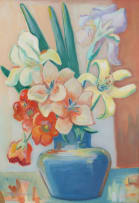
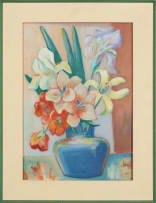
Still Life with Day Lilies and Irises

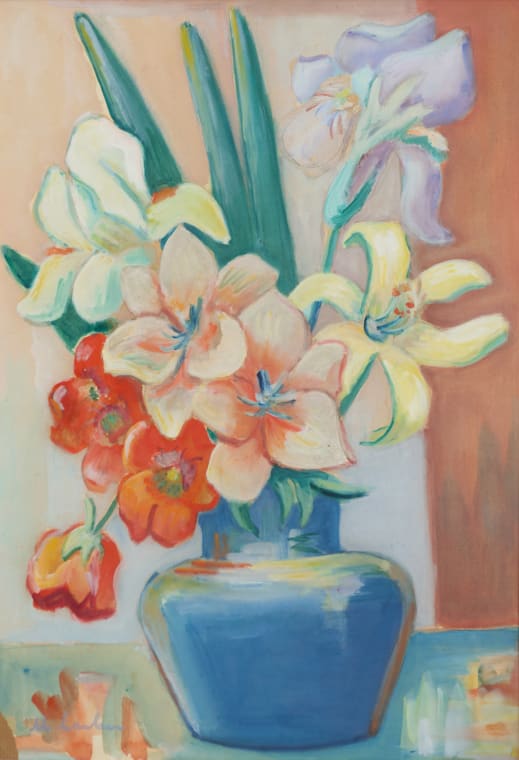
LOT 510
Maggie Laubser
Still Life with Day Lilies and Irises
Incl. Buyer's Premium & VAT
About this Item
signed
Provenance
Acquired from the artist by Mrs E Horn, Cape Town.
Mrs M G Louw, Somerset-West.
Strauss & Co, Cape Town, 7 March 2011, lot 215.
The Stan and Li Boiskin Art Collection.
Literature
Dalene Marais (1994) Maggie Laubser: Her Paintings, Drawings and Graphics, Johannesburg and Cape Town: Perskor, illustrated in black and white on page 309, cat. no. 1279.
Notes
“Maggie Laubser, the shy and rather lonely figure who slowly gained the deep affection of viewers all over South Africa, led a secluded and uneventful life from the time of her permanent return from Europe in 1924. But everything she was and all that motivated her art is traceable to her youthful background amid the quiet pastures of the Cape. Her identification with the land and with her farming forebears. Her empathy with earth and nature were the constant inspiration of her paintings”.¹
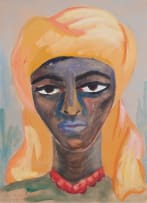
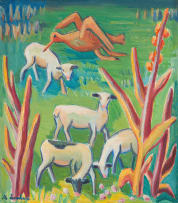
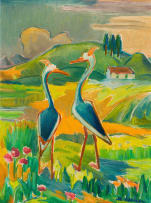
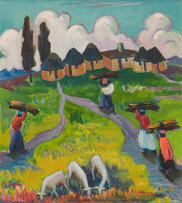
Strauss & Co is honoured to present no fewer than eleven Maggie Laubser lots on the sale, ranging from an early portrait Laubser painted while she was still in Berlin in 1924, to many other portraits she painted of the people at Oordmanspoort, the family farm in the Western Cape, to landscapes of the area, and to still lifes in her inimitable, colourful style.
1. Esmé Berman (1983) Art & Artists of South Africa, Cape Town: A A Balkema, page 252.
Stan and Li Boiskin were well-known Cape Town cultural patrons whose influence extended far beyond collecting art. Active in community organisations and public life, they believed culture should be shared and socially meaningful rather than confined to private spaces. For them, art was a means to educate, to bring people together, and to foster deeper understanding between communities.
Alongside their involvement in the arts, the Boiskins were deeply committed to social causes centred on education, remembrance, and social cohesion. They supported Holocaust education initiatives, interfaith programmes, and projects aimed at reducing prejudice through historical awareness. Their philanthropy also extended to welfare and community support efforts, particularly those that preserve immigrant histories and assist vulnerable families.
Together, they embodied a form of patronage in which art, education, and social responsibility were closely intertwined. Preserving culture, in their view, meant not only caring for artworks but also encouraging dialogue, empathy, and mutual respect.
This carefully curated collection reflects a lifetime of shared dedication to the arts and stands as a tribute to Li Boiskin. Among her many achievements, she was the first person elected to two successive terms as Chairperson of the Cape South African Jewish Board of Deputies. At the heart of her leadership was her character. Widely respected for her integrity and moral clarity, she was guided not by status or popularity but by a strong sense of justice and responsibility to others. Known for her kindness, generosity, and compassion, she embodied the values of faith, family, community, learning, and fairness. Her leadership was principled and people-centred, rooted in a deep commitment to others' well-being.
We hope you enjoy this special collection, which includes mini collections by leading South African artists such as Irma Stern, J H Pierneef, George Pemba and Maggie Laubser. Each played a defining role in shaping South African art in the first half of the twentieth century and contributed, in distinct ways, to the emergence of modern art in the country.
More from Evening Sale