Fikile Magadlela
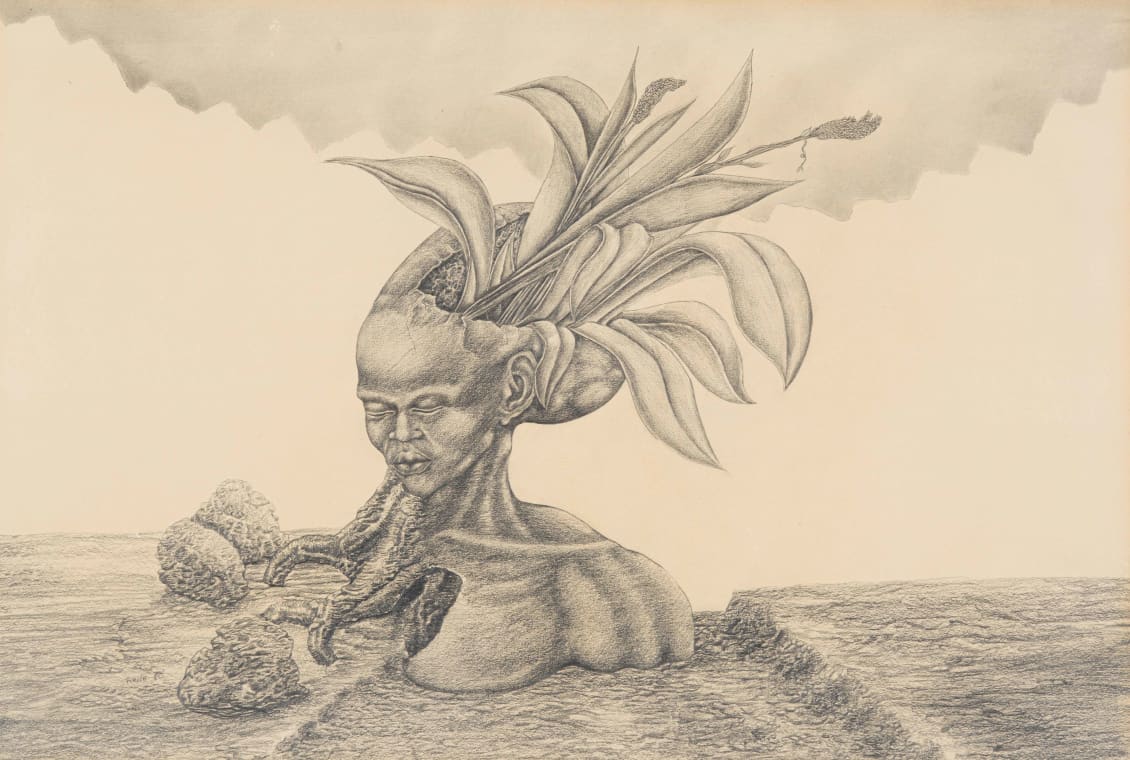
Portrait of a Man with Foliage Emerging from His Crown
About the SessionHair Matters: A Selection of Works from the Georgina Jaffee Collection is a tightly focused, thematic auction that initiates a critical dialogue on the profound significance of hair in contemporary artistic practice. Featuring a cohort of accomplished contemporary artists, primarily those working from the African continent or within the global African diaspora, this selection of works is guided by a singular conceptual mandate: every work turns to hair as a powerful nexus, serving as medium, metaphor, or focal point of exploration.
Hair Matters illuminates the diverse interpretations and artistic vocabularies through which hair shapes identity, memory, and meaning across cultures, nations, and histories. Featuring artists such as Léonce Raphaël Agbodjélou (Benin), Ifeoma U. Anyaeji (Nigeria), Sethembile Msezane (South Africa), and Hank Willis Thomas (United States), the auction examines the aesthetics, politics, and sociology of hair, with particular emphasis on African perspectives and the connective threads that link the continent and its global diasporas.
Curatorial Voices: Natasha Becker, Jared Leite, Vida Madighi-Oghu and Sihle Motsa.
LOT 13
Fikile Magadlela
Portrait of a Man with Foliage Emerging from His Crown
Incl. Buyer's Premium & VAT
About this Item
signed and dated
Provenance
Goodman Gallery, Johannesburg, 1980.
The Georgina Jaffee Hair Matters Collection.
Notes
Selected by Curatorial Voice: Jared Leite.
To encounter Fikile Magadlela’s work within the Hair Matters collection was a great pleasure and surprise. This is mostly since, despite being one of the foremost artists of the Black Consciousness Movement1 Magadlela’s contribution to South African politics and visual culture has gone largely unrecognised. A self-taught artist and poet, Magadlela worked collectively with other Black Consciousness practitioners such as Lefifi Tladi, Dikobe Ben Martins, Gilbert Mabale, Cyril Khumalo and Motlhabane Mashiangwako in shared studios.2 He contributed in important ways to the arts ecosystem, working with collaborators Thami Mnyele and Ben Arnold to present public exhibitions of their work across Soweto3 and ultimately co-founded the Soweto Arts Association. His work resides in local and international institutional collections, such as the Iziko South African National Gallery, The Johannesburg Art Gallery and The University of Fort Hare.
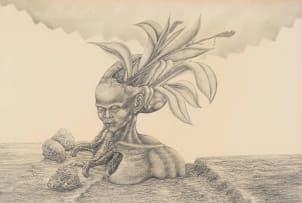
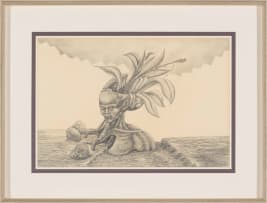
Known mostly for drawings and mixed media compositions on paper, Magadlela’s style has an ostensibly mystical quality. Deemed an Afro-surrealist, Magadlela combined surreal aesthetic sensibilities with elements of African mythology. With a particular focus on ancestral heritage, his work imagines a spiritual connection to the land unfettered by colonial dominance. The present lot reveals a bald male figure emerging from the soil of a barren landscape, breaching the ground at the level of the torso. His demeanour is calm, with eyes closed as foliage bursts from a widening fissure in his swollen head, rising as if to greet the sun. Roots extend from the neck to the ground, accompanied by three amorphous organ-like forms. The biological implication here is perhaps to allude to a liminal state between life and death, or perhaps in a more serious vein – death itself. A death from which new life emerges (symbiosis).
What line could be drawn between the composition in question and the aesthetics of the Black Consciousness Movement? The solitary figure, marked by his entanglement with the land, could convey the power of claims to indigeneity and through that a kind of self-acceptance – an assertion of pride of place. This stands in contrasts to the movement’s emphasis on collective resistance, its espousal of political allegiance among differently oppressed groups. Paying attention to the historical context in which the work was produced, one might infer a different reading, one about martyrdom. Considering his earlier work, Formation (1978), which directly references Biko’s death through a similarly rendered figure, one might infer that the present lot, with its analogous head wound, is a continuation of this reference to Biko. I would further argue that for Magadlela, these illustrations are not merely tokens of remembrance but a vision with real world consequences. In lieu of living presence, the seeds of emancipatory thought sown by political activists would continue to grow and empower – bursting with new possibilities.
Reflecting on the conceptual implications of Fikile Magadlela’s work within the Hair Matters collection, the glaring absence a direct portrayal of hair (albeit implied by foliage) shows that hair acts as an entry point into a broader conversation around race and identity, something which cannot be disimbricate from representations of the body in contemporary art.
Jared Leite, Curator, Co-founder, and Director of Lemkus Gallery.
1. Unknown author (2011) South African History Online, South African Artist Fikile Magadledla is Born, online, accessed 22 January 2026.
2. Shannen Hill (2015) Biko's ghost: The iconography of Black Consciousness. Minneapolis: University of Minnesota Press, page 21.
3. Pamela Allara (2010) 'Thami Mnyele + Medu Art Ensemble Retrospective', de Arte, Volume 45, issue 82.
More from Hair Matters: A Selection of Works from the Georgina Jaffee Collection