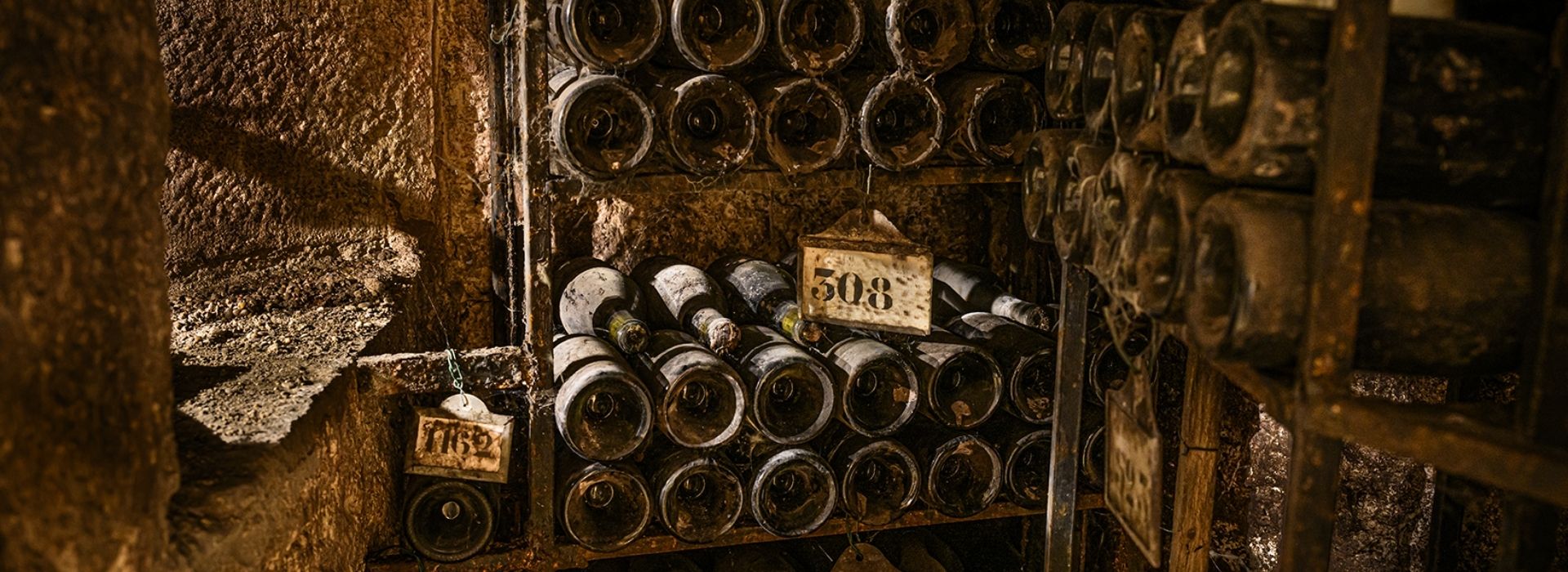
The Modern Secrets of Fine Wine Collecting
4 May 2026
Why do people collect wine?
Adi Badenhorst once said that when Serge Hochar of Château Musar, a winery that historically only missed two vintages during Lebanon’s sixteen-year civil war, was asked what he thought of the 1972 vintage, he responded: “Is that a question?”
He went on to describe how, during the civil war, he drank that wine through the night while sheltering in his Beirut apartment as bombs fell outside. By morning, his neighbours were dead, his life irrevocably altered, but the memory of that bottle remained intact.
While fine wine collecting may appear institutionalised, even gate-kept, at its core it remains an act of personal conviction. A way of assigning value to a producer, a place, a vintage and a style based on nothing more than individual taste. In South Africa, that act has taken on new weight. After more than three centuries of winemaking, the country’s finest wines are increasingly recognised not just as cultural artefacts, but as globally revered assets, placing a premium on terroir, craftsmanship and identity itself.
And for the first time, the barriers to entry are shifting in a meaningful way.
The Rise of the Secondary Market
Historically, fine wine collecting demanded specialist knowledge, access to global networks, trusted storage, and the ability to verify provenance, conditions that confined the market to a relatively small group of insiders.
That ecosystem is evolving. The digital age and platforms such as Strauss & Co have helped formalise South Africa’s secondary wine market, allowing collectors to buy and sell mature, vetted wines with a level of transparency that did not exist. Since launching its fine wine division in 2019, Strauss & Co has sold over 68,000 bottles, achieving an 89% sale rate across more than 10,000 lots that speaks not just to demand, but to the confidence buyers are placing in vetted provenance.
More significantly, these auctions have revealed something long obscured: a continuous, tangible history of South African wine. Bottles dating back to the 18th and 19th centuries, Constantia wines once favoured by Napoleon Bonaparte, sitting alongside modern icons, creating a lineage that collectors can now see, study and participate in.
What Collectors Look For
What draws a collector to wine rather than art, watches or property is partly the fact that the object itself is alive.
A bottle of Klein Constantia Vin de Constance or Kanonkop Paul Sauer changes over decades. Ownership carries the promise of a future experience rather than mere possession. Layered onto that is cultural weight. Each bottle representing a vineyard, a season, a fingerprint, and through auction, entire cellars spanning generations have become public records of taste and history. Scarcity sharpens all of this. And increasingly, so does the financial case.
The development of the South African Fine Wine Top 10 Index (SAFW10), created through collaboration between Stellenbosch University, Wine Cellar and Strauss & Co, marks a significant shift. By tracking liquidity, price performance and critical acclaim, the index offers a benchmark for local fine wine, something previously reserved for regions like Bordeaux or Burgundy.
Early data suggests strong returns over a relatively short period, evidence that South African fine wine is no longer just collectible, but measurable. Just as importantly, it introduces a framework for comparison, allowing collectors to assess performance with greater transparency.
Why Provenance Matters
If value can increase over time, it can also be diminished. Provenance, the history of a wine’s storage and handling, is critical. Auction houses play a central role here. Wines offered through Strauss & Co, for example, are vetted for authenticity and condition, while initiatives such as recorking older bottles help preserve quality and longevity. For collectors, this reduces uncertainty in a market where variables like temperature, light exposure and storage conditions can materially affect both price and drinkability.
A Market Coming of Age
“No wine region is viewed as a mature fine wine market without an established secondary trading platform,” notes Strauss & Co wine specialist Higgo Jacobs. By that measure, South Africa is entering a new phase, despite an uncertain market. The combination of transparent pricing, increased global recognition and the emergence of formal indices is steadily aligning the local market with its international counterparts.
South Africa is not traditionally known for its wine-collecting culture. Many of the country’s finest wines are still consumed relatively young, even in fine dining contexts. For collectors, this presents both a challenge and an opportunity. As older vintages become scarcer, well-cellared wines gain additional significance, culturally and financially.
Collecting Today
Technology and financial innovation continue to reshape access. The barriers, historically, weren’t just high, they were prohibitive for all but a select few. Specialised knowledge, global connections, physical storage, authentication expertise, significant capital. You needed all of it, and even then you needed to know what to buy, where to store it, and eventually how to sell it. As Tom Lyons of Swiss fintech GenTwo has argued, fine wine mirrors what we’re seeing across asset classes more broadly: technology and evolving consumer expectations are “converting previously gated communities into accessible neighbourhoods.”
What was once a closed system is becoming more legible, and more inclusive.
More than an Asset
Ultimately, wine collecting resists a single definition because wine itself does. It is a financial instrument and a personal archive, a store of value that can be traded, but also opened, poured, and shared around a table while bombs fall or while nothing much happens at all. Few assets offer that duality so effortlessly. In South Africa, that duality is becoming increasingly tangible, and increasingly recognised. Collectors are not only buying bottles. They are participating in a broader acknowledgment that these wines are worth preserving, worth studying, and, eventually, inevitably, worth drinking.