Walter Meyer
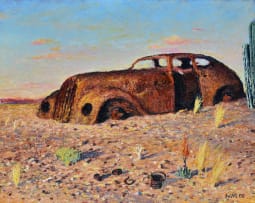
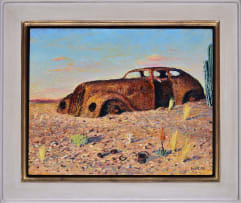
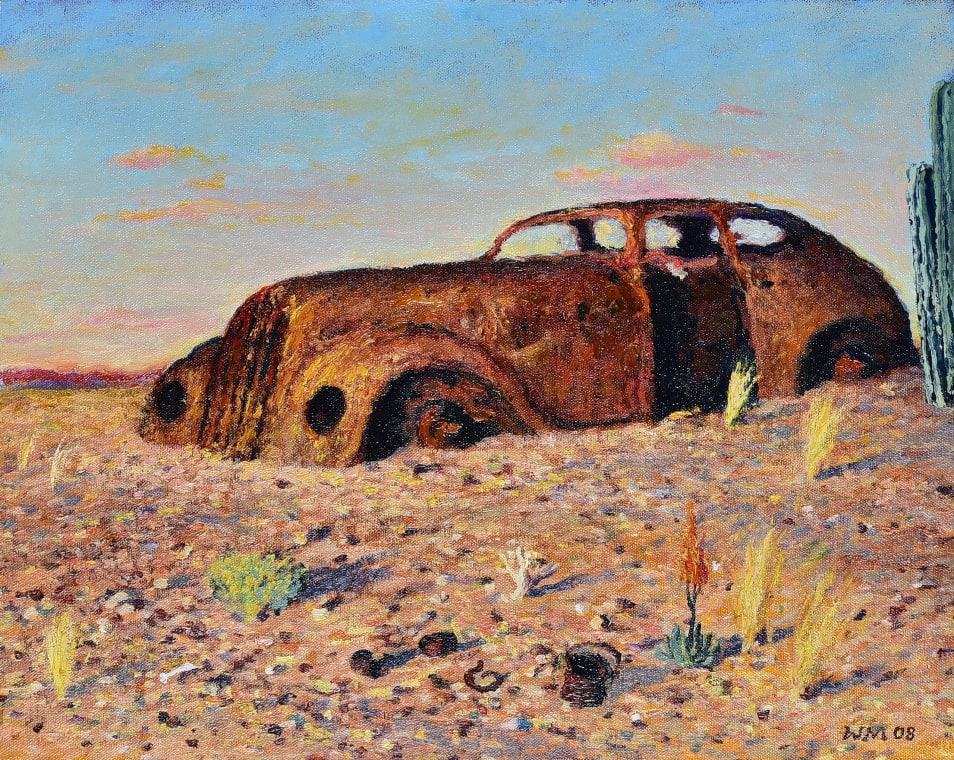
Abandoned Car, Namib Desert
LOT 497
Walter Meyer
Abandoned Car, Namib Desert
Incl. Buyer's Premium & VAT
About this Item
signed with the artist's initials and dated 08; inscribed with the artist's name, the date, title and medium on a Grahams Fine Art label adhered to the reverse; inscribed with the artist's name and the title on a sheet of paper adhered to the reverse
Provenance
Acquired from the artist by the current owner.
Notes
Walter Meyer was in his late twenties when he settled on his mature painting style, a spare naturalism informed by photography. His work, however, shunned mere photographic transcription, offering instead a heightened painterly likeness of unremarkable streets, country homes, veld landscapes and desert vistas. People feature infrequently and, when present, are at most bystanders. “I’m more interested in the things that people make, the things they leave behind them,” he told critic Amanda Botha. “Those things last much longer than the people.”1
Light is integral to an appreciation of Meyer’s work, particularly the vanishing light of dusk, although he was equally adept at depicting scenes bathed in bright sunlight. Critic Hazel Friedman characterised it as a “transfixed light”.2 Meyer initially painted in a neo-expressionist style. While furthering his studies in Düsseldorf he encountered the work of the American realist painter Edward Hopper, renowned for his treatment of light and atmosphere. Meyer was especially drawn to the mood and emptiness of Hopper’s paintings. “It made me think of South Africa,” he said. “When I came back, I was overwhelmed. I saw everything with new eyes.”3
Although reserved in person, Meyer was an active member of Pretoria’s bohemian circles throughout the late 1980s and early 1990s. In the mid-1990s he moved with his family to Bethulie in the southern Free State, near his birthplace of Aliwal North. There he befriended the artist-potter Hylton Nel, who depicted him on a plate. As his unpeopled landscape paintings gained wider attention during the 1990s, critics were at pains to distinguish his work from the landscape tradition of J H Pierneef, Adolph Jentsch and Nico Roos, his teacher at the University of Pretoria.
“Suspended in the ‘now’, his works proclaim not ownership and authority, but transience and temporary residence,” wrote Liese van der Watt.4 Meyer was less concerned than critics with the visual connections proposed by his work. He remained an admirer of Jentsch even after relocating from Cape Town to Upington in 2009. The four paintings offered here, book-ended by City Lights (1990) and Olifantshoek Pas (2015), made two years before his untimely death, capture a twenty-five-year arc in which Meyer ditched the city lights for the heartland, but retained his perceptive treatment of light. They exemplify his sustained preoccupation with the fixtures and atmospheres of South Africa and its people.
“I’m trying to express the moods of certain places, or the moods of my memories of places, like a dream, a childhood memory of being on a farm or how it felt when I went on a road trip with my parents and we stopped at the dorpies,” he said. “It is a smell in the air, the dust, or a colour in a landscape. That is what I am trying to capture, something that no photo can do.”5
A versatile painter whose talents exceeded landscape painting, the four lots include a portrait of the artist’s nephew with whom he was close. My (W)Alter Ego (2006) sits adjacent the artist’s many self-portraits. In the manner of Gregoire Boonzaier, a painter of markedly different style but comparable folk appeal, Meyer frequently portrayed himself without embellishment.
1. Amanda Botha and Anton Karstel (2022) 'Walter Meyer, an Enigma?' in Another Times, Another Place, Vol. 2, Pretoria: University of Pretoria.
2. Hazel Friedman, ‘Tainted Landscape’, Ventilator, 1(1), page 26.
3. Sean O’Toole (2010) ‘From Pretoria to Upington, via Düsseldorf and Bethulie’, in Art South Africa, 8 (3), page 64-69.
4. Liese van der Watt (1997) ‘Now Is the Landscape of Our Discontent’, Vuka, 4(2), pages 25-31.
5. O’Toole, op.cit.
More from Day Sale